Hello Andreas,
It seems you have identified an interesting point in the method of characteristics (MOC) applied to the CD nozzle flow field calculation. Let's address your concerns:
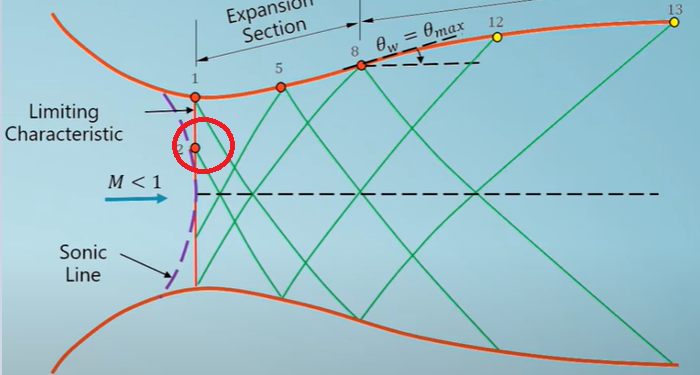
Characteristic Line Angle at the Nozzle Throat (Point 2):
- In the MOC method, the characteristic lines represent the direction of the flow velocity. The angle of the characteristic lines at the throat (Point 2) is influenced by the geometry of the nozzle. The angle can be determined by considering the local slope of the nozzle wall at that point. If the characteristic line is perpendicular to the flow, there might be a geometric consideration or a simplification in the example.
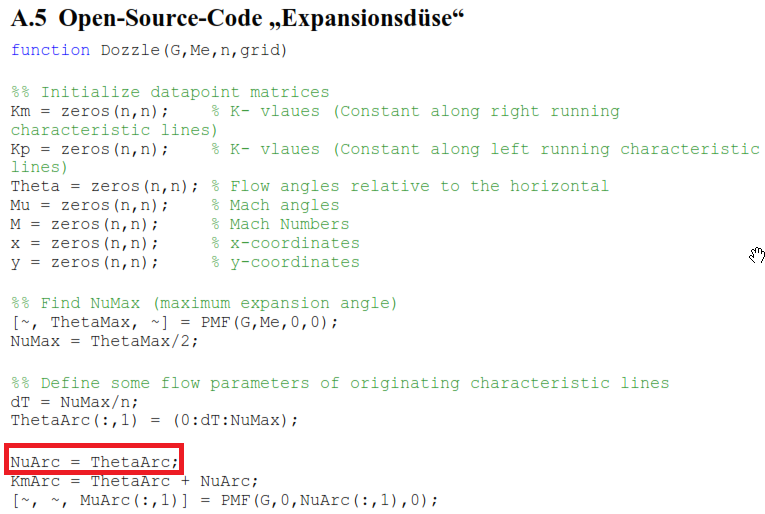
Assumption about θ and ν on the Expansion Arc (Point 5):
- Your assumption that θ and ν have the same value on the expansion arc is correct. This is a common assumption and simplification in certain flow situations. The angle θ represents the nozzle wall angle, and in expansion regions, it's often assumed that the flow follows the nozzle contour, making θ and ν equal.
Starting Calculation with Expansion Arc:
- Starting the calculation with characteristic lines on the expansion arc is indeed a valid approach. It might simplify the calculation and provide a clearer starting point. However, the choice of starting point can depend on the specific requirements of the problem or the preference of the analyst.
Your observations and assumptions align with common practices in the method of characteristics. If the characteristic line at the nozzle throat seems problematic, it's worth revisiting the geometric considerations and possibly consulting additional resources or literature for insights into the specific example you are studying.
If you have access to the NASA code and it employs a similar assumption, it could be valuable to study the code and see how they handle these aspects. Additionally, reaching out to the community or forums related to computational fluid dynamics (CFD) or nozzle design might provide further clarification.
Best regards, Name Combiner Online Tool


















 You are navigating away from the AIS Discovery experience