Ansys Assistant will be unavailable on the Learning Forum starting January 30. An upgraded version is coming soon. We apologize for any inconvenience and appreciate your patience. Stay tuned for updates.
Ansys Innovation Courses

Ansys Innovation Courses

Provide feedback or ask questions related to the Ansys Innovation Courses content.

Innovation Course Stress Analysis in Solid Mechanics

    • mohammed.came
      Subscriber

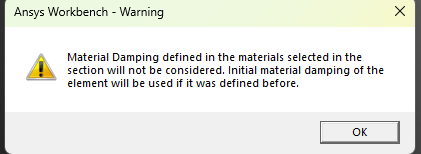
      Hi everyone, I am practising implementing the composite overwrapped pressure vessel example in the above listed course. My simulation model however does not seem to run and gives the following error:
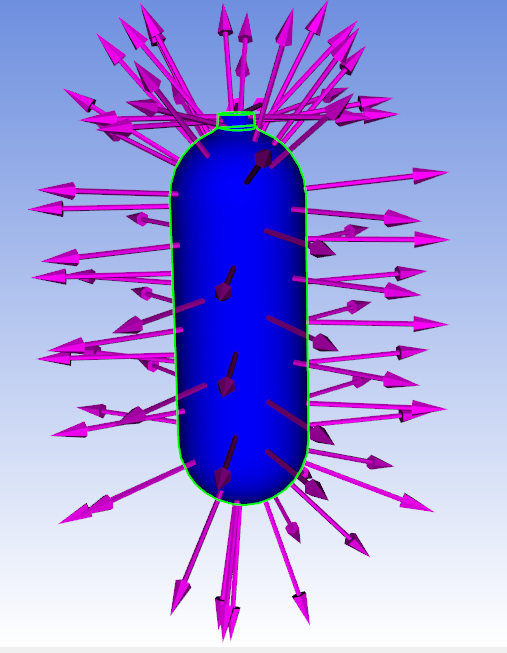
      I could imagine this is due to how I have implemented the ply layers, but am not 100% sure as I followed everything else identical. Once creating the fabrics and and activating the orientation I get the following:
      .

      I applied 5 ply layers using the orientation described in the video file: 
      1. Aluminium 

      2. Carbon epoxy (-45)

      3.Carbon epoxy (45)

      4.Carbon epoxy (-45)

      5. Carbon epoxy (45)

      The order follows from my understanding that the first layer should be aluminium as per the task description (and because the orientation points outward) and then the respective carbon epoxy layers. 
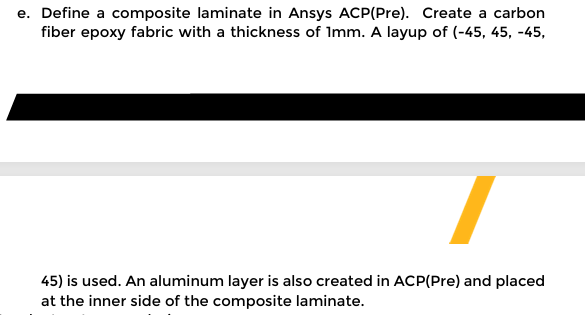
       

      Any help or assistance on understanding where I could have gone wrong would be greatly appreciated.


       

    • Ashish Khemka
      Forum Moderator

      Hello,

      This warning is triggered primarily for layered or multi-material elements (for example SOLID185 layered, layered shells, or similar composite formulations) when both of the following are true: (a) the section definition references multiple materials with damping defined at the section-material level, and (b) the underlying element formulation is coded to take its damping coefficients from the element material pointer MAT rather than from the section materials. In this case, MAPDL determines Rayleigh/material damping from MAT, so any damping you defined on the section materials is ignored and the “initial material damping of the element” is used instead. 

      How to ensure the intended damping definition is used

      Because damping contributions are cumulative in most cases, the key is to avoid overlapping/ignored definitions and to align with how the element reads damping (MAT vs section vs global).

      To make material (MAT) damping control

      • Define Rayleigh or structural damping as material properties in Engineering Data (e.g., Rayleigh alpha/beta, structural damping, damping ratio). These map to MP,ALPD / MP,BETD or related material commands at the MAT level. 
         
      • For layered/multi-material elements where the warning appears, accept that the solver will use the MAT-based damping, not per-section coefficients, and ensure the desired damping is attached to the material referenced by MAT (i.e., your Engineering Data material, not extra section-specific damping). 
         
      • Turn off or clear global Rayleigh/structural damping entries in Analysis Settings if you want the response to be driven primarily by material-dependent damping and to avoid unintentionally high total damping. 

      To make global (Analysis Settings) damping control

      • Specify Rayleigh damping (Alpha, Beta), Damping Ratio, or Constant Structural Damping in Analysis Settings under Damping Controls, and keep material damping definitions minimal or disabled, so the system-level damping dominates. 
      • Use this approach for numerical stabilization when you want a uniform damping behavior across the whole model and do not require material-specific damping distributions. 
         

      General best practices to avoid unintended damping

      • Use only one primary damping definition path per region/material where possible (either Engineering Data or Damping Controls), unless you explicitly want combined global + material damping.
      • Check the solver output for notes indicating when particular damping inputs are ignored in certain analysis types (e.g., constant structural damping ignored in full transient unless activated by TRNOPT / DMPSFreq, or MP,DMPR not included in certain MSUP settings). 
      • Be aware that different spatial distributions of the same nominal Rayleigh coefficients (global vs material) can lead to different dynamic response and convergence even if the numerical α/β values match.

      Regards,

      Ashish Khemka

Viewing 1 reply thread
  • You must be logged in to reply to this topic.
[bingo_chatbox]







