

TAGGED: hill, orthotropic-materials
-
-
September 22, 2021 at 11:23 am
MFN
SubscriberHi
I'm trying to do an analysis of timber in workbench.
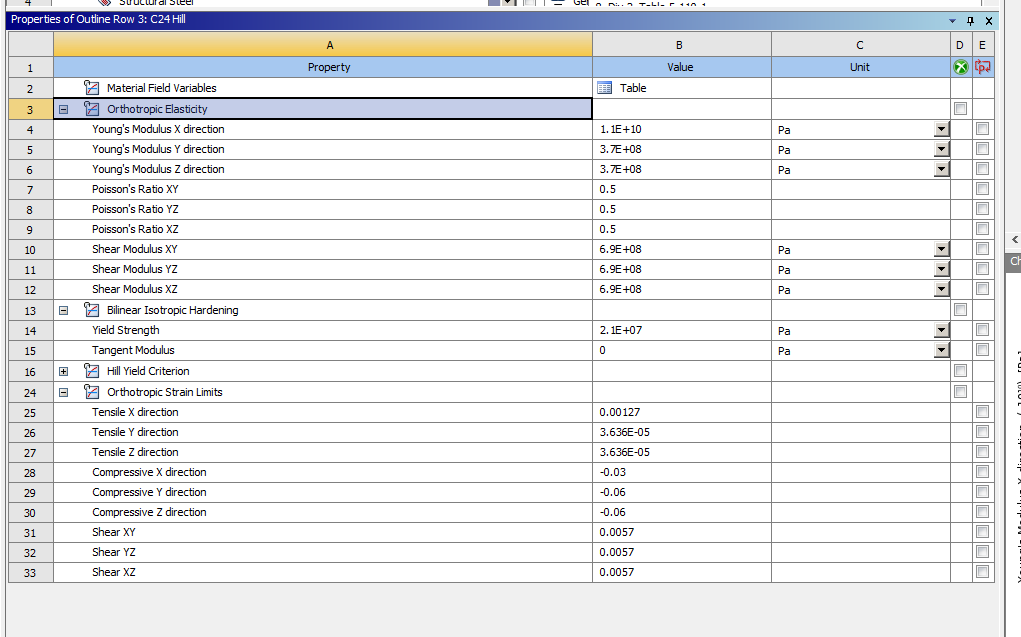
I would like use a material model as shown below. However this is not possible to do in a Static Structural model as it does not account for the strain limits.
When I try to run it in Explicit Dynamics instead I get a problem because Hill yield criterion is not supported.
Do I have any other options?
September 22, 2021 at 11:34 amErKo
Ansys EmployeeHi - this post is better in the explicit dynamic forum where you will get more help (this forum is not for the Explicit solvers). (closing this discussion, and please open a new one in that forum instead)
Just for your reference in ls dyna there is a wood materia model - called: *mat_143
Thank you and all the best
Erik
Viewing 1 reply thread- The topic ‘Modelling of timber’ is closed to new replies.
Innovation Space Trending discussions
- LPBF Simulation of dissimilar materials in ANSYS mechanical (Thermal Transient)
- Simulate a fan on the end of shaft
- Nonlinear load cases combinations
- Real Life Example of a non-symmetric eigenvalue problem
- How can the results of Pressures and Motions for all elements be obtained?
- Contact stiffness too big
- Test post on Forum – LLM response – SC
- 13-Node Pyramid Element Shape Function
- Element Birth and Death
- Python-Script to Export all Children of a Solution Tree
Top Contributors
-
peteroznewman
 4507
4507 -
scabo
 1494
1494 -
Dennis Chen
 1386
1386 -
javat33489
 1209
1209 -
Shyam Prasad V Atri
1021
Top Rated Tags
© 2025 Copyright ANSYS, Inc. All rights reserved.
Ansys does not support the usage of unauthorized Ansys software. Please visit www.ansys.com to obtain an official distribution.
-


The Ansys Learning Forum is a public forum. You are prohibited from providing (i) information that is confidential to You, your employer, or any third party, (ii) Personal Data or individually identifiable health information, (iii) any information that is U.S. Government Classified, Controlled Unclassified Information, International Traffic in Arms Regulators (ITAR) or Export Administration Regulators (EAR) controlled or otherwise have been determined by the United States Government or by a foreign government to require protection against unauthorized disclosure for reasons of national security, or (iv) topics or information restricted by the People's Republic of China data protection and privacy laws.

 You are navigating away from the AIS Discovery experience