Ansys Assistant will be unavailable on the Learning Forum starting January 30. An upgraded version is coming soon. We apologize for any inconvenience and appreciate your patience. Stay tuned for updates.
Ansys Products

Ansys Products

Discuss installation & licensing of our Ansys Teaching and Research products.

Hyperelastic Material Model with Uniaxial Compression data

TAGGED: 

    • mirhan.oezdemir
      Subscriber

      Dear all,

      I am trying to model a hyperelastic material in ANSYS using uniaxial compression test data. My goal is to replicate a simulation from a published paper, where the authors used the Marlow hyperelastic model implemented in another software package.

      The Marlow model is particularly suitable when only a limited amount of test data is available (e.g., one data set). In the paper, the material is assumed to be isotropic and incompressible, and therefore only the deviatoric part of the strain energy potential is considered.

      Below is the relevant excerpt from the paper describing their material model:

      “The formulation of the Marlow model for hyperelastic behaviour is based on a strain-energy potential for compressible and isotropic material (by splitting into deviational and volumetric deformation components). In the model, the strain-energy potential is applied such that the test data (respective FE input data) is accurately adjusted, and it is assumed that this potential is also valid for multiaxial conditions. Compressibility can be considered in the Marlow model by setting the constant Poisson’s ratio (ν), which determines the volumetric response throughout the deformation process.”

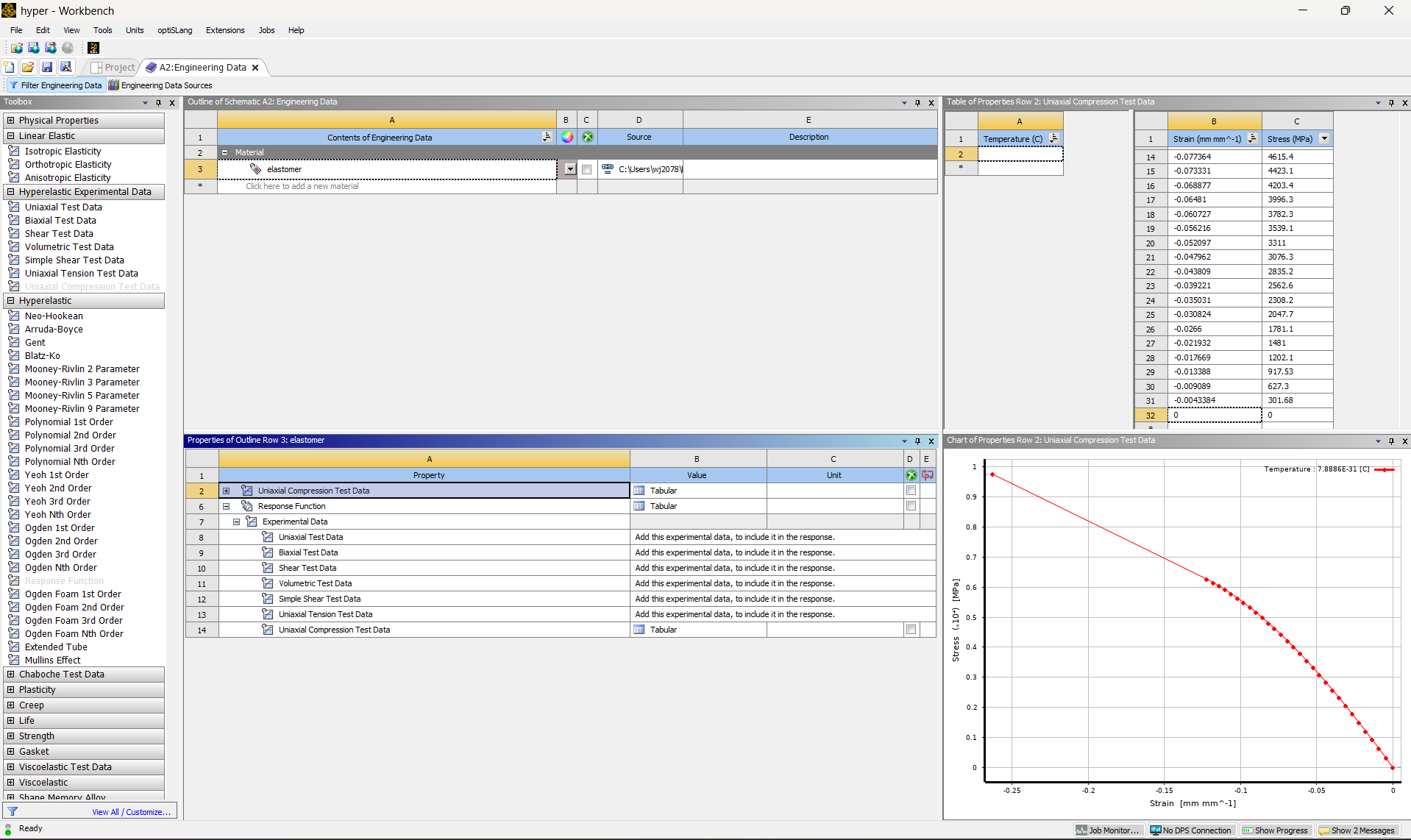
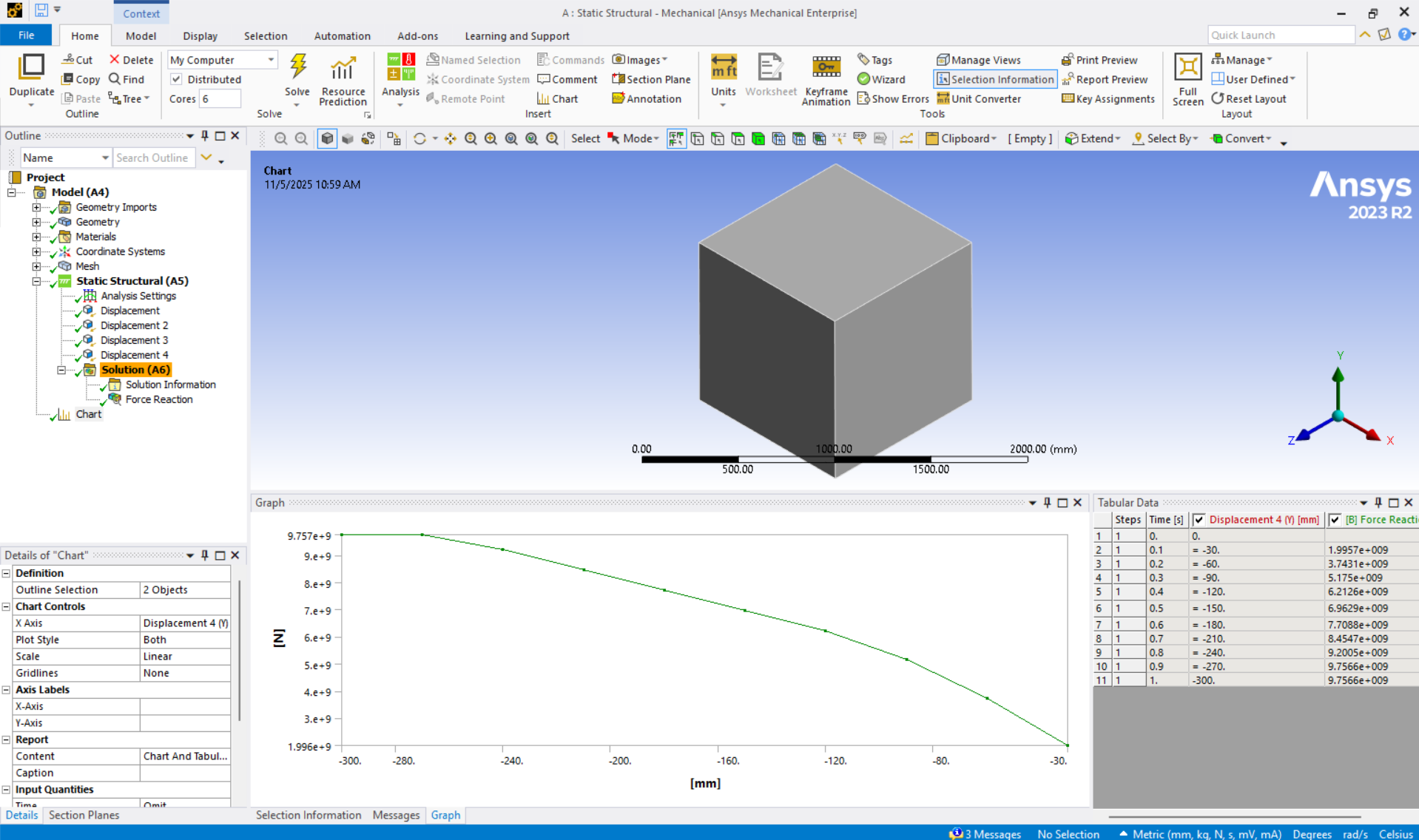
      I have already imported my uniaxial compression data and used the Response Function option to define the material. I tested the model using a single-element simulation, and the results under compression looked reasonable.

      However, I plan to use this material model in a more complex geometry, where the material will experience other deformation modes such as tension, compression, and shear.

      My questions are:

      1. Do I need to provide additional test data (e.g., tension or shear) in the Response Function to ensure accurate behavior in multiaxial conditions?

      2. How should I interpret the phrase “this potential is also valid for multiaxial conditions” from the paper — does it mean the same uniaxial compression data can be used for other deformation modes under an isotropic assumption?

      3. I also noticed that the Response Function in ANSYS does not include an incompressibility parameter (D), which is typically present in other hyperelastic models. Is this parameter implicitly handled in the Response Function approach, or does it need to be defined elsewhere?

      Any clarification or guidance on how to properly implement these assumptions in ANSYS would be greatly appreciated.

      Best regards,

    • Giorgos Papa
      Forum Moderator

      Hello,


      Let’s go through your points one by one:

      1.A solid understanding of your material is crucial, especially for hyperelastic materials. The more experimental data sets you can provide, the more accurately the FEA results will reflect real-world behavior.

      Even with limited experimental data, you can still use hyperelastic models. Curve fitting will generate a complete response curve across all deformation conditions, even for regions where no direct data were provided.

      However, this is not the case for the response function option. While it offers easier setup, it only applies to stress states within the range of your available data.

      Therefore, if your data are limited, I recommend using a different hyperelastic model (not response function).


      2.This should be treated as an assumption. The more complex the deformation state of your model (depending on loads and geometry), the more likely this assumption may not hold. Ultimately, this requires engineering judgment rather than a software-based decision.


      3.By default, the material is assumed to be incompressible (when no experimental volumetric data are provided). Compressibility can be introduced by including experimental volumetric data.

      You can find more details in the relevant ANSYS documentation here:

      https://ansyshelp.ansys.com/public/account/secured?returnurl=/Views/Secured/corp/v252/en/ans_mat/aQw8sq22dldm.html


      Kind regards,

      Giorgos

      • mirhan.oezdemir
        Subscriber

        Thanks a lot Giorgos, your comments helped a lot! 

        Best regards.

Viewing 1 reply thread
  • You must be logged in to reply to this topic.
[bingo_chatbox]