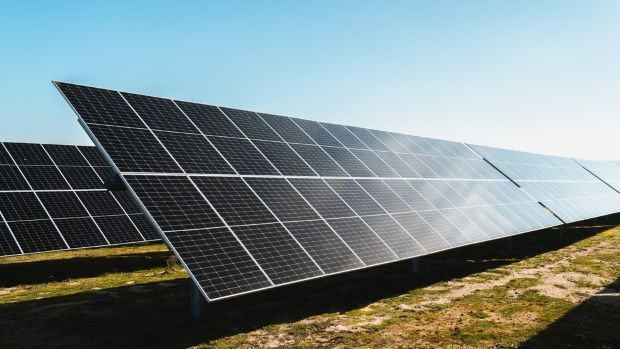
This Application Best Practice (ABP) provides a practical guide on setting up and running Electrodynamic Screen (EDS) simulations for solar panels cleaning in dusty environments. It covers the simulation workflow, key parameters, and best practices to model particle removal effectively, helping you optimize electrode design, waveform settings, and operational conditions to maintain panel efficiency and reduce maintenance costs.
Learning Outcomes:
Following completion of this Application Best Practice (ABP), you will be able to:
- Explain the principles and challenges of Electrodynamic Screen (EDS) technology.
- Set up and execute multiphysics simulations using Ansys tools.
- Analyze and interpret simulation results to assess cleaning performance.
- Optimize EDS system parameters for maximum efficiency.
- Apply best practices for modeling, data handling, and result validation.
Prerequisites:
- Rocky Tutorial Guide, Chapter 1: Tutorial - Transfer Chute
- Rocky Tutorial Guide, Chapter 3: Tutorial - Vibrating Screen
- Ansys Maxwell Getting Started
- Getting Started with Ansys optiSLang Software
- Rocky Module Manual, Chapter 11: Electromagnetic Coupling Module (Beta)
Please note: These training materials were developed and tested in the 2025R2 release.
Application Best Practices (ABPs) outline engineering design goals for specific applications and provide guidance for how to achieve those goals using Ansys simulation software. It is important to note that a Geometry File or other Input Files are not always available. ABPs, as opposed to the official training-material workshops/tutorials, are not meant to be a step-by-step instruction document. ABPs are a link between product-based training courses and application specific tutorials, educating on the "how" and "why" of the best modeling approach, highlighting best practices and workflows for a particular application.