-
-
September 4, 2018 at 2:05 pm
-
September 7, 2018 at 6:00 pm
Mark Solveson
Ansys EmployeeUsing ANSYS Maxwell in the Electronics Desktop, which also includes RMxprt for analytical machine design and automatic generation of 2D and 3D transient FEA models, allows users to modify the FEA models to emulate different operating conditions. In a 2D FEA model, for example, you could remove one of the bars from the model; this would require a full symmetry model. In Maxwell transient solvers, the end ring can be modeled as an excitation (boundary condition specifically assigned to the rotor bars), or the end ring could be modeled explicitly with an external circuit, where each end R and L are connected together and linked to each bar that is modeled as a Winding. You could model one of the end connections with a different impedance value.
-
September 17, 2018 at 3:27 pm
-
March 5, 2020 at 4:55 am
ranjanpal999
SubscriberHi,
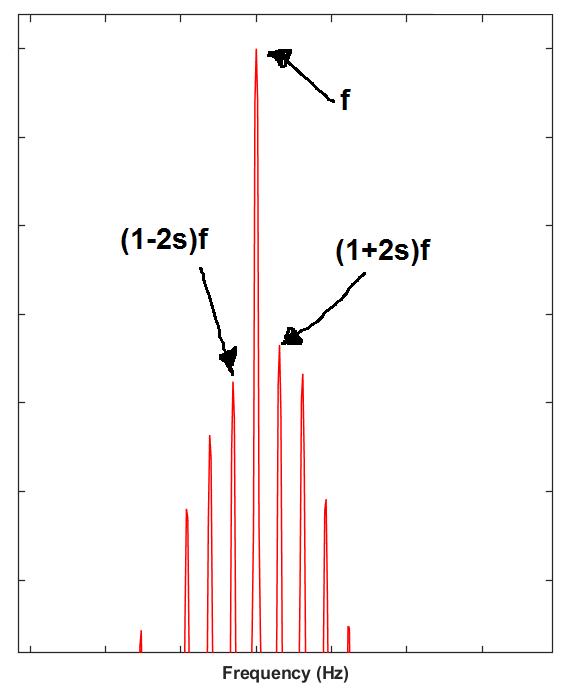
I modeled a motor with broken rotor bars and following is the frequency spectrum of current data.
here f=supply frequency and s=slip of the motor
The appearance of sidebands around the supply frequency are fine.
Here it can be seen that amplitude of (1-2s)f < (1+2s)f
However, in literature, it has been said that amplitude of (1-2s)f > (1+2s)f.
Why is that Maxwell showing opposite results?
Can anyone please comment on this!
-
- The topic ‘How to Modelling Broken Rotor Bars on Ansys 2d or 3d’ is closed to new replies.

-
6450
-
1906
-
1457
-
1308
-
1022
© 2026 Copyright ANSYS, Inc. All rights reserved.