
-
-
June 26, 2021 at 2:37 am
Anish_Mondal
SubscriberHello,
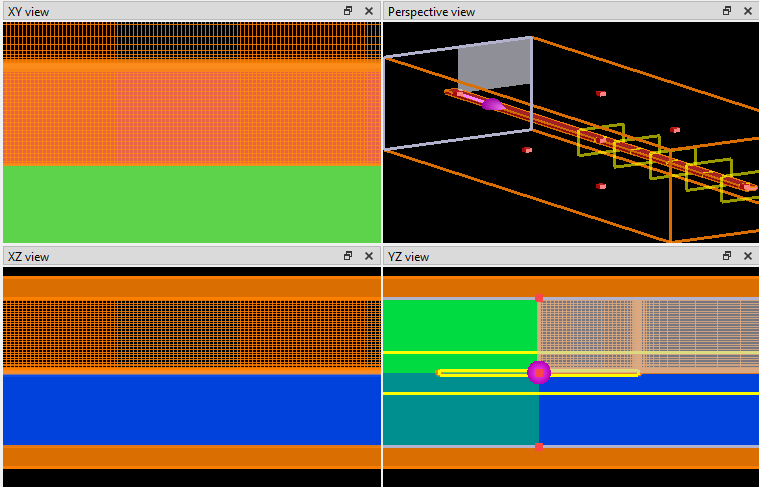
I have applied the surface roughness suggested by Lumerical in the link given below. I want to measure the propagation loss in the waveguide due to surface roughness for a wavelength of 1.55um.[sigma = 2nm, correlation length (Lc) = 50nm.]
I believe that I am using sufficient meshing for the simulation. I have placed 5 DFT monitors at uniform intervals to measure the power in the core of the waveguide passing through them.
June 29, 2021 at 11:10 amGreg Baethge
Ansys Employee
Thank you for posting your question on the forum. Modelling loss due to surface roughness is quite challenging: it requires a mesh fine enough to resolve the roughness, and a propagation length long enough so its effects are noticeable (the loss should be larger than the numerical noise in the simulation).
First, I would run some convergence testing to make sure the simulation settings are ok. The other thing to look at, the DFT monitors will record the power flowing through them. This will not necessarily reflect the actual loss, as part of the power will not be in the waveguide's mode. For that reason, I would use a mode expansion monitor so you can get the actual coupling to the mode supported by the waveguide.
Viewing 1 reply thread- The topic ‘How to accurately measure propagation loss for a wave-guide with surface roughness?’ is closed to new replies.
Innovation Space Trending discussions
 Top Contributors
-
peteroznewman
 6520
6520 -
scabo
 1906
1906 -
Dennis Chen
 1463
1463 -
javat33489
 1310
1310 -
Shyam Prasad V Atri
1022
Top Rated Tags
© 2026 Copyright ANSYS, Inc. All rights reserved.
Ansys does not support the usage of unauthorized Ansys software. Please visit www.ansys.com to obtain an official distribution.
-


The Ansys Learning Forum is a public forum. You are prohibited from providing (i) information that is confidential to You, your employer, or any third party, (ii) Personal Data or individually identifiable health information, (iii) any information that is U.S. Government Classified, Controlled Unclassified Information, International Traffic in Arms Regulators (ITAR) or Export Administration Regulators (EAR) controlled or otherwise have been determined by the United States Government or by a foreign government to require protection against unauthorized disclosure for reasons of national security, or (iv) topics or information restricted by the People's Republic of China data protection and privacy laws.

 You are navigating away from the AIS Discovery experience