Hello everyone,
I'm civil engineering B.S. student in Korea currently interested in Floating Offshore Wind Turbine design.
So i'm working on Ansys AQWA program to analyze NREL 5MW Semi-submersible platform.
Due to my insufficient back ground knowledge i've got to some questions about "Thin" and "Line Body".
I understood that "Line Body" as a Morison's element is not included in calculation of potential theory, for example added mass or radiation damping coefficient. (Am I right?)
So i designed lower pontoon and bracing of NREL reference wind turbine as "Line Body" instead of "Thin" because they have relatively small diameter with respect to length itself.
But i found out serious mismatching about heave added mass down below. (Case 01)
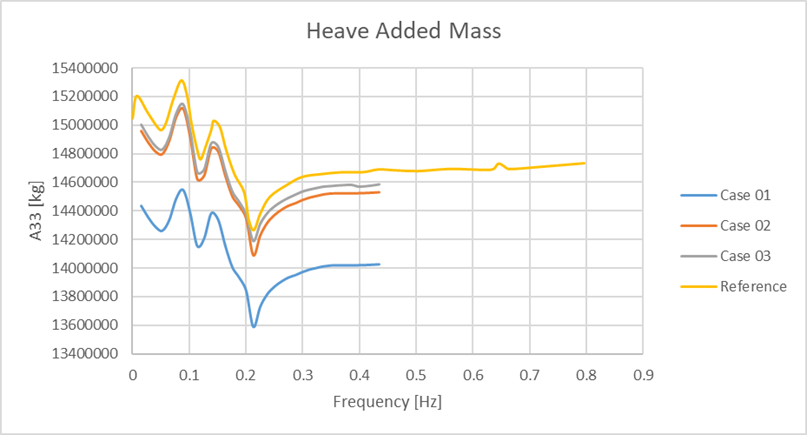
So i desinged lower pontoon as "Thin" (Case 02) and bracing (Case 03) too, so that i could get similar behavior with reference(caculated by WAMIT).
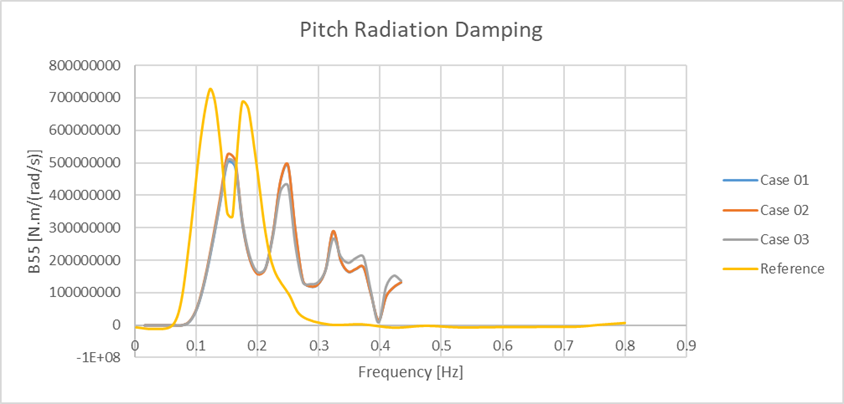
And I also found out that pitch radiation damping does not align with reference.
More over, result of "Froude-Krylov Force" and "Diffraction Force" in pitch, yaw direction of Case 03 has serious discrepancy like down below:

Thus I can't trust heave added mass result for Case 03.
So my question is:
Q1. Why does designing lower pontoon as "Thin" make substantial difference in "heave added mass"?
Q2. How can i deal with "pitch radiation damping" coefficient.
Q3. What is the actual difference between "Line Body" and "Thin"
Q4. Can I use "Case 03" design to match heave added mass?
Thank you all for your help, and have a happy New Year!























 You are navigating away from the AIS Discovery experience