Ansys Assistant will be unavailable on the Learning Forum starting January 30. An upgraded version is coming soon. We apologize for any inconvenience and appreciate your patience. Stay tuned for updates.
Photonics

Photonics

Topics related to Lumerical and more.

difference between n_eff and group index in single-frequency simulation (FDE)

    • haimshal
      Subscriber

      Hi,

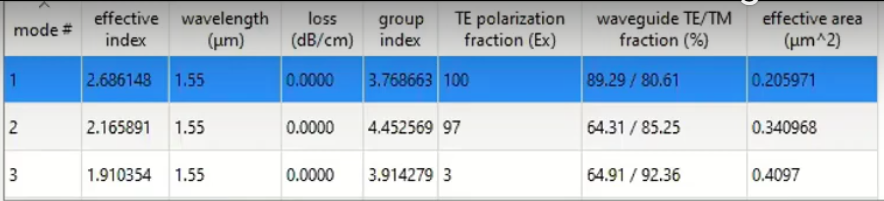
      I simulate a simple waveguide made of silicon in FDE (with a single wavelength of 1064nm). And get the different modes that can propagate in a cross-sectional area defined by the simulation region.
      I would expect that for propagation of a single frequency - the phase velocity and the group velocity would be the same. Because there is no group of waves - there is a single wave with a wavelength of 1064nm.
      Why do I get a big difference (factor 2)?
      In addition, I understand that in reality there is no single frequency but a finite bandwidth - and I would still expect it to be close and not twice.

      The reason I want to understand this is because (in general) I want to build a traveling wave electrode modulator .
      So I want the propagation velocities of the optical and RF signals to be close. But I'm not sure which velocity to take in each of them (especially in the optical) - phase velocity or goup velocity


      thanks.

    • Amrita Pati
      Ansys Employee

      Hi,

      Although you are running a single frequency simulation, internally FDE calculates the modal properties at a neighboring frequency and then evaluates dw/dk to find the group velocity and then c/vg to calculate the group index.

      Do the other modal properties like effective index, losses etc. look accurate to you? Usually we recommend users to perform convegence testing to make sure that the simulation setup is accurate. 

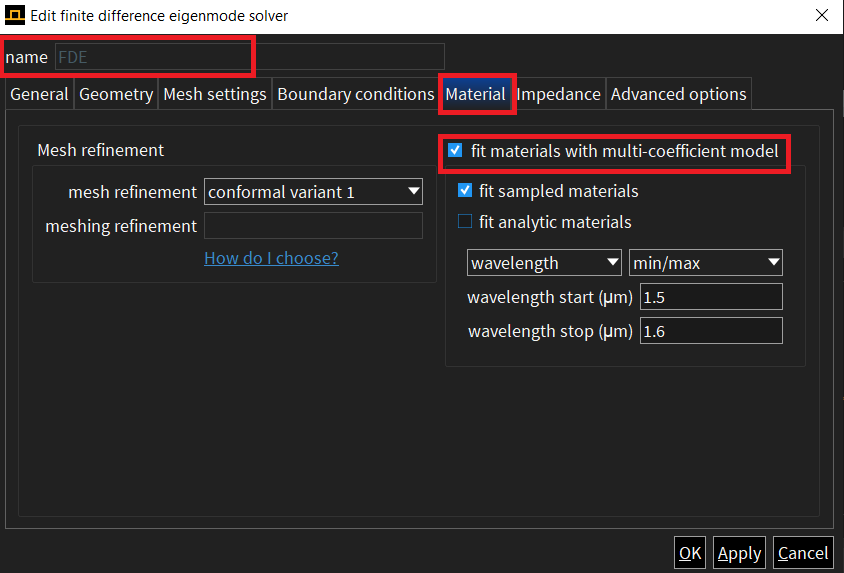
      Also, are you using dispersive materials? If yes, make sure you are using the "multi-coefficient model" for fitting the material data. This is because by default FDE uses a linear interpolation between the consecutive data points of the material data. So, if the default fitting is used the results of the frequency analysis (in this case for internal group index calculation) can be discontinous resulting in incorrect group index. The multi-coefficient model uses a single smooth fit for the material data instead.
      Regards,
      Amrita
    • haimshal
      Subscriber

      Hi,

      Thank you very much for your response.

      I tried changing to "Fit with multi-coefficient model," but I did not observe any significant change.

      In addition, I would like to know how to perform a convergence test.


      thank you.


    • Amrita Pati
      Ansys Employee

      Hi,

      I apologize for the delay in getting back to you. I was traveling last week and couldn't manage to reply. You may find a short video on Convergence testing in FDE here: Convergence Testing — Lesson 3. More detailed information on convergence testing can be found here: Convergence testing process for FDTD simulations. Although this is related to FDTD, a lot of the details still apply to FDE.

      Regards,
      Amrita

Viewing 3 reply threads
  • You must be logged in to reply to this topic.
[bingo_chatbox]