TAGGED: combustion, fluent-dpm
-
-
December 3, 2025 at 12:53 pm
fanbo9802
SubscriberHello there,
I am modeling the Sydney Needle Spray Burner in Fluent with the EDC species transport model using a simplified ethanol mechanism, which could use in Chemkin to simulate 0D/1D flame.
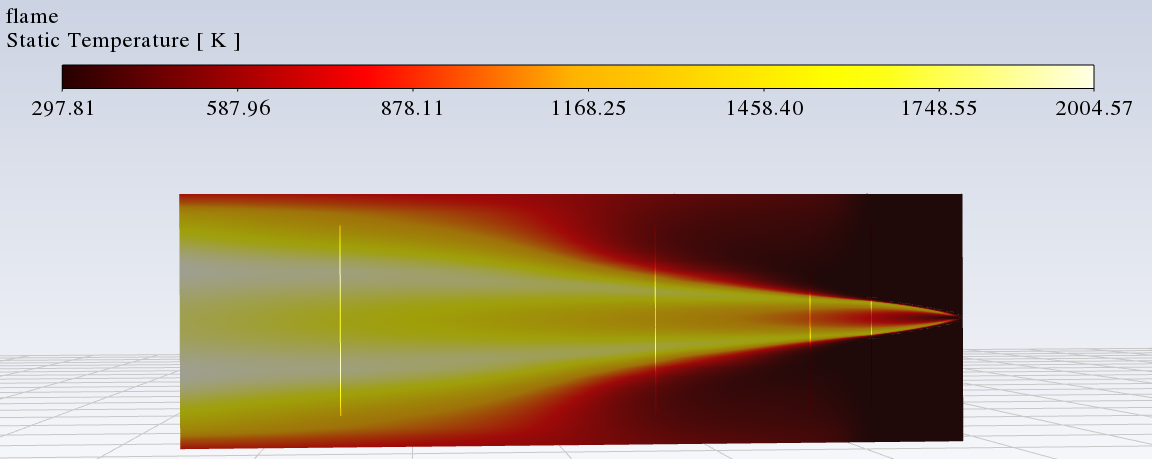
I got an EDM intial result, and switched model to EDC, the simulation does not float. But it also occurs the general problem, which extinguishing. Fig. 1 shows the temperature contour of EDM and EDC.
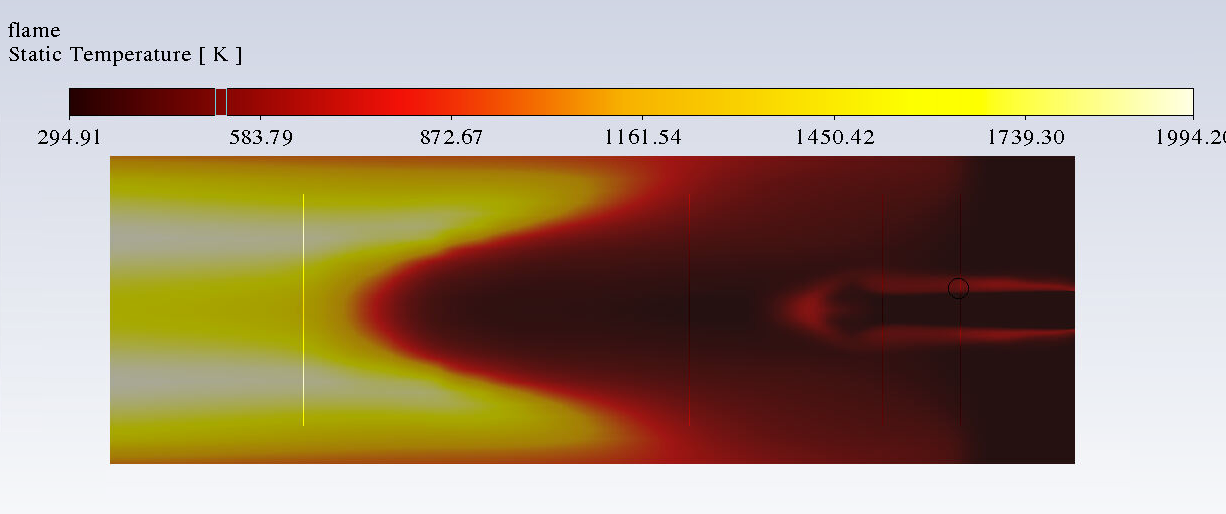
EDC result EDM result
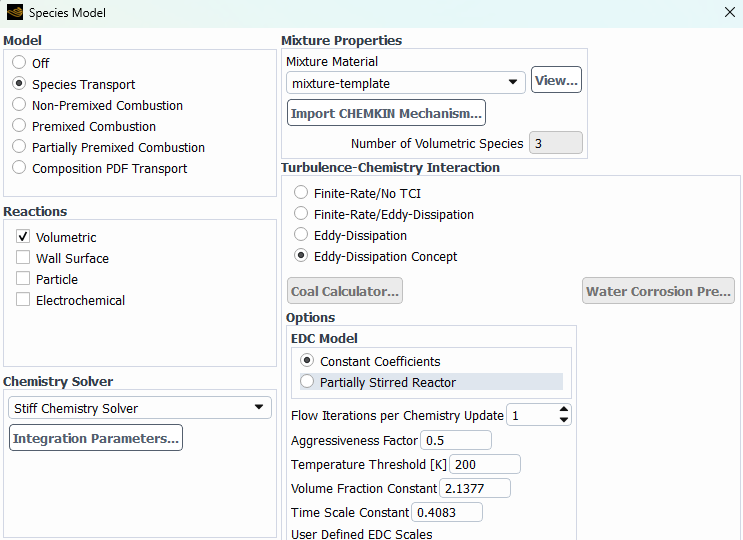
I have tried to patch high tempture region, and mass fraction of products, also increased the volume fraction constant to 5, and time scale constant to 3, only few steps after patching, I can see the trend of ignition.
For turbulence modeling, the k-Omega SST is used. The time step is 1e-6 s.
I also want to know, becasue of the grids number of injection face, the particles injected into domain is much more, which could reach at 30 million, its too much and increase the simulation costs.
-
December 4, 2025 at 4:34 pm
jcooper
Ansys EmployeeHi:
Even though the EDM and EDC models have similar rules when it comes to determining what conditions will allow ignition, there is not a perfect match between the two. This may affect flame position. For instance, it may be difficult to sustain ignition when switching between the two models, or you may get unexpected flame attachment, as shown in your pictures. The coefficients in the EDC model are tuned for natural gas, which is a very flammable fuel. If these are used for a less flammable fuel, combustion in some areas may be over-predicted.
The EDC model coefficients control the fine-scale residence time and volume fraction. Inappropriate EDC coefficient values can lead to either overly fast or slow reactions, affecting flame stabilization and lift. Decreasing the volume fraction constant may allow the flame to lift further from the burner and would be a good adjustment to try if you want the EDC flame to lift. Using the Partially Stirred Reactor (PaSR) option has also improved predictions in some cases. It may also be useful to refine the mesh close to the fuel injection point, so that the turbulence is more resolved, this will help in improving the flame position because the underlying flow field is better-predicted.
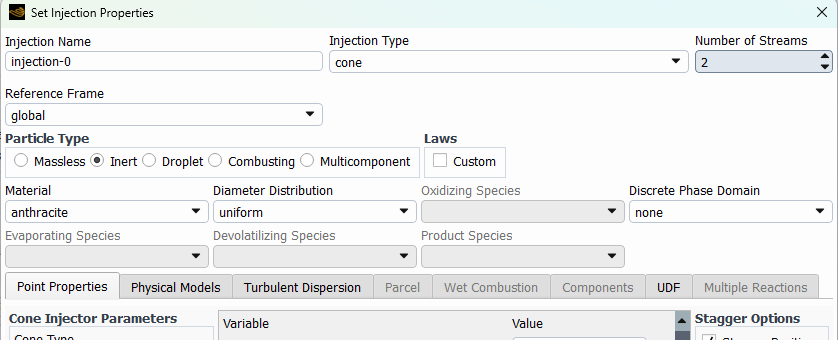
I am not sure what you mean by your last question on particles. If you are using one of the injectors, such as conical injection, you can control the number of particles injected by setting the number of streams.
Regards,
Judy
-
- 您必须登录才能回复此主题。
-
4512
-
1494
-
1386
-
1209
-
1021
© 2025 Copyright ANSYS, Inc. All rights reserved.