

-
-
April 23, 2022 at 9:07 pm
Sjames22
SubscriberHi,
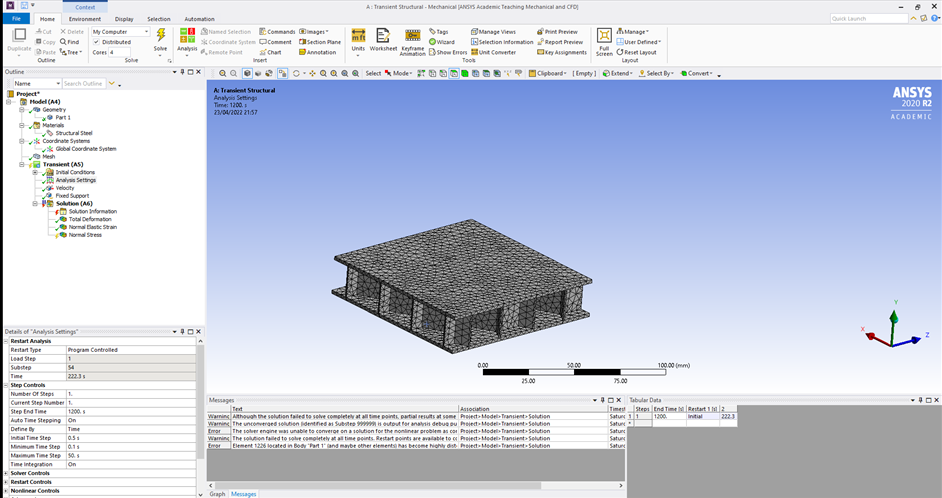
I'm using ANSYS Mechanical 2020, to simulate a compression test on imported geometry. When solving, the solution cannot converge and fails. I'm unsure of what is causing this and have unsuccessfully tried several different methods. Belo are some screenshots of the analysis.
Any help on this would be greatly appreciated.
April 24, 2022 at 11:23 pmpeteroznewman
SubscriberWhat data do you want the simulation to provide to you?
What material properties do you have for the structure?
April 25, 2022 at 8:55 amSubscriberStress, Strain, Force and deformation/displacement. As well as this seeing the different stages of failure on the model.
Currently It is default structural steel as I am waiting on the resin material to be unlocked by my admin, which is what I intend to apply to the model. Any properties will likely be taken from the ANSYS database.
Thank you for your help
April 25, 2022 at 11:56 pmSubscriberThe details of the material model for the resin will make a big difference in how the structure will collapse.
When you have those details, please show them.
You will also need a mesh with at least 4 elements through the wall thickness.
April 26, 2022 at 11:50 amSubscriberMy part is not sweepable, this would be the only way I'd know how to have 4 elements in the walls without an excessive amount of nodes. If you have any suggestion on how to go about that, it would be very helpful.
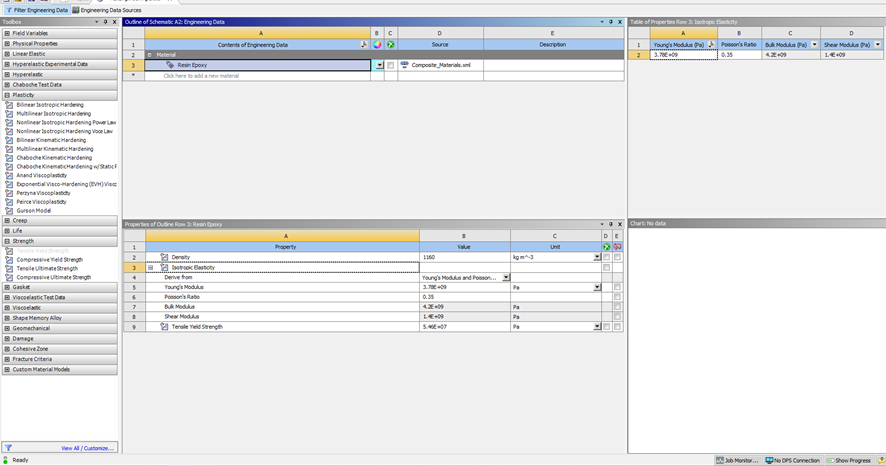
Below is the material properties I now have for Resin Epoxy, do I need more data?
April 27, 2022 at 1:09 amSubscriberI ran a model with an element size of 0.25mm to allow for 4 elements within the walls, however this resulted in a very long meshing time. If there is a way to implement this that is simpler it would be greatly appreciated if you could help.
April 27, 2022 at 2:20 amSubscriberThe part is sweepable if you slice the top and bottom plates using the faces of all the walls.
April 27, 2022 at 4:20 amSubscriberThank you that made it sweepable.
With 2-3 divisions of the wall it resulted in over 16000 elements and has been running for close to an hour.
do you have any suggestions to reduce the computational load?
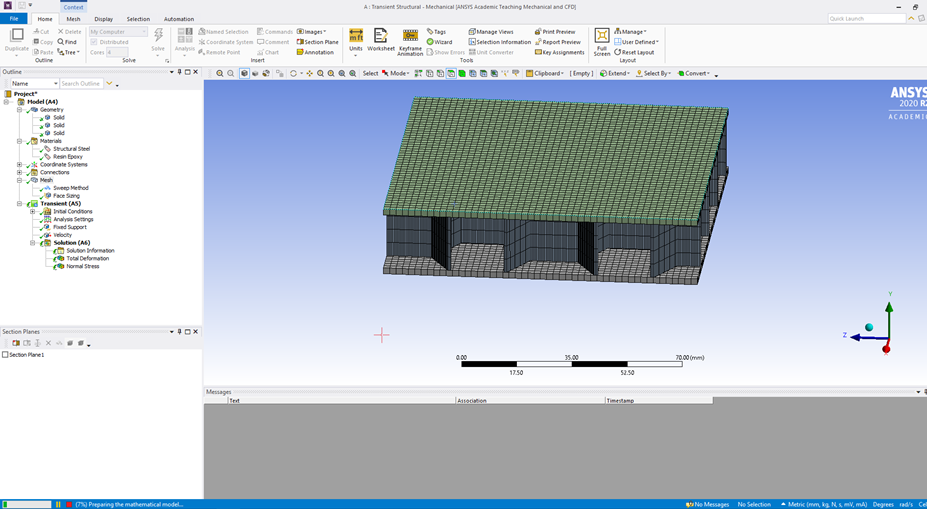
April 27, 2022 at 4:43 amSubscriberThe last one failed to converge, all the previous attempts and this one have failed to converge around 100 seconds in solution.
Do you have any recommendations for the model?
April 27, 2022 at 5:10 amSubscriberShow the pattern of the core. Are there planes of symmetry? If so, you can cut the model on the symmetry plane and reduce the size of the model, but that enforces symmetry on that plane whereas the full model might have buckled in a non-symmetric way.
April 27, 2022 at 1:30 pmSubscriberBelow is the pattern of the core.
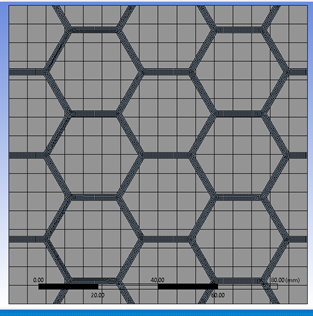
April 27, 2022 at 8:55 pmSubscriberI see 8 full cells in the center and many partial cells on the edges. You could cut it down to a smaller section with fewer full cells. For the smallest model, you could use 6 planes and cut it down to a single cell. I would put the cutting planes at the halfway point along the cell side walls so you have a hexagon with six short walls extending out. Use a Symmetry Region and create coordinate systems with an axis direction aligned with each of the six short wall segments to create a symmetry boundary condition that represents the other half of the wall scoped to the cut face of the short wall.
April 28, 2022 at 2:20 pmSubscriberI did as you said this cut down the computational time somewhat, thank you for this.
However, It is failing to converge at about 200 seconds.
Do you know how this could be fixed?
Is there any other material that I could provide that would help?
How can I upload a link to the study onto this forum since it was not possible to upload the standard format?
Thanks again for your continued help
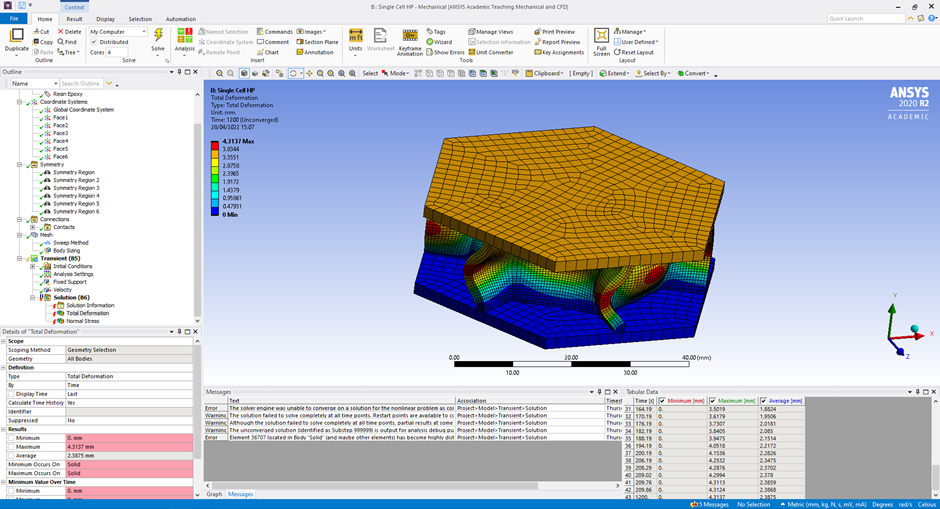
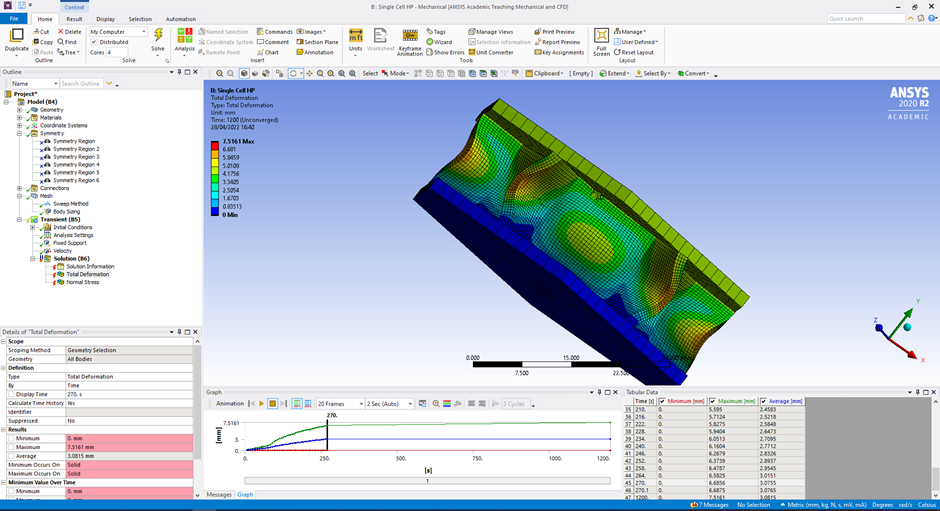
April 28, 2022 at 3:44 pmSubscriberHere is the second attempt, this one got to 270 seconds in the model before failing to converge.
April 28, 2022 at 8:43 pmSubscriberThe required memory for the model is about 6GB, the computer that it has been run on only offers 1.5GB for the Model. Warnings about bottlenecks are given.
Could this be the issue?
April 28, 2022 at 10:07 pmSubscriberThe required memory is for solving it fast. It can solve it slowly with less memory.
If you are using Structural Steel, that is a linear material, so there is no yield point defined in the model.
Try changing to Structural Steel NL which has a Plasticity material model so that the steel has a yield point and the metal gets permanently bent.
This model is being compressed slowly, so you don't need Transient Structural, you can get the same result in Static Structural.
It would be beneficial if you don't have bonded contact between the cell walls and the face sheets. In SpaceClaim, on the Workbench tab, use the Share button. Then add Multizone mesh control to the top and bottom face sheets. This should flow the mesh from the walls into the facesheets so that the mesh will be connected at the nodes instead of with bonded contact.
April 28, 2022 at 10:23 pmSubscriberIf I were to use static structural, how could I implement a velocity/displacement of 1mm per minute or is this simply not possible on static structural?
April 28, 2022 at 11:14 pmSubscriberI have been using the Epoxy Resin material as shown above, for these tests. All the values that I have are shown in that picture. Will this not be sufficient for the test?
April 29, 2022 at 6:51 amSubscriberThe inertial forces for a velocity of 1mm/min are practically zero, therefore a Transient Structural and Static Structural solution will provide the same result. All that matters in Static Structural is the total displacement.
The Epoxy Resin you show above has only linear elastic material properties so no material failure is defined. You need to add some kind of material damage model to see the material fail. Ductile materials such as steel exhibit plasticity after exceeding the yield strength. You can add a Plasticity material model to allow the material to flow after the material exceeds the yield strength. There are also viscoplastic material models which might be relevant to an epoxy resin. You need to do a lot more study of material failure models and figure out what is appropriate for your material.
April 29, 2022 at 11:55 amSubscriberI do not have any experimental values for plasticity to use in a multilinear plasticity model, Is there a way to obtain this data through a material test on ANSYS?
I do not think a bilinear test would be sufficient for investigating the energy absorption of two designs, and even then I do not have a tangent modulus to implement.
Since I am investigating the difference between two different designs the material used can be changed as long as it could reasonably be applied in real life.
The materials that I would ideally use are either Titanium beta alloy or Epoxy Resin. Though most steels would also work.
Thank you for the insights.
Viewing 19 reply threads- The topic ‘Transient Structural Analysis not converging on Compression Test’ is closed to new replies.
Innovation Space Trending discussions
 Top Contributors
-
peteroznewman
 6309
6309 -
scabo
 1906
1906 -
Dennis Chen
 1457
1457 -
javat33489
 1308
1308 -
Shyam Prasad V Atri
1022
Top Rated Tags
© 2026 Copyright ANSYS, Inc. All rights reserved.
Ansys does not support the usage of unauthorized Ansys software. Please visit www.ansys.com to obtain an official distribution.
-


The Ansys Learning Forum is a public forum. You are prohibited from providing (i) information that is confidential to You, your employer, or any third party, (ii) Personal Data or individually identifiable health information, (iii) any information that is U.S. Government Classified, Controlled Unclassified Information, International Traffic in Arms Regulators (ITAR) or Export Administration Regulators (EAR) controlled or otherwise have been determined by the United States Government or by a foreign government to require protection against unauthorized disclosure for reasons of national security, or (iv) topics or information restricted by the People's Republic of China data protection and privacy laws.

 You are navigating away from the AIS Discovery experience