

-
-
March 11, 2022 at 8:47 am
L_Ching
SubscriberHi, we are doing some research related to EM loss and heating rate by HFSS and Icepak. We use materials with dielectric constant varying with temperature, and our purpose is to compare heating rate between different materials. Hence, we're thinking if we can make use of 2-way coupling with solution type: transient.
This is our guess of how 2-way coupling for transient type works (and also what we need):
March 22, 2022 at 10:45 pmNikhil Tamhankar
Ansys EmployeeHi Can you please comment again with the image embedded in the post, since we cannot open attached files in this forum. That would help me to provide you a response.
Thanks Nikhil
March 23, 2022 at 6:28 amSubscriber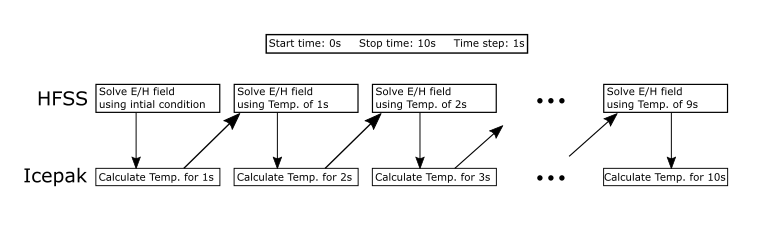 Sure thing. Thanks a lot!
March 29, 2022 at 4:03 pmAnsys EmployeeHi Thanks for attaching the image again. I just confirmed again and yes, the feedback you received earlier was correct. There isnt a live transient feedback from time step to timestep as of now in the 2-way coupling workflow. However, ANSYS will definitely announce it if implemented in the near future.
Regards Nikhil
Viewing 3 reply threads- The topic ‘Icepak-HFSS 2-way coupling with transient solution type’ is closed to new replies.
Innovation Space Trending discussions
 Top Contributors
-
peteroznewman
 5864
5864 -
scabo
 1906
1906 -
Dennis Chen
 1420
1420 -
javat33489
 1306
1306 -
Shyam Prasad V Atri
1021
Top Rated Tags
© 2026 Copyright ANSYS, Inc. All rights reserved.
Ansys does not support the usage of unauthorized Ansys software. Please visit www.ansys.com to obtain an official distribution.
-


The Ansys Learning Forum is a public forum. You are prohibited from providing (i) information that is confidential to You, your employer, or any third party, (ii) Personal Data or individually identifiable health information, (iii) any information that is U.S. Government Classified, Controlled Unclassified Information, International Traffic in Arms Regulators (ITAR) or Export Administration Regulators (EAR) controlled or otherwise have been determined by the United States Government or by a foreign government to require protection against unauthorized disclosure for reasons of national security, or (iv) topics or information restricted by the People's Republic of China data protection and privacy laws.

 You are navigating away from the AIS Discovery experience