

TAGGED: fluid-flow, periodic, periodic-boundary
-
-
May 4, 2021 at 8:27 pm
Dio
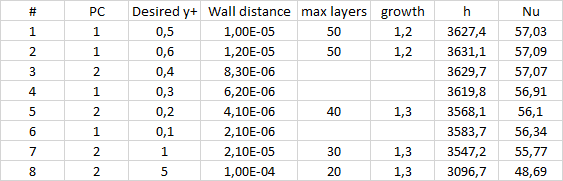
SubscriberI run for different Desşred y+ values and get Nusselt and Heat transfer coeff.
for k-w SST, as I search online, desired y+<1, am I on the right way or should I try for different y+?
How can I check correct y+ on fluent solution
Also I am using facet average to get Nu and h, is that correct way to get these values or I should try different way?
I am following https://www.cfd-online.com/Tools/yplus.php
I am running periodic simulation.
Inlet mass flow rate: 0.0422509
D: 0.01m
Inlet temperature: 303.15K
density: 995.6
Dynamic viscosity: 0.000844 kg/ms
Cp: 4123 kj/kgK
Thermal conductivity: 0.636 W/mK
Constant heat flux at wall: 12752 W/m2
Any suggesttion?
May 5, 2021 at 7:07 amDrAmine
Ansys EmployeeWhat is your Prandtl Number?
May 5, 2021 at 10:31 amSubscriberit is Pr= 5.47
Calculated from this formula (2): https://www.engineeringtoolbox.com/prandtl-number-d_1068.html
May 6, 2021 at 9:22 pmSubscriberit is Pr= 5.47
Calculated from this formula (2):https://www.engineeringtoolbox.com/prandtl-number-d_1068.html
May 7, 2021 at 6:50 amAnsys EmployeeOkay is not very large so I guess a good start is to have yplus around 1 if you want to resolve the viscous sublayer and properly model thermal effects.
It is however not only the yplus which is important the number of cells you put to resolve the boundary layer is equally important. I recommend to have at least 10-15 cells there (You can afford it for this simple case).
From that you can carry out a mesh sensitivity study and assess all numerical errors.
May 7, 2021 at 12:12 pmSubscriberThank you When I tried 10-15 layers, mesh quality is getting about 10e-3. When I try 20-50 layers, mesh quality increase above 0.15 and Nu and h results looks like in the table. for y+=5 Nu and h looks decreasing. I guess for k-w SST y+ below 1, Nu and h becomes very close to experimental results.
May 7, 2021 at 12:39 pmRob
Forum ModeratorRemember y+ helps guide the near wall cell height, you still need enough mesh in the right place to resolve the flow and thermal boundary layers as well as the bulk flow.
May 7, 2021 at 3:58 pmSubscriberThank you I think I get some good results. Errors were between 2-6% compared to experimental results. But how can I get pressure loss? analysis was periodic so outlet is disappeared when I defined periodic.
10mm length and 10mm dia pipe, original length 1400 mm and 1200mm portion has constant heat flux 12752 W/m2
May 7, 2021 at 4:02 pmForum ModeratorYou set pressure drop to get mass flow, so if you compare the pressure drop you set with your data how close is the mass flow?
May 7, 2021 at 6:28 pmSubscriberI have figure for pressure drop and I just want to see how close my simulation to experimental value and looking for d,d I simulate well or not. Around 10% error also ok for me. I am triyng for 0.025
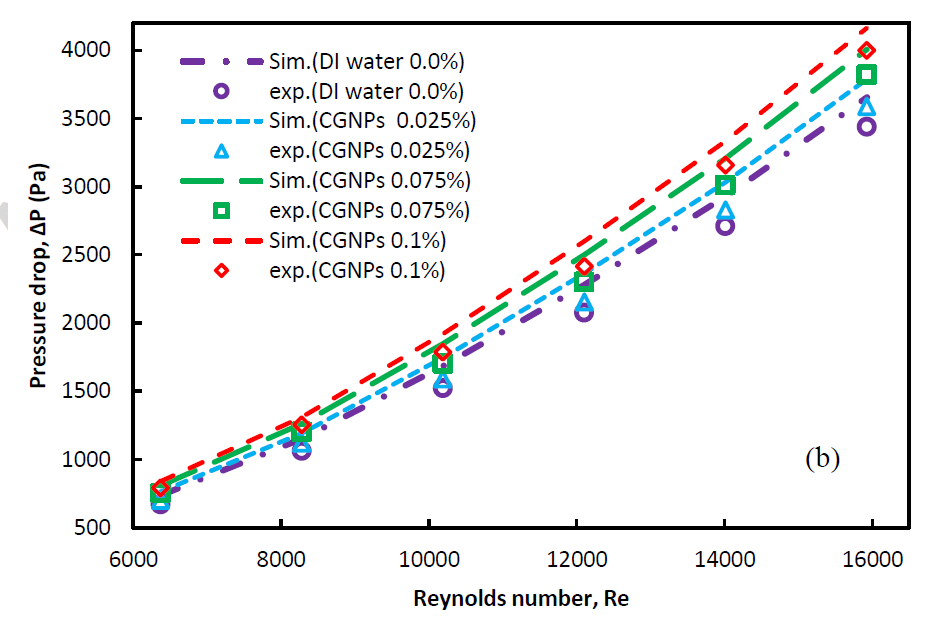
May 8, 2021 at 10:48 amSubscriberI trid different mass flow and after calculation I realiezed that, in periodic condition, pressure gradient changeed 0 to -856.163 Pa/m
when I multiply this value with total pipe legth I get very close value with figure I shared. I believe this approach is correct ?
Can I see this value by using "Reports" ?
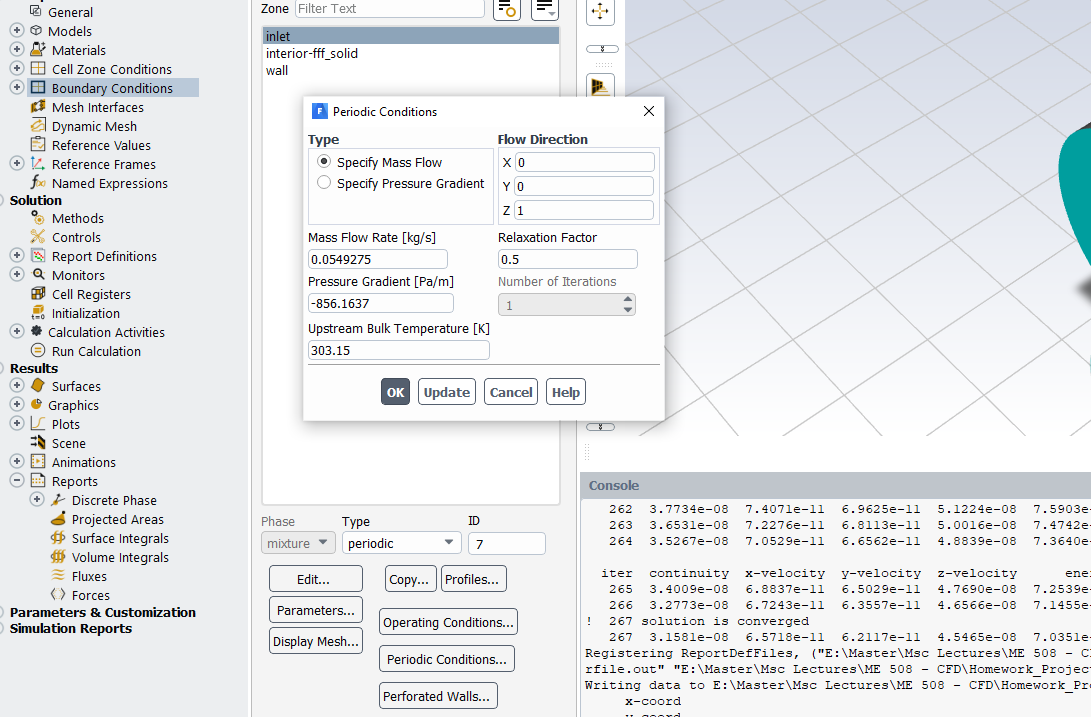
May 9, 2021 at 9:11 amForum ModeratorPeriodics and reports are a bit messy as you have a pressure drop and "pressure" is relative as we have incompressible flow: have a look and see what you get. That's why the periodic panel is the way it is: you see the pressure loss per metre & mass flow.
May 9, 2021 at 9:19 amSubscriberThank you it looks like it is better to write pressure drop formulation for turbulent flow as expression to see what I will get.
May 10, 2021 at 9:12 amAnsys EmployeeThe Pressure loss will be that pressure gradient by the length of the pipe. So your approach is correct.
Viewing 13 reply threads- The topic ‘How to decide y plus (y+) ?’ is closed to new replies.
Innovation Space Trending discussions
 Top Contributors
-
peteroznewman
 6515
6515 -
scabo
 1906
1906 -
Dennis Chen
 1463
1463 -
javat33489
 1309
1309 -
Shyam Prasad V Atri
1022
Top Rated Tags
© 2026 Copyright ANSYS, Inc. All rights reserved.
Ansys does not support the usage of unauthorized Ansys software. Please visit www.ansys.com to obtain an official distribution.
-


The Ansys Learning Forum is a public forum. You are prohibited from providing (i) information that is confidential to You, your employer, or any third party, (ii) Personal Data or individually identifiable health information, (iii) any information that is U.S. Government Classified, Controlled Unclassified Information, International Traffic in Arms Regulators (ITAR) or Export Administration Regulators (EAR) controlled or otherwise have been determined by the United States Government or by a foreign government to require protection against unauthorized disclosure for reasons of national security, or (iv) topics or information restricted by the People's Republic of China data protection and privacy laws.

 You are navigating away from the AIS Discovery experience