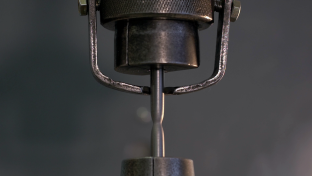

 Four-point bending strength is performed to analyze the flexural strength of a material. This test is useful for materials that tend to crack (brittle failure) under the bending load (like composites, concrete beams, and car axles). A common example of such a material is the electronic PCB. The four-point bending test is conducted on these PCBs to determine their material strength.
This SimCafe course was developed by Rajesh Bhaskaran, Swanson Director of Engineering Simulation at Cornell University in partnership with Ansys; it was last modified by Sebastien Lachance-Barrett. It serves as an e-learning resource to integrate industry-standard simulation tools into courses and provides a resource for supplementary learning outside the classroom. In this tutorial, we will learn to conduct this test, virtually, on a simple T-beam made of structural steel, to understand the boundary condition setup by following the end-to-end workflow in Ansys Structural.For more ways to learn, check out the Cornell edX course, A Hands-on Introduction to Engineering Simulations at ansys.com/cornell.
Cornell University also offers a Fluid Dynamics Simulations Using Ansys online certificate authored by Dr. Rajesh Bhaskaran. Learn more here: https://ecornell.cornell.edu/fluiddynamics
A course completion badge allows you to showcase your success. With our badging platform, digital badges can be easily shared in email signatures, digital resumes, and social media profiles, helping you highlight your achievements. The digital image contains verified metadata that describes your participation in our course and the topics and skills that were covered. This badge is for successfully completing the A Four-Point Bend Test on a T-Beam course.
-
Cost: FREE
- Course Duration: 2-4 HOURS
- Skill Level: Beginner
- Skills Gained: Four-point bend test, Structural Analysis
No reviews available for this learning resource.