
What’s New for Rocky in Ansys 2026 R1
The Ansys Rocky™ particle dynamics simulation software 2026 R1 release introduces new physics capabilities, expanded multiphysics coupling, and usability improvements that help engineers get the best from DEM simulations.
This release further strengthens Multiphysics workflows by improving integration with other Ansys products, including Ansys Fluent® software, expanding the possibilities for the projects you can create.
In addition to new capabilities, Ansys Rocky 2026 R1 brings Performance and Usability enhancements that help users run simulations more efficiently and streamline project setup.
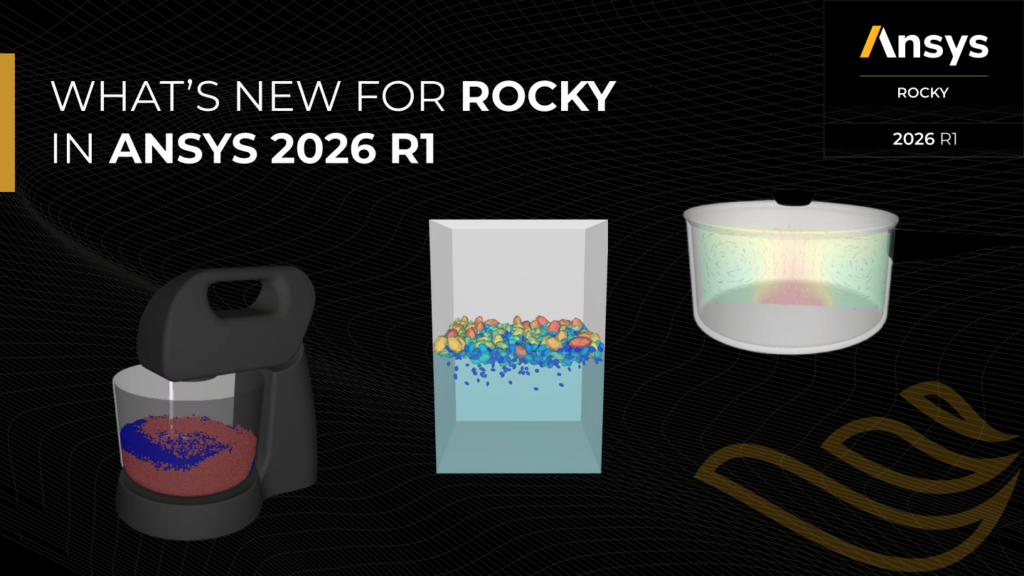
Explore what’s new in Ansys Rocky 2026 R1 and discover how these enhancements can help you accelerate innovation in your applications.
DEM Simulation Improvements
Mixing Index Calculator
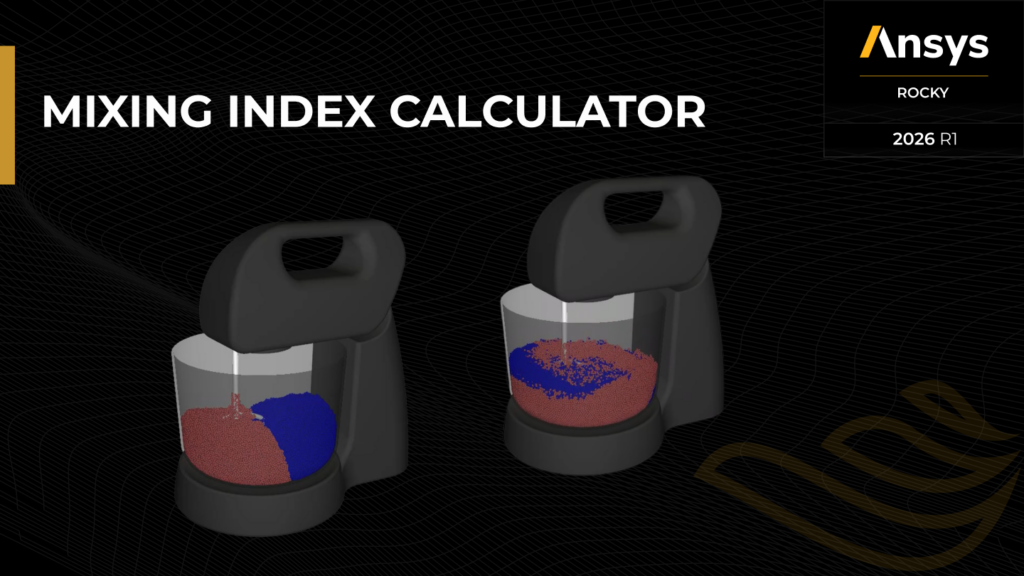
The new Mixing Index Calculator provides an automated way to quantify the quality of powder mixing in DEM simulations.
This ready-to-use script evaluates the mixing index of multiple materials throughout the simulation, helping users determine how uniformly particles are distributed in the system. It can also help identify the optimal stopping point for mixing processes once a target mixing threshold is reached.
The feature is especially relevant for industries where powder mixing is critical, such as:
- Pharmaceutical manufacturing
- Chemical processing
- Food processing
- Soil and granular material modeling
By automating the evaluation of mixing quality, the calculator reduces manual post-processing and helps optimize mixing processes.
A new script to automate the calculation of the mixing index for multiple materials in a mixer that is based on the proportion of each material in different cells of the domain.
Intermolecular Forces and 1-Way Free Surface
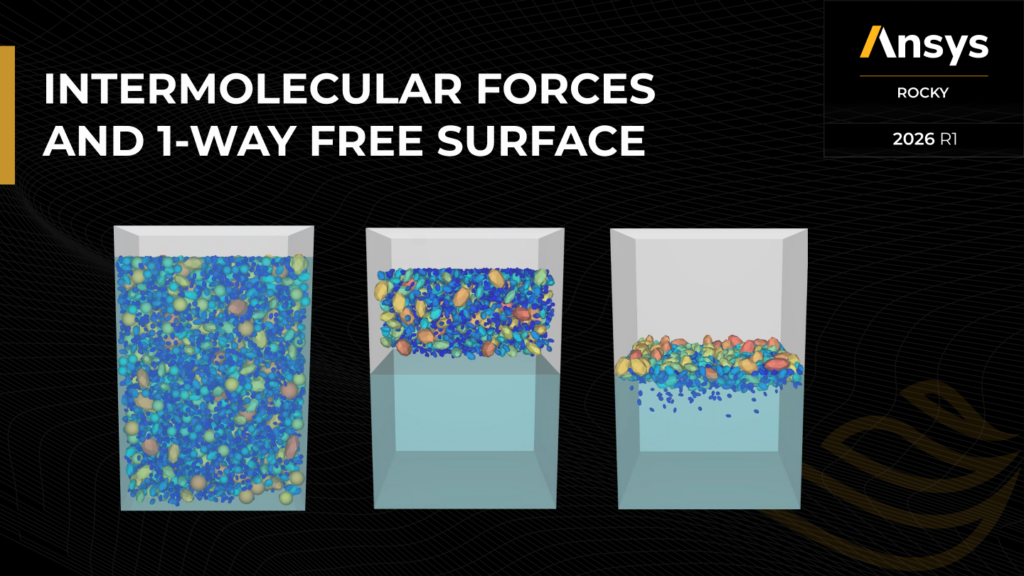
Ansys Rocky 2026 R1 introduces the Intermolecular Forces and 1-Way Free Surface modules to support simulations in which particle behavior is influenced by surrounding fluids without explicitly modeling the fluid phase.
These modules allow users to represent fluid-related forces acting on particles without requiring computationally expensive CFD or SPH fluid simulations.
Two approaches are available:
- Fixed free surface model — Represents a static fluid interface.
- Moving free surface model — Represents a dynamic interface, such as liquid evaporation or surface evolution.
Additional intermolecular interactions can also be included, such as repulsive forces and van der Waals forces.
These capabilities are particularly relevant for battery manufacturing processes, where particle behavior is affected by thin liquid films or evaporating solvents.
Multiphysics Coupling
1-Way Fluent GPU-Rocky support
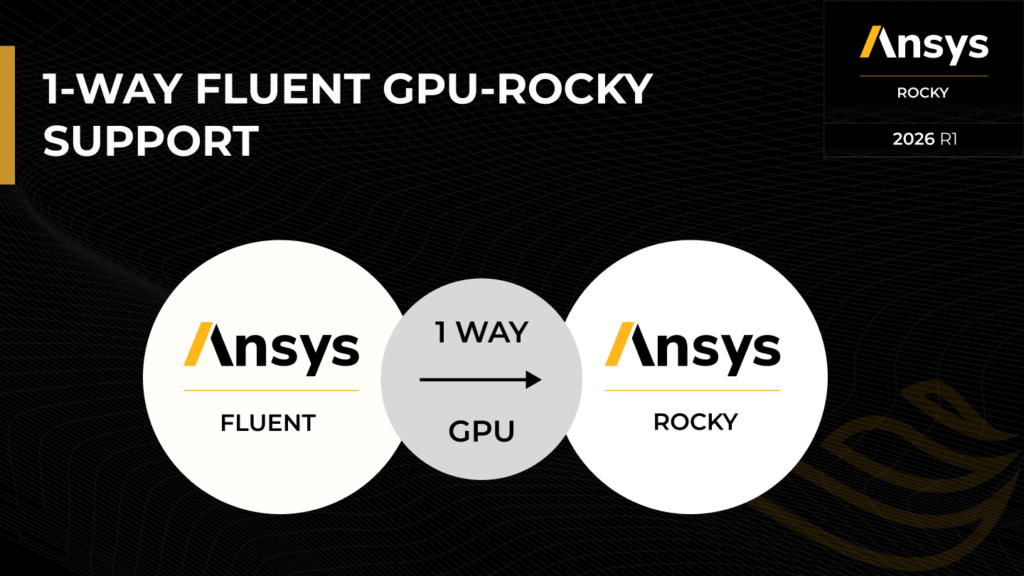
The multiphysics coupling between Rocky and Ansys Fluent has been expanded with support for 1-way coupling between Fluent GPU simulations and Rocky.
This enhancement enables users to leverage the high-performance GPU solver in Fluent while transferring flow-field information to Rocky for particle simulations.
Although the current implementation supports only 1-way coupling, it represents an important step toward fully GPU-based coupled workflows between Fluent and Rocky.
Buoyancy force using fluid expansion coefficient
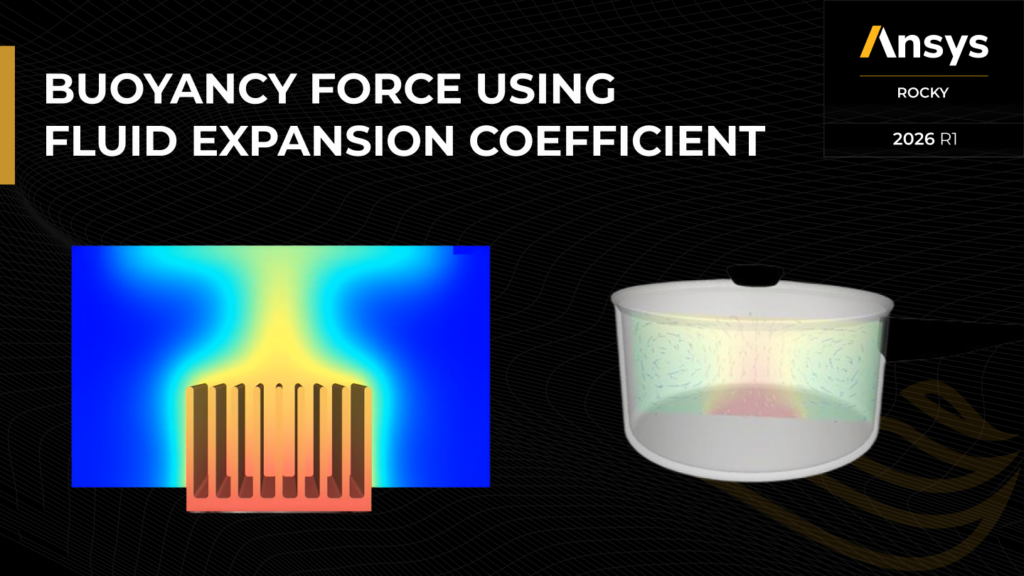
Natural convection can now be modeled in SPH simulations through a buoyancy formulation based on the fluid thermal expansion coefficient.
This implementation uses the Boussinesq approximation, where density variations are considered only in the gravity term, enabling the simulation of thermal buoyancy effects without requiring fully compressible fluid models.
The formulation introduces buoyancy acceleration on SPH elements, enabling more accurate prediction of natural convection and wall heat transfer rates, particularly for complex geometries.
Natural convection on SPH models for predicting wall heat transfer rate at complex boundary (Beta).
Torque Law in the Rocky UI
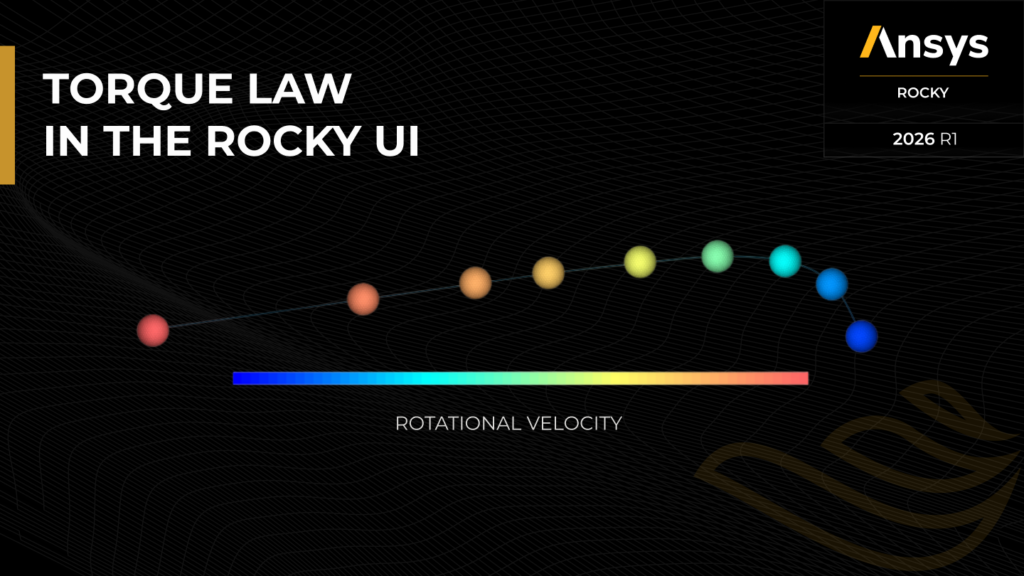
A torque law has now been introduced for 1-Way Constant coupling to model rotational effects and torque-driven particle motion. This feature enables users to simulate scenarios where particle rotation plays an important role, allowing torque-induced energy dissipation or rotational dynamics to be incorporated into particle–fluid interaction models.
The torque law is implemented as a one-way interaction model, providing a straightforward method to include rotational physics in simulations where torque effects are significant.
Distributed Parallel Computing (Beta)
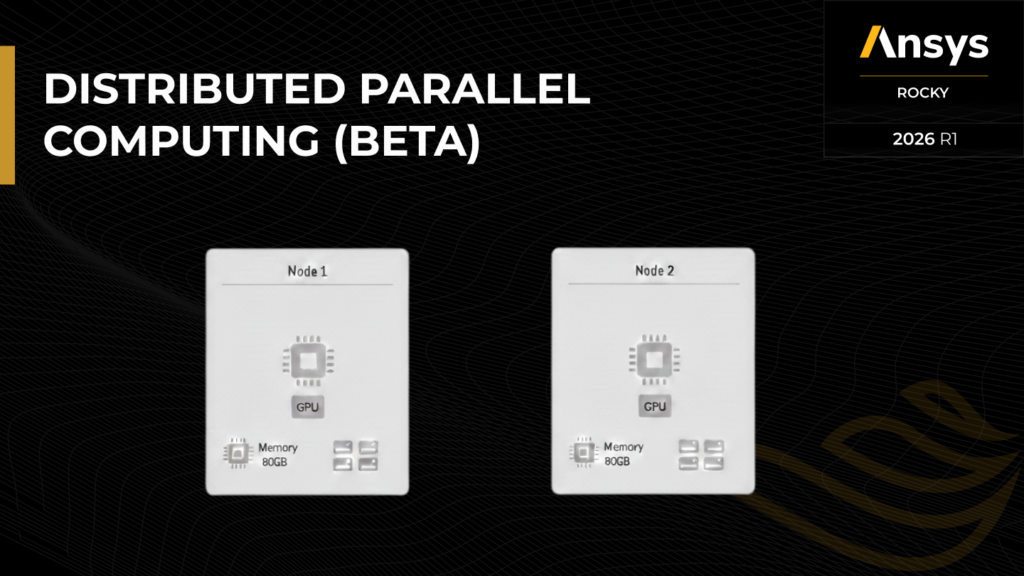
The new release brings Distributed Parallel Computing in beta, enabling simulations to run across multiple GPUs on different nodes.
Previously, Rocky simulations were limited to GPUs within a shared-memory node. With this enhancement, users can now scale simulations beyond a single node and leverage large GPU clusters.
Key characteristics of this feature include:
- Multi-node GPU execution
- Increased scalability for large particle counts
- Improved simulation capacity for large-scale DEM models
In this beta version, distributed computing is currently supported for DEM spherical particles.
Optimization of the volumetric generation of DEM/SPH elements.
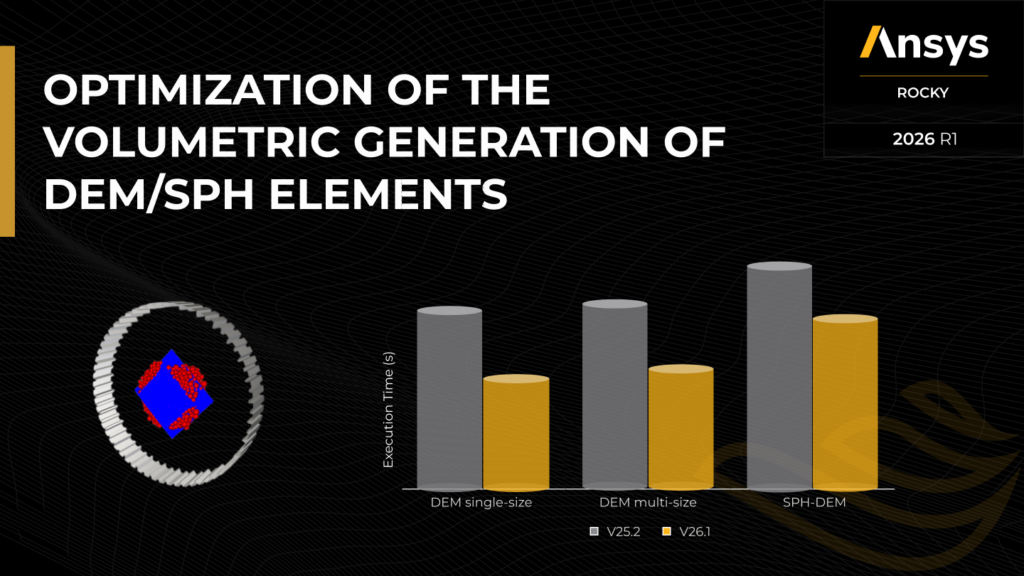
The initialization stage of simulations has been optimized to accelerate the generation of DEM and SPH elements.
Performance improvements have been implemented for scenarios involving:
- Injection of large numbers of particles
- Filling operations in tanks or containers
- Single-size and multi-size particle distributions
- Combined DEM and SPH initializations
Automation with PrePost Scripting Improvements
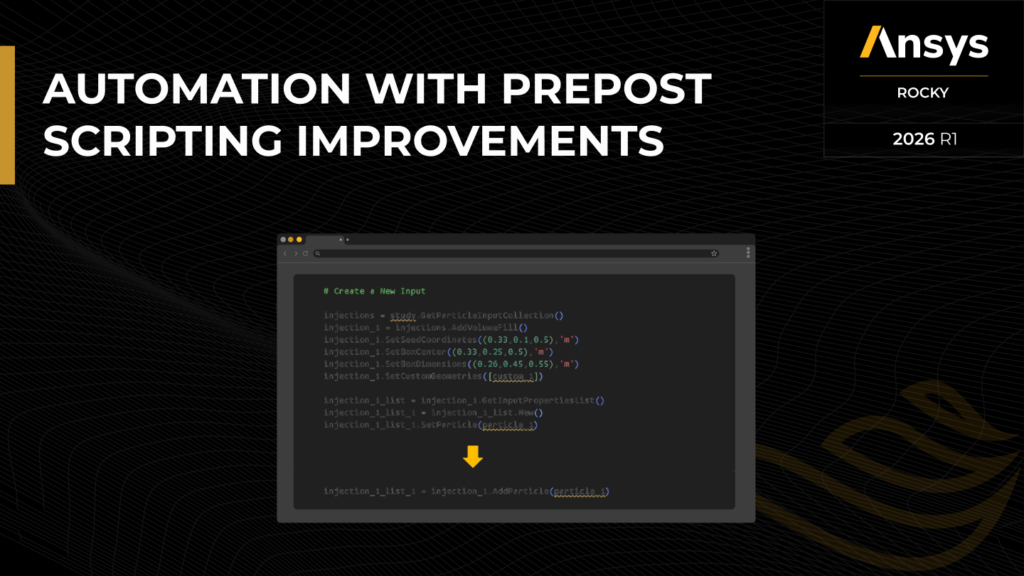
Automation capabilities have been expanded through improvements in PrePost scripting.
A new scripting workflow allows users to programmatically define particle inlets, including:
- Particle injection locations
- Material properties
- Initial velocities and other parameters
This enhancement enables easier automation of model setup and supports the creation of repeatable simulation workflows.
Rocky Scripts Improvements
Starting with Ansys Rocky 2026 R1, the distribution of Rocky scripts has been reorganized to improve accessibility, simplify installation, and better align with Ansys platform standards.
Key updates include:
Centralized Repository for PrePost Scripts
All PrePost Scripts source code (General Scripts) now hosted in the Ansys Rocky PrePost Scripts & Modules Repository on the Ansys GitHub page.
Script Wizards Distribution
The Script Wizards are now distributed through the App Catalog on the Ansys Developer Portal, including:
- Material Wizard
- Coating Visibility Wizard
- Calibration Suite
- Material Storage
- Closed Loop Motion — A New script available in the 2026 R1 release, which automates the creation of replicated geometry motion. It will also generate motion frames with high accuracy.
Visit the Rocky Scripts Page to browse all of them.
Ansys Engineering Copilot
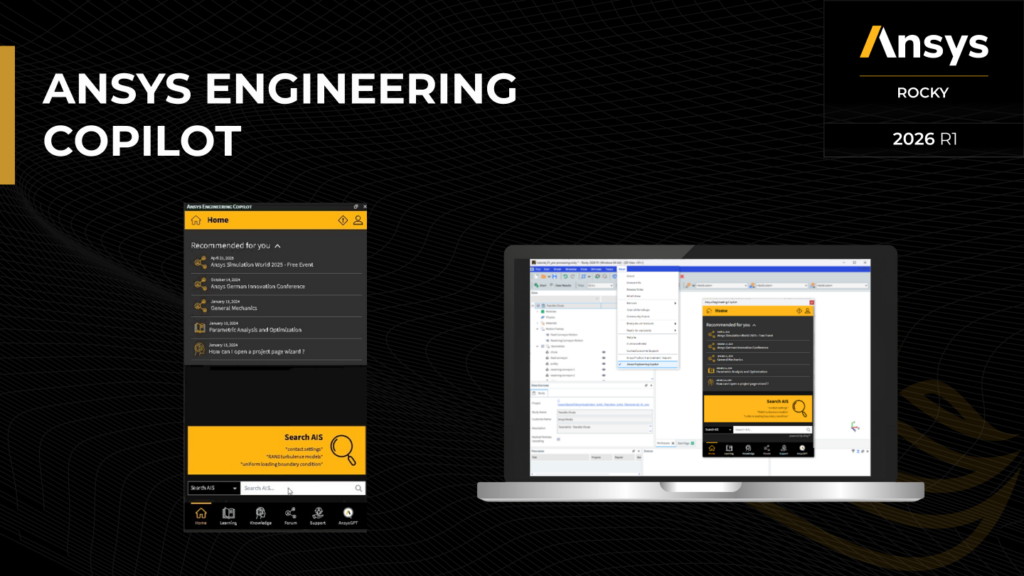
Ansys Rocky 2026 R1 has Ansys Engineering Copilot, an AI-powered assistant designed to help users quickly find technical information and learn from the broader Ansys knowledge ecosystem.
Engineering Copilot retrieves information from multiple sources, including:
- Ansys Innovation Space
- Knowledge base articles
- Community forum discussions
- AnsysGPT™
Within Rocky, Engineering Copilot appears as a dockable interface, allowing users to ask questions and access learning resources directly inside the software environment.
This integration helps users quickly find answers, explore documentation, and engage with the global Ansys community while working within Rocky.
With the 2026 R1 release, Ansys Rocky software continues to expand its capabilities for high-fidelity particle dynamics simulations. New physics models, enhanced multiphysics coupling with Ansys Fluent software, and improvements in performance, scalability, and automation enable users to simulate increasingly complex particle-driven processes with greater efficiency.
Together, these advancements help engineers accelerate development, gain deeper insights into particulate systems, and extend the range of applications that can be addressed with Rocky software.
Ansys Rocky™ particle dynamics simulation software
Learn more about Ansys Rocky™ software in Ansys Rocky Innovation Space.

JANAINA OLIVEIRA
Senior Technical / Product Publications









 You are navigating away from the AIS Discovery experience