

-
-
April 7, 2022 at 8:38 am
DongwooChoi
SubscriberHello, I'm little confused about temperature settings.
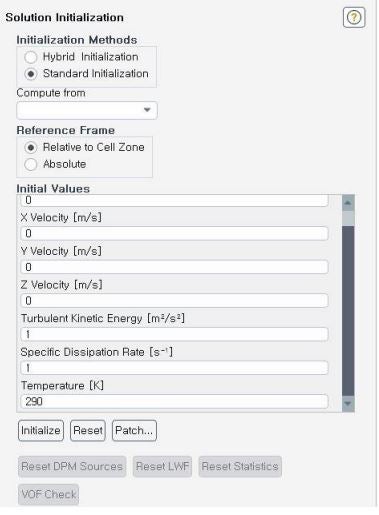
When I set initialization temperature of 290K in contained fluid like picture below, fluid's temperature became 290K
April 7, 2022 at 10:34 amRob
Forum ModeratorThe initialisation value is just that, it's the value in the domain at iteration 0, ie before you start solving the model.
The boundary condition is the value added to the domain from that boundary.
As the solvers are iterative we need a first "guess" at the solution. The solver takes that and then uses the boundary settings, models etc to calculate the solution. In steady state the initial condition wants to be sensible but generally doesn't have much impact on the solution (pressure in and pressure out with compressible flow is an exception - you need a good starting solution). In the transient case the solver also adds time into the mix, so a silly initial condition may take many time steps to be removed from the results.
April 7, 2022 at 11:31 amSubscriberThank you for replying! (I'm sorry about Duplicated post I thought that was deleted)
I initially thought initialisation value is just for guessing solution(as you said), so whatever I enter at there, I thought maybe there could be difference in calculation time, but there should be no difference at fluid's initial temperature.
But when I enter 200K at initialisation temperature, fluid's initial temperature became 200K, when I enter 300K, fluid temperature start from 300K.
So, I thought it might be setting for initial(at 0second) temperature.
It still makes me little bit confusing.
Can you give me some light ?
April 7, 2022 at 12:36 pmForum ModeratorInitial temperature is the setting for t=0 assuming you use the standard initialisation or patch. In your model I might patch the gas region at 200K and the solid at 500K as my starting point. I'll then watch the hot bit cool down and the cold bit warm up over the solution.
Material entering the domain will take the boundary temperature. So an inlet temperature of 250K means air will enter the domain at 250K. If you set a wall temperature, the wall will be that temperature and the neighbouring fluid will slowly move towards the same value.
April 7, 2022 at 1:38 pmSubscriber
Thank you very much, sir
Viewing 4 reply threads- The topic ‘What is difference between Inlet temperature and Initialization temperature?’ is closed to new replies.
Innovation Space Trending discussions
 Top Contributors
-
peteroznewman
 6450
6450 -
scabo
 1906
1906 -
Dennis Chen
 1457
1457 -
javat33489
 1308
1308 -
Shyam Prasad V Atri
1022
Top Rated Tags
© 2026 Copyright ANSYS, Inc. All rights reserved.
Ansys does not support the usage of unauthorized Ansys software. Please visit www.ansys.com to obtain an official distribution.
-


The Ansys Learning Forum is a public forum. You are prohibited from providing (i) information that is confidential to You, your employer, or any third party, (ii) Personal Data or individually identifiable health information, (iii) any information that is U.S. Government Classified, Controlled Unclassified Information, International Traffic in Arms Regulators (ITAR) or Export Administration Regulators (EAR) controlled or otherwise have been determined by the United States Government or by a foreign government to require protection against unauthorized disclosure for reasons of national security, or (iv) topics or information restricted by the People's Republic of China data protection and privacy laws.

 You are navigating away from the AIS Discovery experience