Hello everyone,
I know this topic has been posted before, and I've read multiple answers already, however my question is a bit different. So I've been modelling a simple soil layer, in transient structural analysis and testing different ways of applying the fixed boundary condition.
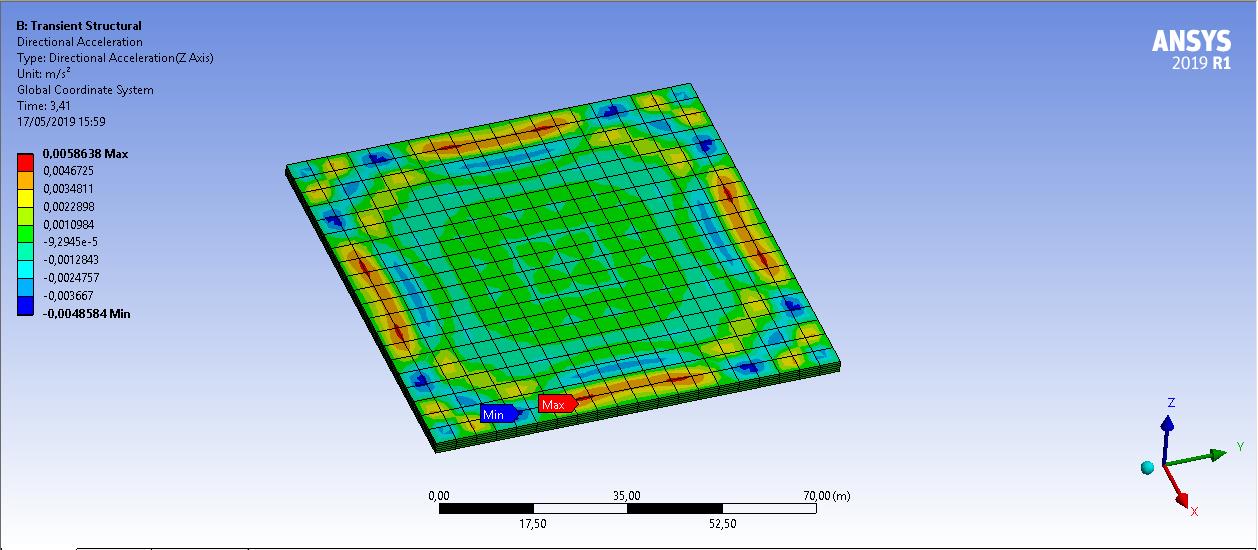
As you can see, i have this simple solid, I tried placing the fixed boundary condition in different ways. Mainly, at the bottom, at the bottom and on the sides and just at the sides. And running the animation to see the propagation of the acceleration along the model. However I'm unable to know exactly what's causing the reflection. Is it the free end or the fixed end ? I've read an article somewhere that the transient analysis uses the implicit solver, and therefore the boundary conditions are absorbant ? If you can point me out to a documentation explaining this phenomenon I would be grateful. And if you can suggest the best type of boundaries for this kind of analysis, I would be grateful as well (infinite elements and their application, spring elements, I was also thinking about prolonging my model, and applying some kind of material with very high damping value, not sure if that works).
Thank you in advance.
Regards,
Nizar

















 You are navigating away from the AIS Discovery experience