-
-
June 30, 2021 at 9:22 am
MCK_Pandaleon
SubscriberHello!
I am having issues with solution parameters on ANSYS Workbench 2020 r2. All seems fine until I want to solve.
I want to visualise both total and directional deformations as well as the voltage applied on the piezo-eletric ceramic that I am studying. I am unable to solve because I have to input the maximum, minimum and average deformation and when they occur but I am unable to input anything in those specific areas.
I encounter this issue with transient and static structural analysis and also with modal+harmonic responses.
Thanks in advance!
June 30, 2021 at 9:25 amErKo
Ansys EmployeeHi
Can you show some images of the errors/issues you are having so we can try and help - also explain a bit more in detail.
Thanks
Erik
June 30, 2021 at 10:08 amMCK_Pandaleon
SubscriberI am studying a simplified transducer with only the piezoelectric ceramic and the coupling module on top. The voltage applied is a slot signal that goes from -100V to 100V at a frequency of 200kHz (which is supposed to be the driving frequency).
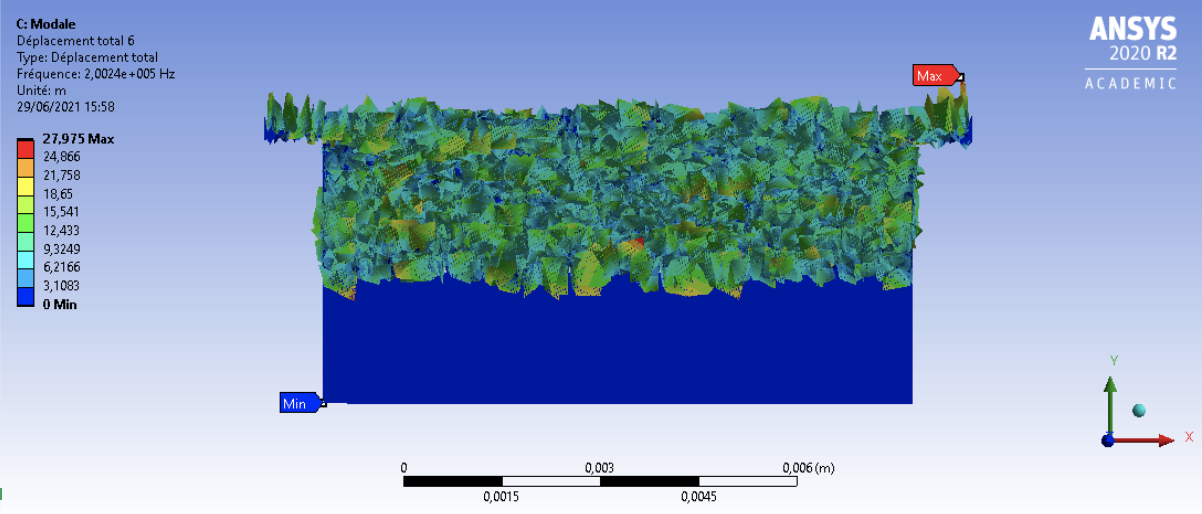
I will first launch modal analysis to then visualise total deformations for different resonance modes, but the results I get don't make much sense : the piezo is absolutely not deformed and the coupling module seem to be too deformed.
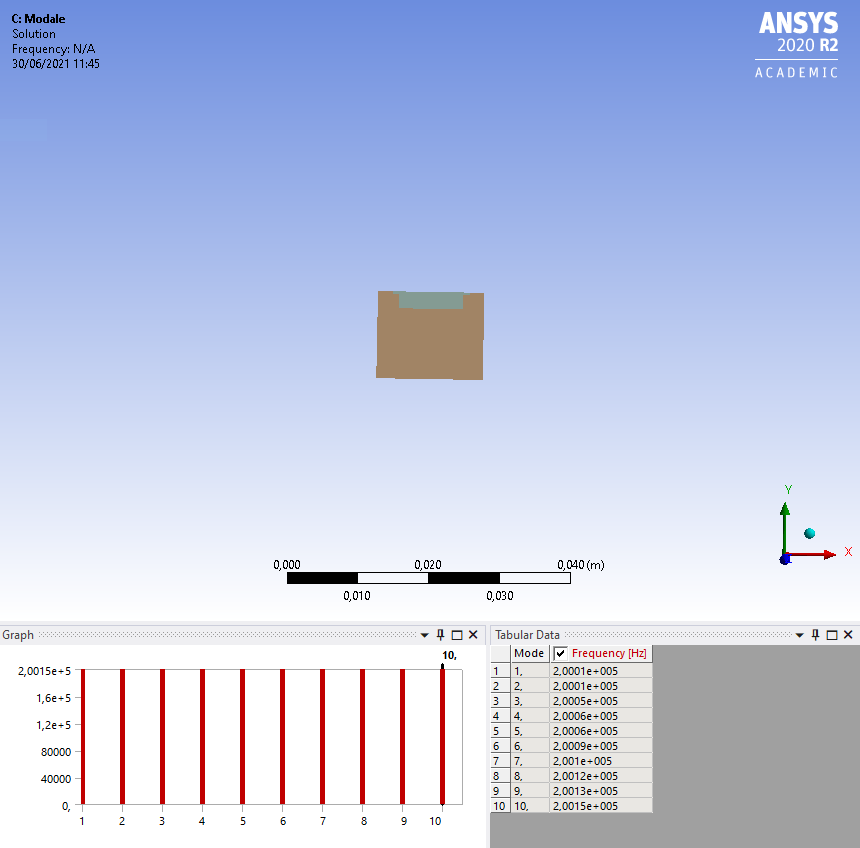
This the result for one of the modes, when I create them from the results of the modal analysis, which are here :

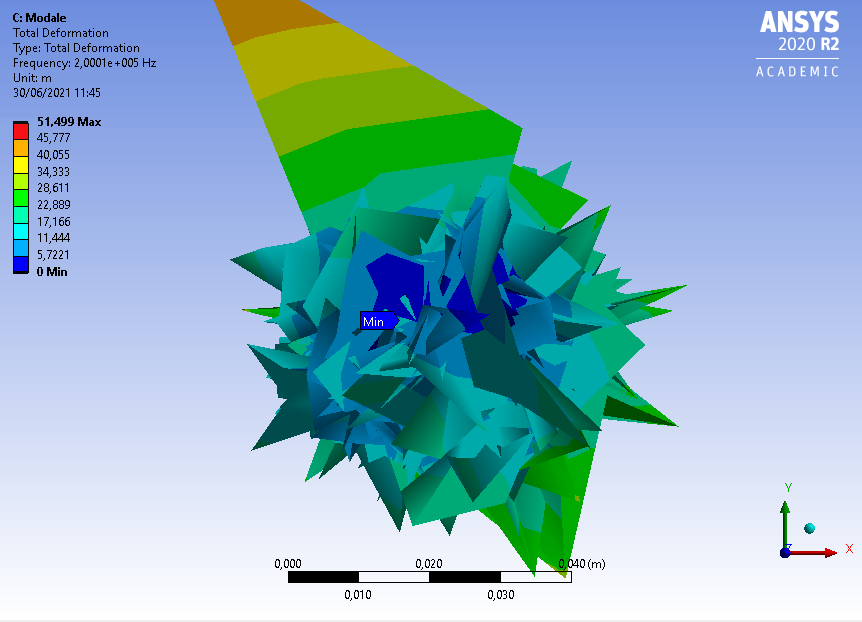
When I add the backing module around this first part the results are even worse :
The proportions of the deformation are simply impossible.
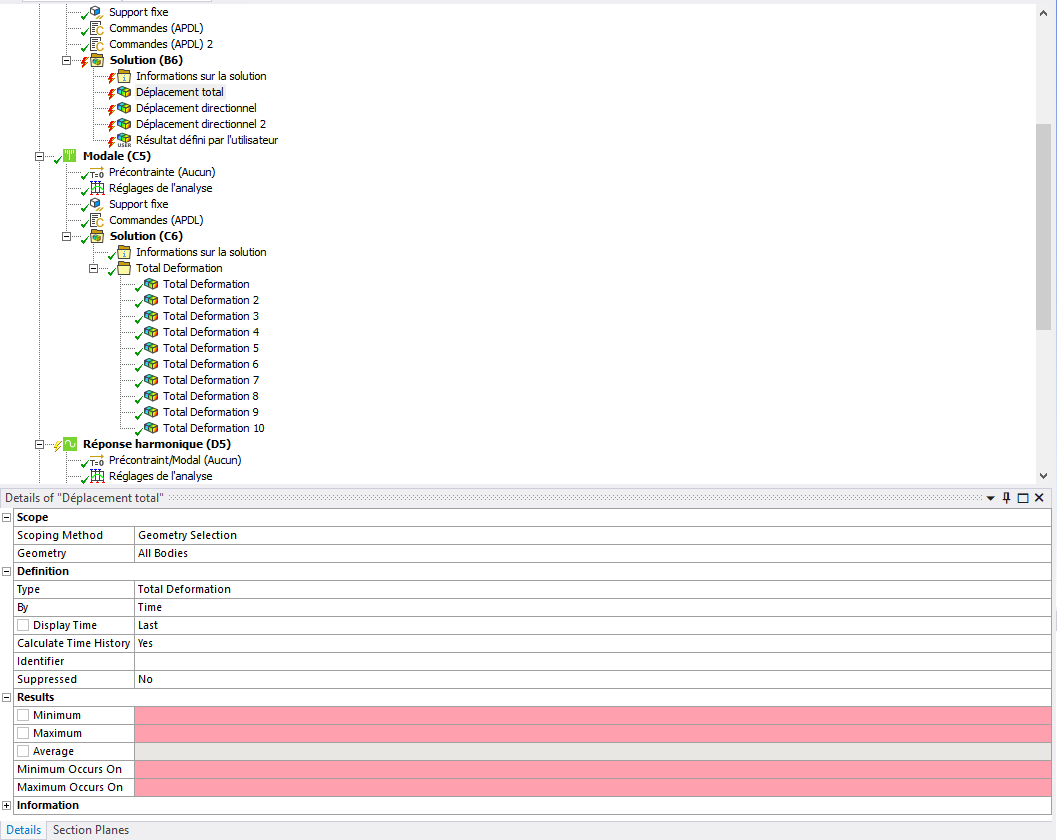
As for the Static and transient structural analysis I get this issue :
I am supposed to input values in the places highlighted in red but I cannot input anything.
I also get a warning because I am using multiple dimension analysis even if all the analysis are set on the same dimension setting.
For the commands I am not sure of the one used for the transient and static analysis, but the one used for the modal and harmonic responses is :
'd, positive, 100
d, negative, 0 '
June 30, 2021 at 10:47 amErKo
Ansys EmployeeHi
Just run a full harmonic response no need for modal - the results you see are strange because the nonpiezo material is softer so it behaves funny like this.
So just run the full harmonic response and excite your piezo - plot the displacements and deformation of the piezo only (so scope results to that part only) and see that it behaves as expected.
Erik
June 30, 2021 at 1:10 pmMCK_Pandaleon
SubscriberThis does work , but I still have an issue with the command of the transient and static structural analysis.
I want to impose a slot voltage that varies from +100V to -100V at a frequency of 200kHz. How do I do this?
The electrodes are named selections (positive and negative), I thought of putting a time frequency table in place but I haven't managed to do so. Therefore, the simulation doesn't work well.
June 30, 2021 at 1:18 pmErKo
Ansys EmployeeThat is good - piezo are normally done in freq. domain using harmonic response.
For static use just d,exc,volt,100, and for transient, use a table called for instance voltexcite shown below (that varies with time) instead of a constant:
like this:
/PREP7
CMSEL,S,EXC,NODE
CP,NEXT,VOLT,ALL
ALLSEL,ALL
CMSEL,S,GROUND,NODE
CP,NEXT,VOLT,ALL
ALLSEL,ALL
/SOLU
KBC,1
*DIM,tbexc,TABLE,4,,,TIME
tbexc(1,0) = 0,0.0000011,0.0000022,0.000002225
tbexc(1,1) = 0, 100,0,0
*DIM,voltexcite,TABLE,31,1,1,TIME ! Time values
voltexcite(1,0,1) = 0.
voltexcite(2,0,1) = 2.5e-007
voltexcite(3,0,1) = 2.25e-006
voltexcite(4,0,1) = 2.5e-006
voltexcite(5,0,1) = 2.75e-006
voltexcite(6,0,1) = 4.75e-006
voltexcite(7,0,1) = 5.e-006
voltexcite(8,0,1) = 5.25e-006
voltexcite(9,0,1) = 7.25e-006
voltexcite(10,0,1) = 7.5e-006
voltexcite(11,0,1) = 7.75e-006
voltexcite(12,0,1) = 9.75e-006
voltexcite(13,0,1) = 1.e-005
voltexcite(14,0,1) = 1.025e-005
voltexcite(15,0,1) = 1.225e-005
voltexcite(16,0,1) = 1.25e-005
voltexcite(17,0,1) = 1.275e-005
voltexcite(18,0,1) = 1.475e-005
voltexcite(19,0,1) = 1.5e-005
voltexcite(20,0,1) = 1.525e-005
voltexcite(21,0,1) = 1.725e-005
voltexcite(22,0,1) = 1.75e-005
voltexcite(23,0,1) = 1.775e-005
voltexcite(24,0,1) = 1.975e-005
voltexcite(25,0,1) = 2.e-005
voltexcite(26,0,1) = 2.025e-005
voltexcite(27,0,1) = 2.225e-005
voltexcite(28,0,1) = 2.25e-005
voltexcite(29,0,1) = 2.275e-005
voltexcite(30,0,1) = 2.475e-005
voltexcite(31,0,1) = 2.5e-005
! Load values
voltexcite(1,1,1) = 0.
voltexcite(2,1,1) = 100.
voltexcite(3,1,1) = 100.
voltexcite(4,1,1) = 0.
voltexcite(5,1,1) = -100.
voltexcite(6,1,1) = -100.
voltexcite(7,1,1) = 0.
voltexcite(8,1,1) = 100.
voltexcite(9,1,1) = 100.
voltexcite(10,1,1) = 0.
voltexcite(11,1,1) = -100.
voltexcite(12,1,1) = -100.
voltexcite(13,1,1) = 0.
voltexcite(14,1,1) = 100.
voltexcite(15,1,1) = 100.
voltexcite(16,1,1) = 0.
voltexcite(17,1,1) = -100.
voltexcite(18,1,1) = -100.
voltexcite(19,1,1) = 0.
voltexcite(20,1,1) = 100.
voltexcite(21,1,1) = 100.
voltexcite(22,1,1) = 0.
voltexcite(23,1,1) = -100.
voltexcite(24,1,1) = -100.
voltexcite(25,1,1) = 0.
voltexcite(26,1,1) = 100.
voltexcite(27,1,1) = 100.
voltexcite(28,1,1) = 0.
voltexcite(29,1,1) = -100.
voltexcite(30,1,1) = -100.
voltexcite(31,1,1) = 0.
D,EXC,VOLT,%voltexcite%
D,GROUND,VOLT,0

Viewing 5 reply threads- The topic ‘Unable to input maximum and minimum values in the Result section of analysis’ is closed to new replies.
Innovation SpaceTrending discussionsTop Contributors-
6234
-
1906
-
1457
-
1308
-
1022
Top Rated Tags© 2026 Copyright ANSYS, Inc. All rights reserved.
Ansys does not support the usage of unauthorized Ansys software. Please visit www.ansys.com to obtain an official distribution.
-
Ansys Assistant will be unavailable on the Learning Forum starting January 30. An upgraded version is coming soon. We apologize for any inconvenience and appreciate your patience. Stay tuned for updates.