Ansys Assistant will be unavailable on the Learning Forum starting January 30. An upgraded version is coming soon. We apologize for any inconvenience and appreciate your patience. Stay tuned for updates.
Fluids

Fluids

Topics related to Fluent, CFX, Turbogrid and more.

Transmitted wave height using ansys aqwa

    • Sreelakshmi_m240589ce
      Subscriber

      I have seen below sentences from a reference paper "In this study, to calculate the wave transmission coef-

      ficient, the AQWA-GS module of ANSYS-AQWA is used. In

      this module, the results of calculations are displayed in

      different ways. After applying the wave load with determined

      characteristics, the wave amplitude can be calculated for

      different points of the domain. )en, by calculating the ratio

      of the amplitude of the incident wave to the amplitude of the

      wave behind the rear FBW, the wave transmission coefficient

      is obtained." How to get this transmitted wave height, pls help

      . I'm using 2025r1 version

    • Mike Pettit
      Ansys Employee

      Hello,

      You can retrieve the disturbed wave surface elevation from the Aqwa frequency-domain analysis (Hydrodynamic Diffraction/Aqwa-Line solver) in a couple of ways.

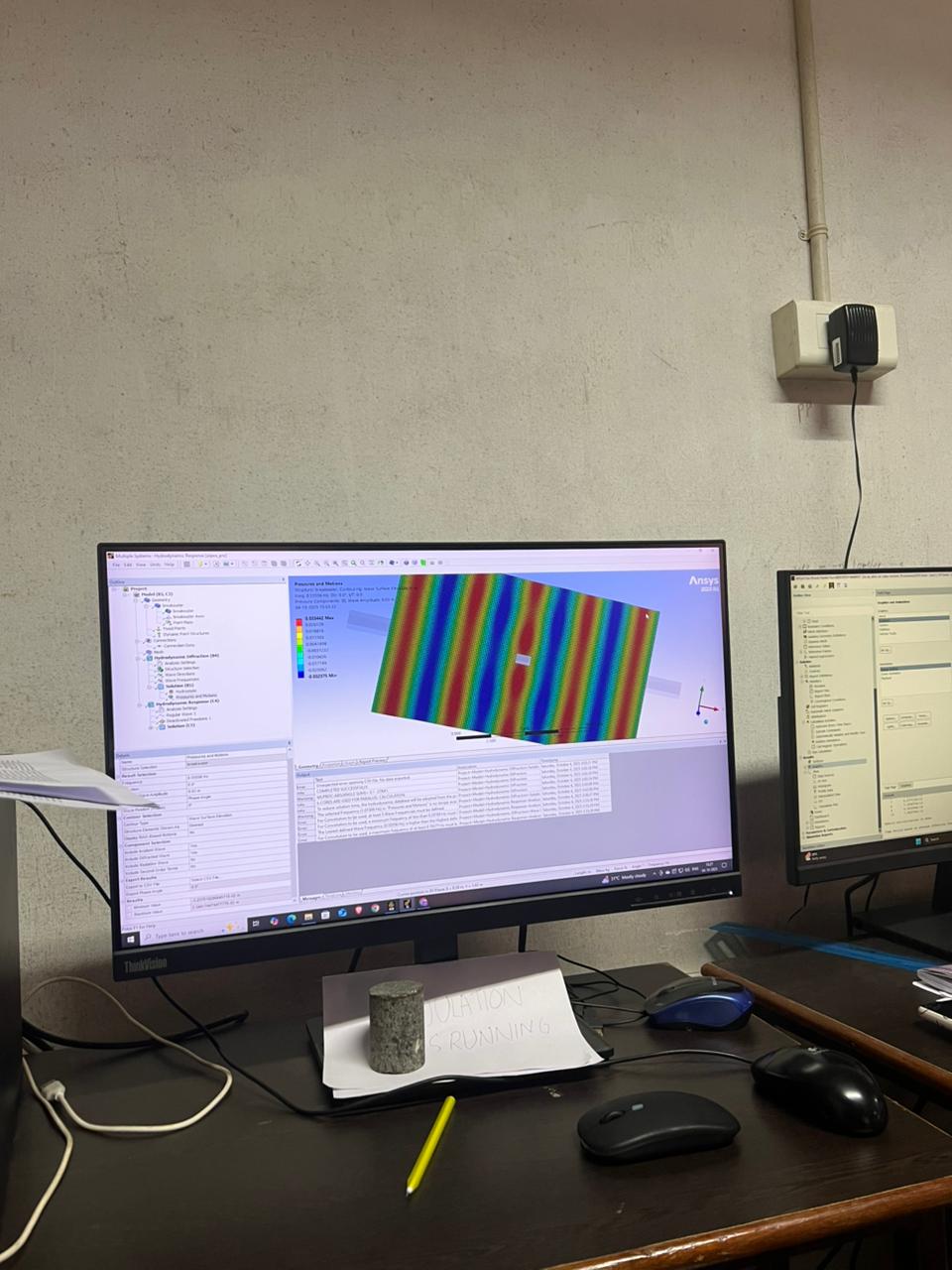
      If you are using the Ansys Aqwa Workbench editor, there is a Pressures and Motions result available under the Hydrodynamic Diffraction solution. Set the Wave Frequency and Wave Direction as needed; leave the Wave Amplitude as 1 m; set the Result Type to Maximum; and set the Contour Type to Wave Surface Elevation. Then right-click and Evaluate the result. This shows you the maximum disturbed wave surface (i.e. incident + diffracted + radiated wave, plus a second-order term) around the structure, which can also be considered as the wave transmission coefficient (i.e. ratio of the transmitted wave to the incident wave). You can use the Export to CSV File option in the result details panel to export the data across the entire wave grid.

      Alternatively, you can use the AqwaFlow command line utility to post-process the Aqwa output files. This allows you to retrieve the disturbed wave surface amplitude at one or more specific locations in the radiation-diffraction analysis.

      I hope this helps.

      Mike

    • Sreelakshmi_m240589ce
      Subscriber

      Thanku for ur response .may I know is there any option to increase the wave grid size ? It's showing 1m×1m ..if I want results within 3×3m how to get that

      • Mike Pettit
        Ansys Employee

        Hello,

        There are some options in the Hydrodynamic Diffraction Analysis Settings for this. While 'Generate Wave Grid Pressures' is set to 'Yes', you can switch the 'Wave Grid Resolution' between 'Standard (81 x 51)' and 'Fine (161 x 101)' to change the grid resolution, or you can adjust the 'Wave Grid Size Factor' to change the overall size of the grid. The default wave grid size is determined from the bounding box of the structure.

        Mike

    • Sreelakshmi_m240589ce
      Subscriber

      Ok thanku 

    • Sreelakshmi_m240589ce
      Subscriber

      Why it's showing like this ,when an obstacle comes ; elevation must change right?

    • Mike Pettit
      Ansys Employee

      Hello,

      In this case the scale of the diffracted and/or radiated wave is small compared to the incident wave amplitude. In other words, the diffracting/radiating effect of the structure is relatively small, because the structure dimensions are small compared to the wavelength of the incoming wave.

      You can use the Component Selection in the Pressures and Motions details to choose which wave components to include in the wave surface plot. For example, you could turn off the 'Include Incident Wave' option to make the wave disturbance more visible.

      Mike

    • Sreelakshmi_m240589ce
      Subscriber

      Thanku

    • Sreelakshmi_m240589ce
      Subscriber

      Is there any option to find out reflection coefficient in ansys aqwa

    • Mike Pettit
      Ansys Employee

      Hello,

      I guess the reflection coefficient can be found by setting the Pressures and Motions wave surface elevation result's Component Selection to Include Diffracted Wave (only, i.e. turn the other components off).

      Mike

Viewing 8 reply threads
  • You must be logged in to reply to this topic.
[bingo_chatbox]