Ansys Assistant will be unavailable on the Learning Forum starting January 30. An upgraded version is coming soon. We apologize for any inconvenience and appreciate your patience. Stay tuned for updates.
LS Dyna

LS Dyna

Topics related to LS-DYNA, Autodyn, Explicit STR and more.

Reducing Oscillations in Transient Heat Transfer Model with LS-DYNA Solver 12

    • mrijal
      Subscriber

      Hi everyone,

      I’m currently running a transient heat transfer simulation in LS-DYNA on a large model with over 5 million elements. The setup applies a short-duration heat flux to the top surface, and I extract nodal temperatures for post-analysis.

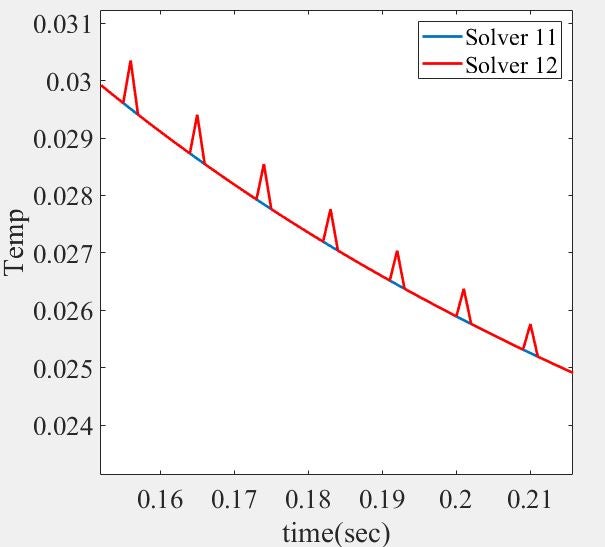
      Using the direct solver (Solver 11) yields accurate results but takes days to complete, which is challenging as I need to run multiple simulations. Switching to Solver 12 (conjugate gradient) significantly reduces execution time but introduces considerable oscillations (spikes) in the temperature output, even though I’m using fully implicit time integration.

      I’ve already adjusted the time step based on the minimum element size. While this setup produces smooth results with Solver 11, the oscillations persist with Solver 12 as seen in Figure

      Are there any specific parameters or settings I can tweak to eliminate these oscillations in Solver 12? Any suggestions or advice would be greatly appreciated!

    • Pedram Samadian
      Ansys Employee

      Hi,

      Can you please check the value of the parameter "TIP" in the *CONTROL_THERMAL_TIMESTEP card? To eliminate the ocsillations, it needs to be 1, not 0.5 (LS-DYNA Keyword Manual).

      Thanks,

      Pedram 

    • mrijal
      Subscriber

      Hi Pedram,

      Thank you for your response. As mentioned in my initial thread, I have been using fully implicit time integration (TIP: 1), yet I am still encountering those oscillations.

      Thanks,
      Manny

    • Ram Gopisetti
      Ansys Employee

      Hi 

      Usually, Conjugate gradient-based solvers are faster than Gauss solvers so solver 11 ( Sparse Gauss) takes time to solve but it's a robust solution. 

      So you can test with other CG-based solvers to see if you can iron out these spikes and try with your best available latest solvers. 

      Cheers, Ram 


Viewing 3 reply threads
  • You must be logged in to reply to this topic.
[bingo_chatbox]








