-
-
May 20, 2020 at 2:27 pm
Weiqiang Liu
SubscriberHi all,
I am doing a propane combustion simulation with fluent. Actually I am trying to reproduce literature results. My maximum temperature is 100K lower than literature results.Â
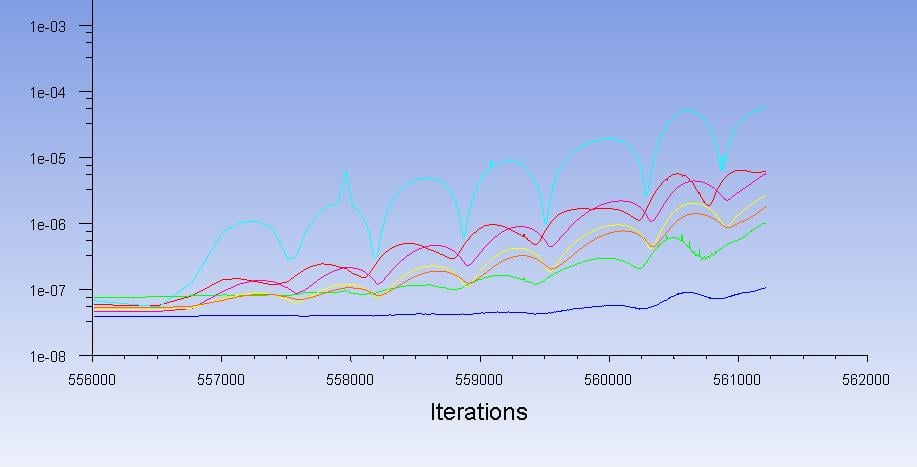
I am wondering is this because my case is not converged yet. all the residuals in my case are flat. The monitor variable kept constant as well. Then I checked mass balance of the combustor, it's balanced. Finally I checked the total sensible heat transfer rate. The detailed data set is as follows:
inlet: -58.4W
outlet:-200W
external_wall:-182W
heat of reaction source:461.55 W
net:9.74 W
I know that the net heat transfer rate of the whole system should be 0 if the case is fully converged. However, I can not make it smaller with further iteration.
I am wondering is this an acceptable value to determine convergence or are there any ways to decrease this value further in order to get converged case.
Best regards
Weiqiang
-
May 22, 2020 at 12:03 am
RK
Ansys EmployeeHello,Â
The solution not converging, might be the issue. You can reduce the residuals further and run the simulation and check flux balance again. Let us know what you get. Thanks.Â
-
May 22, 2020 at 2:10 pm
Weiqiang Liu
SubscriberHi, rahkumar,
I can not reduce the residuals by further iterations under the current energy under relaxation factor which is 0.9
If I increase the under relaxation factor of energy to 0.95, the whole system would become unsteady. The maximum temperature just vibrated between 1600K and 2100K back and forth in just tens of iterations.
However, when it vibrated to 2100K which is very close to literature results, the total sensilble heat flux would be very close to zero, which indicates convergence I think.Â
I am wondering how can I make this system steady and approach to converged results without oscillation.Â
Thanks very much for your concern!
Weiqiang
-
May 22, 2020 at 3:43 pm
RK
Ansys EmployeeHello,Â
What is the solution method you using?
-
May 22, 2020 at 3:55 pm
Rob
Forum ModeratorIf the solution is unstable have you checked the mesh resolution and whether the flame is stable?
-
May 23, 2020 at 1:01 am
Weiqiang Liu
SubscriberHi,
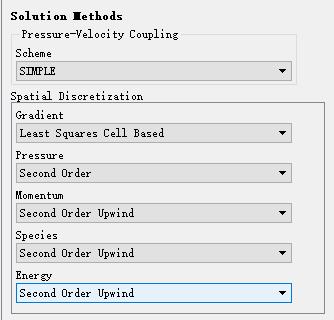
I think I just followed the solution method settings in the paper. Velocity and pressure is coupled with SIMPLE. All terms are discretized with second upwind method.
I don't have access to my computer now. I will confirm the solution method further.
Best regards
weiqiang
-
May 23, 2020 at 1:04 am
Weiqiang Liu
SubscriberHi ,
I have exactly the same mesh with literature. Because the author listed the node number and density in every edge. The author claimed the flame is stable. However, the author also simulated unsteady results and finally the flame would be stable.
Best regards
Weiqiang
-
May 23, 2020 at 6:30 am
Weiqiang Liu
SubscriberHi rahkumar,
Can I ask you a question? how small the net value of sensible heat transfer rate should be at which I can determine that this case is converged according to your experience?
Best regards
Weiqiang
-
May 25, 2020 at 9:11 am
-
May 25, 2020 at 9:26 am
DrAmine
Ansys Employee1% of the most relevant input at your boundaries. Best to have it as small as possible.
-
May 25, 2020 at 9:31 am
-
May 25, 2020 at 9:58 am
Weiqiang Liu
Subscriberhi abenhadj,
Do you mean the net heat flux should be less than 1% of the relevant input? For example, the heat flux of inlet is 58W, therefore , the net heat flux should be 0.58W?Â
Best regards
Weiqiang
-
May 25, 2020 at 12:40 pm
DrAmine
Ansys EmployeeDo not alter the implicit energy URF. Keep it default.Â
Switch to Coupled Solver and check if the behavior is enhanced, if you are concerned about convergence and speed-up of steady-state cases.
Â
And yes regarding the net heat flux and even lower.
-
May 25, 2020 at 1:48 pm
Weiqiang Liu
SubscriberHi Amine,
Thanks very much for your answer! Do you mean that energy URF does not really effect the steady of the whole system?Â
Best regards
Weiqiang
-
May 25, 2020 at 2:21 pm
DrAmine
Ansys EmployeeYou should not reduce the URF of the energy equation as it has a negative impact on the diffusive load (energy equation is diffusive). You will require a lot of iterations to get back to the full load.Â
Â
-
May 25, 2020 at 2:28 pm
Weiqiang Liu
SubscriberHi Amine,
Thanks very much! By the way, is the default URF of energy 1 in fluent?
Best regards
Weiqiang
-
May 25, 2020 at 2:35 pm
DrAmine
Ansys EmployeeFor segregated solver: Yes.
-
May 25, 2020 at 2:39 pm
Weiqiang Liu
SubscriberThanks for your patience
Best regards
Weiqiang
-
- The topic ‘total sensible heat transfer rate to determine convergence’ is closed to new replies.

-
6625
-
1906
-
1469
-
1311
-
1022
© 2026 Copyright ANSYS, Inc. All rights reserved.