Lumerical FDTD solves discrete Maxwell's Equations, and outputs E and H fields in the frequency domain monitors as well as time domain monitors. The Frequency domain monitors can also output the Poynting Vectors and transmission, which are calculated internally from the E and H fields for easy use.
frequency-domain results are the time-averaged. Since Lumerical uses Fourier transform of the time signals to obtain the frequency-domain results, for linear optics and some nonlinear simulations, the results are normalized to source.
Therefore there is no time-averaged power loss equations. If you want to get loss or absorption, a simple way is to use A=1-R-T where R and T are the power reflection and transmission ratio to the source power. Please refer this
Convergence testing process for FDTD simulations
Both R and T are calculated by the same "transmission" script function, with possible negative sign correction to fulfill physics.
It is also possible to get the spatial absorption density, eg A(r,w) where r is the space location and w is the angular frequency. We have a few dedicated analysis groups ready for use:
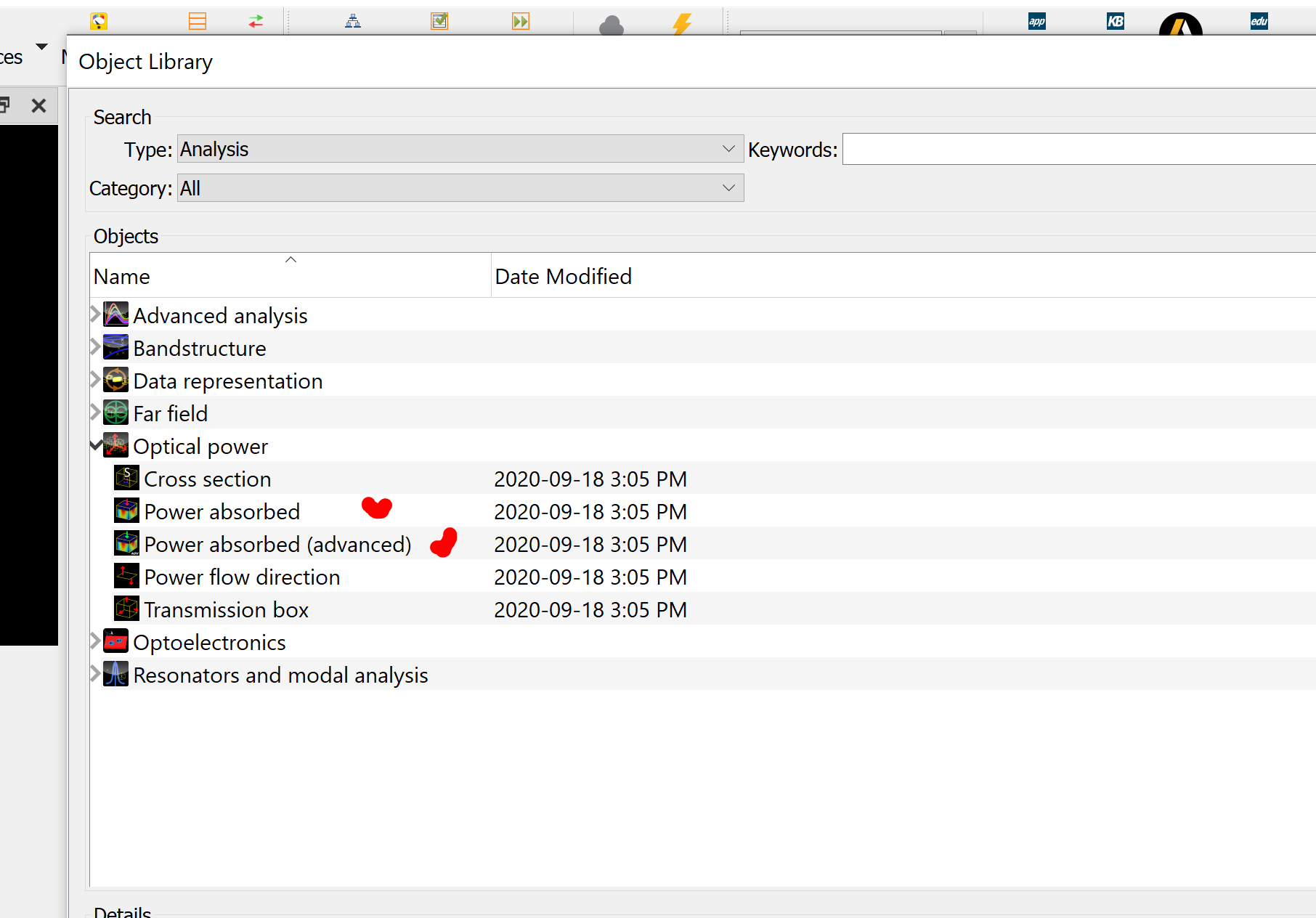
Some examples can be found in Solar and detector simulations:
https://support.lumerical.com/hc/en-us/sections/360007208293-Solar-cell
https://support.lumerical.com/hc/en-us/sections/360007592533-PIC-Active
and other examples.
A side note: for uniform material you can calculate the power loss from the imaginary part of the bulk refractive index. And the loss per injected power watts is better calculated as the loss ratio A so once you know the actual injection source power you can know the loss in Watts, absolute value.
Working with lossy modes and dB/m to ╬║ conversion
If you have a specific device and have related questions, please write another post with some screenshots of the device and some setting.

















 You are navigating away from the AIS Discovery experience