TAGGED: ansys-mechanical, structural-analysis
-
-
January 22, 2025 at 3:52 am
sdbrother
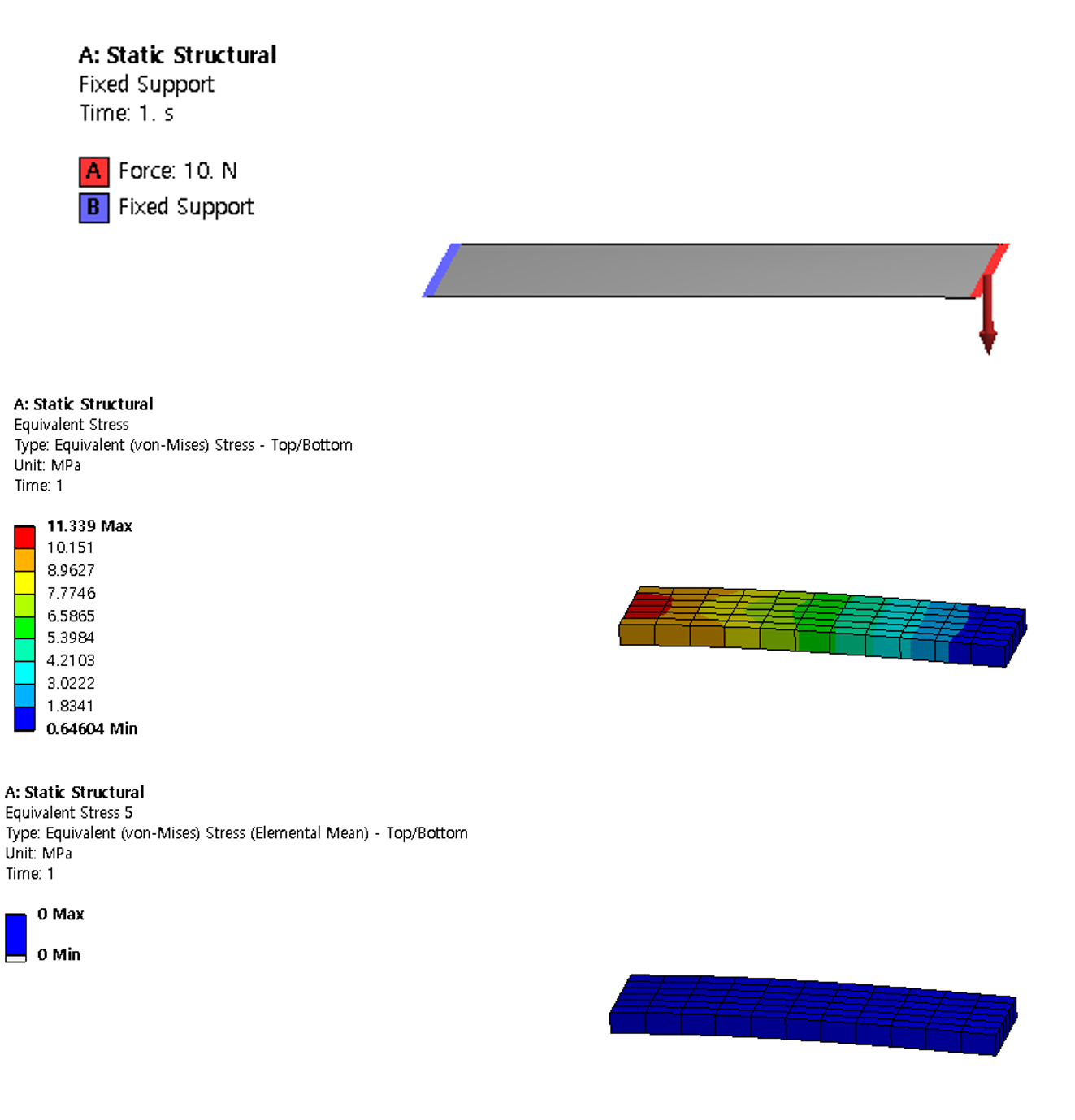
SubscriberWhen the Equivalent Stress in shell structure analysis is set to Elemental Mean, setting the Position to Top/Bottom results in values that are either zero or significantly smaller (compared to when set to Averaged).
Even with through-thickness averaging, I believe that Equivalent Stress should prevent the stresses on the top and bottom from canceling each other out. Is the Equivalent Stress calculated using the averaged stresses, or is there a different method that I might not be aware of?
Additionally, when extracting averaged stress, why do the contours for the top and bottom surfaces appear differently when using Top and Bottom separately instead of the Top/Bottom option?
-
January 22, 2025 at 2:20 pm
-
January 22, 2025 at 11:18 pm
sdbrother
SubscriberThank you for your response.
After reviewing the content in the Mechanical Help, I have additional questions.
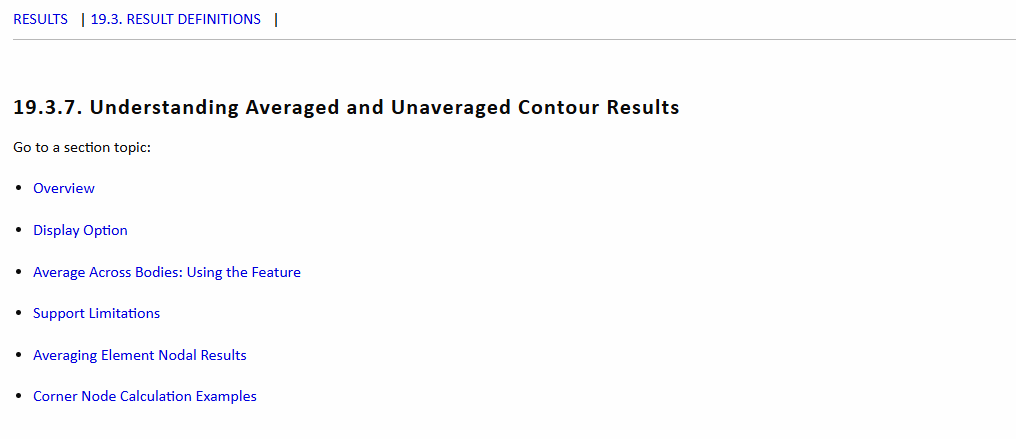
It seems that the options "Averaged" and "Elemental Mean" in the Display Option are derived based on the so-called Nodal Solution. Likewise, "Unaveraged" does not provide a representative value for the stress applied to the element.
Does ANSYS support such an "Element Solution" (for example, something like "Unaveraged + Elemental Mean")?
-
January 23, 2025 at 2:48 am
danielshaw
Ansys EmployeeThe basic method is:
· . The equation of motion (F=KU for a static model) is solved to calculate the nodal DOFs (displacements in a structural FE model)
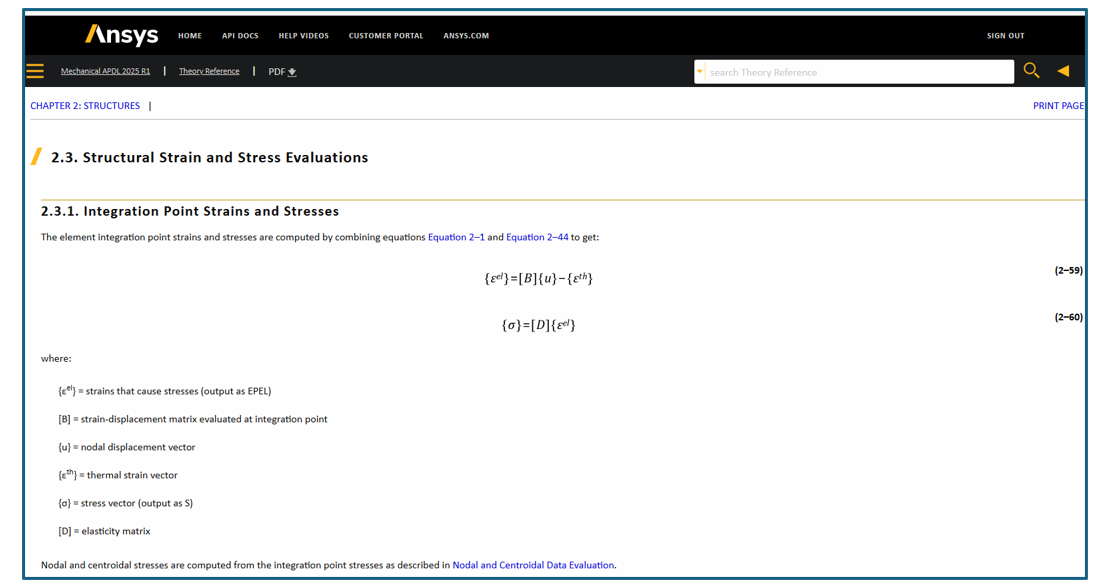
· .The nodal DOFs, the B matrix (strain-displacement matrix), and the D matrix (stress-strain matrix) are used to calculate a set of stresses at each element Gaussian quadrature point (interpolation points) - the number and location of the integration points depends on the element type.
· . The interpolation point stresses are either extrapolated or copied to the nodes to produce the unaveraged element nodal stresses (aka just as the element stresses) - so each node has a set of unaveraged element nodal stresses from each element attached to it.
· . For each node the unaveraged element nodal stresses from each element are averaged to calculate the average nodal stresses (aka just at the nodal stresses)
· . For each element the integration point stresses and the shape functions are used to calculate the element centroidal stresses (elemental mean). Note: It may not matter much whether you average the element nodal stresses or use the integration point stresses to calculate the element centroidal stress, but I believe MAPDL/Mechanical use the integration point stresses.
.The method of calculating nodal and centroidal stresses are explained in Section 2.3.1 of the MAPDL Theory Reference.
It is not clear why you would want to sum the unaveraged element nodal stresses and the element mean stress. What physical meaning would that stress value have?
-
January 23, 2025 at 5:21 am
sdbrother
SubscriberI sincerely appreciate your response.I have some questions regarding the statement you mentioned: "For each element, the integration point stresses and the shape functions are used to calculate the element centroidal stresses (elemental mean)."In the "Display Option" section of the document you referred to, "Understanding Averaged and Unaveraged Contour Results," the following description is provided:Elemental Mean: Computes the elemental average from the averaged component results.I interpreted "Averaged component results" not as "Unaveraged Element Nodal Stresses (aka just the element stress)" but rather as "averaged nodal stresses." In other words, it seems to me that this refers to the averaged nodal stresses applied to the nodes rather than stresses calculated from the integration points and shape functions.The reason I am curious about this is that, up until now, I have used the elemental mean while considering it equivalent to the elemental solution. However, there may be a possibility that they are not the same.If this interpretation is correct, it might explain the results shown in the picture.Even though the same load and boundary conditions were applied, the significant difference between the two values could be due to the fact that the elemental mean is not the same as the elemental solution but instead derived from a different calculation. (For example, it could be the average of directional values derived from the top and bottom, resulting in a value of zero, which is then used to compute the equivalent stress.) -
January 23, 2025 at 2:58 pm
danielshaw
Ansys EmployeeIt is possible that Mechanical uses the nodal stresses to calculate the element mean rather than directly using the integration point stresses. MAPDL and Mechanical sometimes use slightly different algorithms. Both approaches should produce similar element centroid results.
Your image makes sense to me. It is a pure bending cantilever beam model. Physically, the stress at the centerline should be zero.
All stress averaging is done on the component stresses (SX, SY, etc.), not on the derived stresses (S1, Seqv, etc.). The “averaged” derived stresses are re-calculated from the averaged component stresses. In your model, the axial stress is about +11.339 MPa on the top surface and -11.399 MPa on the bottom surface, so the element mean is zero.
-
January 23, 2025 at 10:28 pm
sdbrother
SubscriberThank you very much for your kind response.
Then, it seems that the Elemental Mean may behave differently in body structure analysis and shell structure analysis, as the stresses on the top and bottom surfaces in a shell may cancel each other out during the averaging process.
Is there a way to calculate the Elemental Mean based on the Unaveraged Solution values (rather than using the average of the nodal solutions)?
-
January 23, 2025 at 10:53 pm
danielshaw
Ansys EmployeeShell and solid elements calculate stress differently. Mid-plane stresses are not directly calculated from the DOFs for shell elements. Top and bottom surface stresses are calculated from the DOFs, and the mid-plane stresses are just the average of the top and bottom stresses.
You cannot modify how the mean stress is calculated.
-
- You must be logged in to reply to this topic.
-
6420
-
1906
-
1457
-
1308
-
1022
© 2026 Copyright ANSYS, Inc. All rights reserved.