

-
-
May 19, 2022 at 3:19 pm
Teru123
SubscriberHello,
First things first: I have a pipe thats has an oil flow with 25°C. On the bottom of this Pipe there is a capillary, with a sensor at the end. Now, when everything is filled, i want to heat the oil in the pipe to 350°C. I want to know how long the Capillary has to be so the Temperature on the Sensor is low enough (120°C) so the sensor wont get damaged.
Thats why I wanted to simulate it. I watched some videos and to make it easy I wanted to make something like in the picture attached. I have 2 bodies, one for the Pipe with the 350°C and one for the capillary with 25°C. The walls and the Oil are modelled seperatley so I can have different materials. One for the Pipes and one for the Oil. Now I wanted to add conduction at the outside of the Pipe, simulating the ambient temperature nof 20°C. I wanted to simulatie it as Transient Thermal in the Mechanical program.
Do you think I can do it like that? My professor told me its only to apporach the lenght of the capillary so we have an Idea how long it could be. It isnt the main part of the Thesis.
Or do I need to use ANSYS Fluent?
I hope you can help me, I would appreciate it!
May 20, 2022 at 10:08 amRob
Forum ModeratorIf you can ignore convection terms then Mechanical is fine. You may need to include the metal bits as bodies (I don't know much about Mech as does) for the conduction. I think there are fluid element to mimic the fluid-solid heat transfer too.
We'd use CFD (Fluent or CFX, I'd go with Fluent) if the temperature profile in the main flow was very non-uniform or you needed to consider convection (buoyancy) in the capillary tube. In reality, is the tube material able to mix with the main flow?
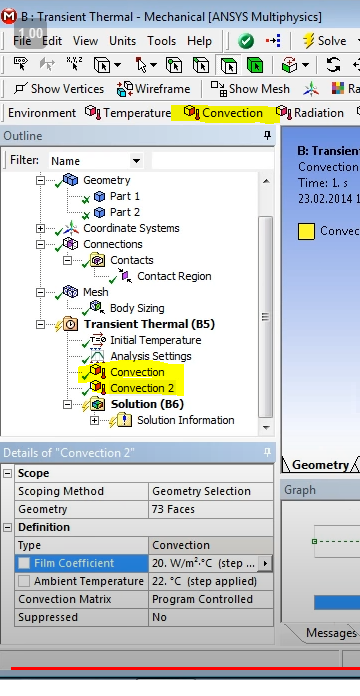
May 20, 2022 at 10:42 amSubscriberThank you for your answer. You say "If you can ignore convection terms then Mechanical is fine". But I watched some tutorials and there I can chose Convection in the Ansys Transient Thermal tool (Image). Or is this something else?
The tube material could mix with the main flow because its the same fluid. But I think it doesnt happen because there is no flow in the capillary am i right? And im installing the capillary under the main pipe, so the warm fluid in the main pipe wont flow up.
May 20, 2022 at 1:17 pmSubscriberSo i had a small chat with my professor. He said that it is essential to consider the convection from the capillary to the ambient air. So I have to use ANSYS fluent right? How exactly do I model the convection? Do I have to define the ambient or just say how much heat is lost to air?
May 20, 2022 at 1:18 pmForum ModeratorNo idea about Mechanical, but there are some heat transfer correlations for pipes/plates so it might be related to that.
You may or may not get some diffusion/mixing depending on size and other factors. It's not a bad initial assumption, but one that I would check on as an examiner/referee might ask.
May 20, 2022 at 5:06 pmSubscriberTo make the simulation as simple as possible and because the capillary is relatively thin, I would ignore the diffusion at first and concentrate on the convection of the pipe to air. Can I do this by defining the bondaray condition of the outside of the pipe as a wall and then define the thermal conditions to conduction?
Viewing 5 reply threads- The topic ‘Temperature in a Pipe with Capillary attached on the side’ is closed to new replies.
Innovation Space Trending discussions
 Top Contributors
-
peteroznewman
 5849
5849 -
scabo
 1906
1906 -
Dennis Chen
 1420
1420 -
javat33489
 1305
1305 -
Shyam Prasad V Atri
1021
Top Rated Tags
© 2026 Copyright ANSYS, Inc. All rights reserved.
Ansys does not support the usage of unauthorized Ansys software. Please visit www.ansys.com to obtain an official distribution.
-
Ansys Assistant will be unavailable on the Learning Forum starting January 30. An upgraded version is coming soon. We apologize for any inconvenience and appreciate your patience. Stay tuned for updates.



 You are navigating away from the AIS Discovery experience