-
-
May 27, 2020 at 8:22 pm
killian153
SubscriberHello everyone,
I try to simulate a convergent-divergent nozzle flow based on this subject https://ntrs.nasa.gov/search.jsp?R=19820006179
Following the method used by these people: https://tfaws.nasa.gov/TFAWS11/Proceedings/TFAWS2011-AE-001.pdf?fbclid=IwAR28cKI5Ghk_hSVQ5ckgZiXs3ibXEyAWBguCsy7cCUrd8aXHURRLa3gRX1E
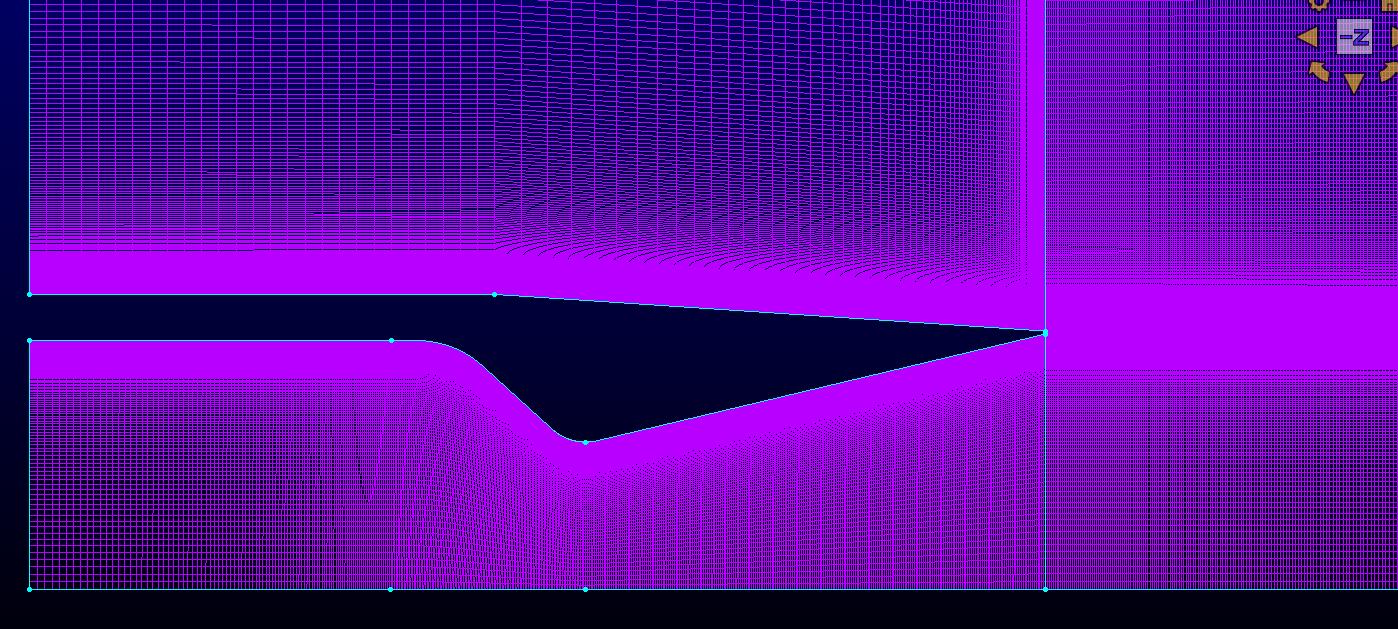
I went from a simulation where I wasn't satisfied about the results I got regarding the pressure coefficient results and the flow separation position. So I came back to my mesh and refined it nicely, with y+ consideration. My new results with a pressure-based method are way better than before, the target y+ is good and the pressure coefficient near the wall finally fits the experimental one.
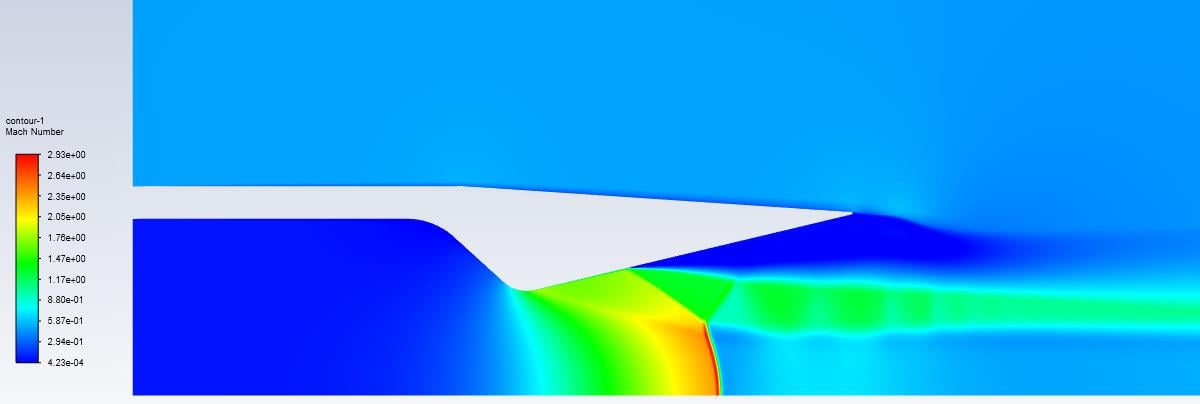
Â
BUT, when I switch to Density-based method, things go wrong. Simulation fails to start well and diverges very quickly. I tried everything : CFL number variation, changing from AUSM to FDS, using standard or hybrid initialization etc.
Â
The methods used are:
- Pressure Based Coupled Solver (PBCS) with 1/ 2nd order for all equations
- Density Based Solver (DBNS) with 2nd order for all equations
Input parameters:
Material: Air (ideal-gas)
Model: SST k-omega (2 equ.)
Boundary conditions: 1 pressure inlet (2.5 atm), 1 pressure outlet (1 atm)
Solution method: AUSM - Least square - 2nd order
Initialization method: Hybrid or Standard
Â
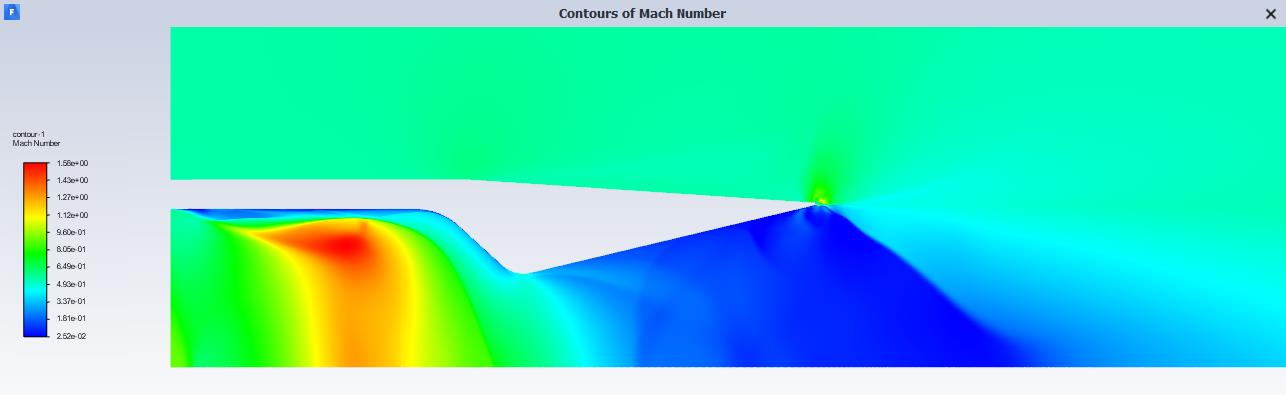
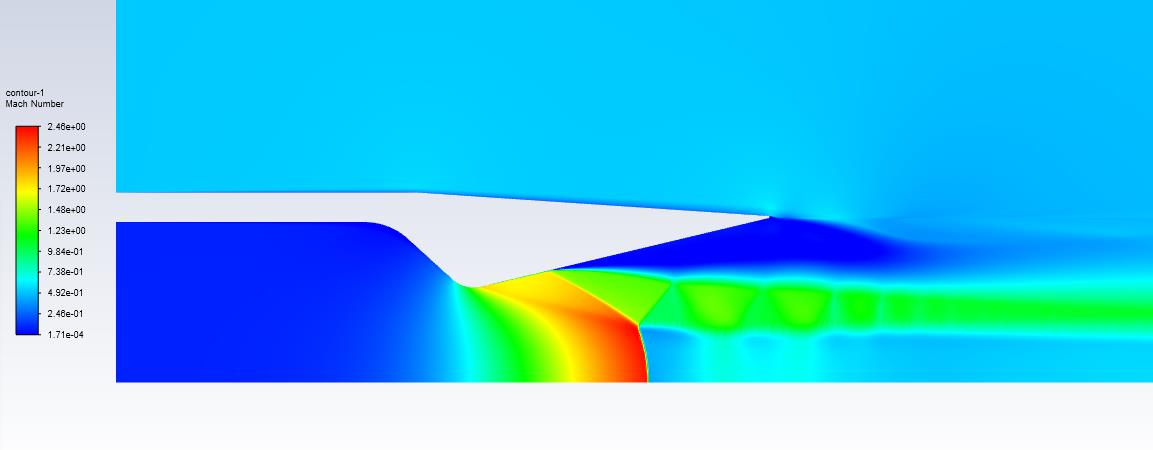
It seems like a shock wave is created at the first iteration (ignoring the initialization) and is at the origin of the divergence.
I screened the first iterations :
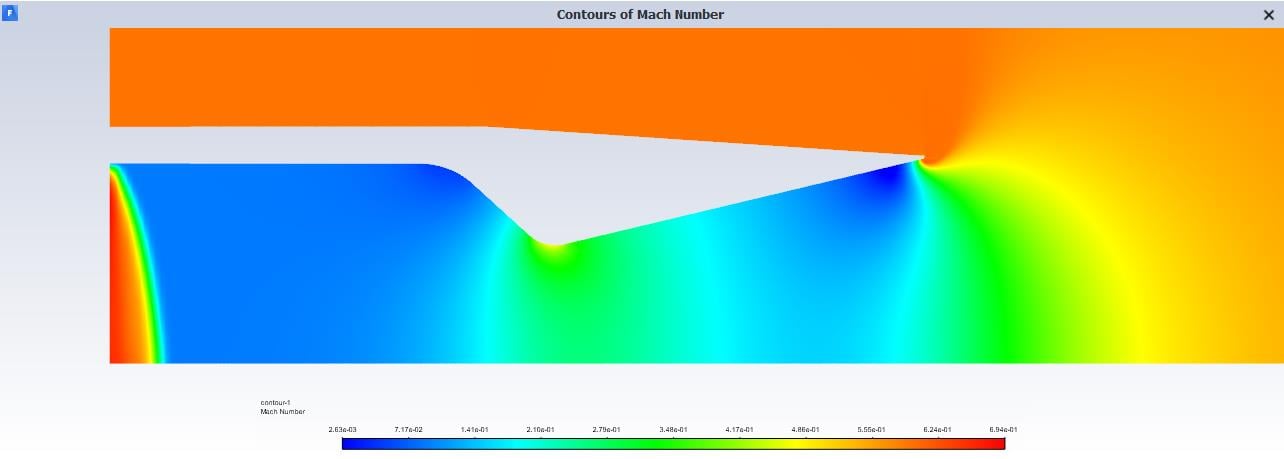
Â
Â
Do you have any idea what could be the origin of this failure?
Â
Best regards.

-
May 27, 2020 at 9:12 pm
Kalyan Goparaju
Ansys EmployeeHello,
Can you try using 1st order schemes to launch the simulation and if/once the solution settles, change them to 2nd order?
Thank you,Â
Kalyan
-
May 27, 2020 at 9:56 pm
-
May 27, 2020 at 11:32 pm
-
May 28, 2020 at 1:40 am
Rahul Kumar
Ansys Employee Hello,Â
When you using DBNS, can you try with explicit formulation and let us know what you get.Â
-
May 28, 2020 at 6:28 pm
-
May 28, 2020 at 7:36 pm
Kalyan Goparaju
Ansys EmployeeHello,Â
Shock waves are discontinuities in the flow which create instabilities. By using first order, you are artificially adding a lot of dissipation and ensuring that any numerical instabilities/disturbances are smoothed out. It is always best to "establish" a reasonable flow-field and then switch over to high order schemes to ensure stability of the numerical scheme.
Thanks,Â
Kalyan
-
May 28, 2020 at 7:55 pm
killian153
SubscriberOk I see, so this fact increases with the mesh quality? I mean, with a poor mesh I was able to start at 2nd order directly, but not with the actual mesh.
And do you now why I can't get the right results? Is my CFL = 1 too high? With Implicit formulation CFL should not be too high with this value.
Thanks.
-
June 1, 2020 at 4:18 am
Kalyan Goparaju
Ansys EmployeeWith a poor mesh, you are diffusing the shock. So, it might be helping you in stabilizing the solution.Â
CFL=1 is a good choice. In fact, you can even go higher when using an implicit formulation. Unfortunately, without digging into the depths of the problem, I don't think I can comment on the cause for discrepancy in the results.Â
Thanks,Â
Kalyan
-
June 1, 2020 at 10:35 am
killian153
SubscriberHello Kalyan
Indeed, I've seen that CFL can be way higher with Implicit.
I would really like to go in the depths of the problem. Do you think we should start with the mesh? Can I send you the .cas file containing the mesh?
Best regards
Killian -
June 1, 2020 at 12:45 pm
Kalyan Goparaju
Ansys EmployeeHello Killian,Â
Unfortunately, support through this forum is limited to providing guidance and debugging (when possible) only. If I were to debug the problem, I would definitely start with the mesh.Â
Thank you,Â
Kalyan
-
June 5, 2020 at 10:08 am
killian153
SubscriberHello Kalyan,
So to solve my problem I went back to the mesh as you recommended. I decided to reduce the number of boundary layers at the nozzle wall, in order to make the shock diffusion easier while keeping my targeted y+. Indeed, my thoughts were that too many thin boundary layers could make shock wave attachment to the wall really difficult.
And it worked! I reduced the boundary layers to 20 with a 1.2 growth rate and now I have good results even when starting directly with 2nd order.
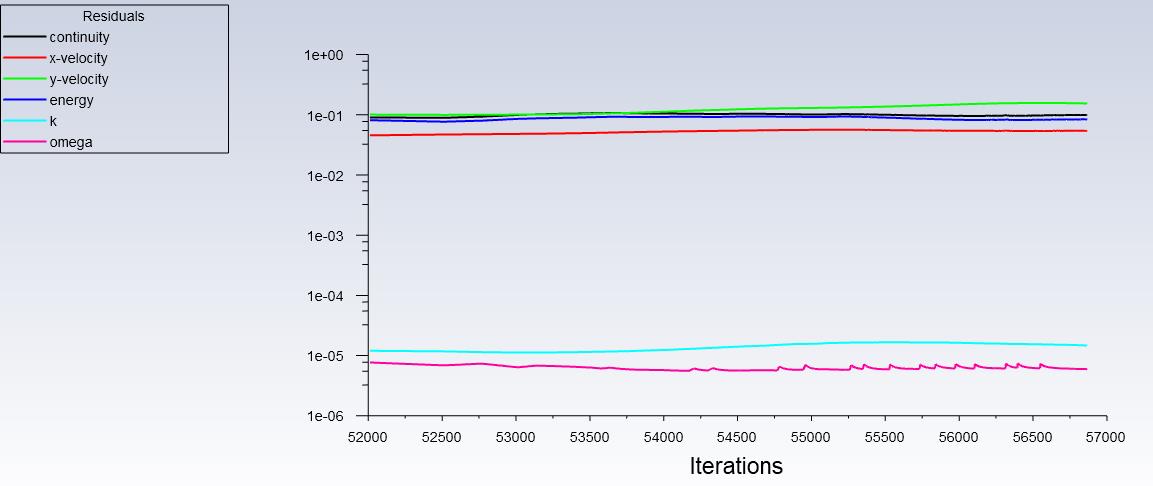
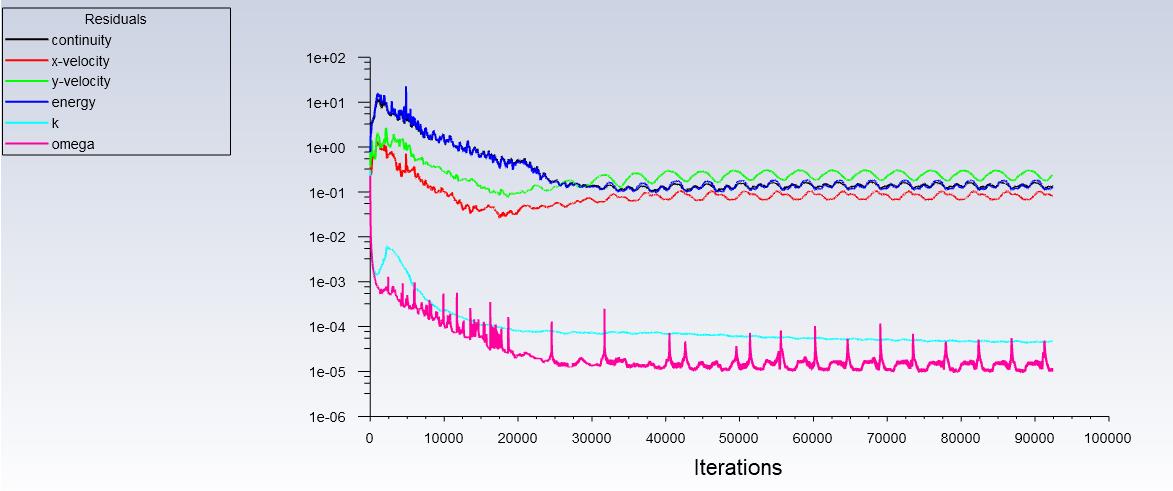
Just a question: how do I know when my solution is converged/finished? I mean, as you can see below, it seems that after 40000 iterations I have a some stability and cycle pattern.
Â
Thank you!
-
June 5, 2020 at 1:18 pm
Kalyan Goparaju
Ansys EmployeeHello,Â
I am glad that you were able to work things out. The default setting for convergence is for the residuals to fall below a threshold of 1e-03. If there is any unsteadiness in the flow, the residuals generally start oscillating. This behavior is usually the cue for conducting a transient analysis to check for the cause of unsteadiness. If you know for a fact that you should get a stead-state solution, but the residuals are flat/oscillating instead of monotonically going down, I would recommend reducing the under-relaxation factors for the 'higher' residuals and checking if that helps stabilize the simulation and take it to convergence.Â
Thanks,
Kalyan
-
June 6, 2020 at 8:10 pm
killian153
SubscriberHello,
How do I know which URF I should reduce? And do I have to restart the solution? In my solution controls I have:
- Turbulent kinetic energy : 0.8
- Specific dissipation rate : 0.8
- Turbulent viscosity : 1
- Solid : 1
My residuals seem to show that 4 residuals cannot converge (continuity, x-velocity, y-velocity and energy).
Thanks.
-
- The topic ‘Successful simulation (with Pressure-based method) diverges with Density-based’ is closed to new replies.
-
4678
-
1565
-
1386
-
1241
-
1021
© 2025 Copyright ANSYS, Inc. All rights reserved.