-
-
April 29, 2020 at 1:46 pm
konsmi
SubscriberHello Community,
I am studying the material properties of an interface between two bodies.I used the Separation Distance based Debonding option of cohesive zone(CZM)Â in workbench.I would like to know if I am able to combine this option with another properties option in engineering data like isotropic elasticity.These two options work together and affect my model properly as a combnation of material properties or there is no correlation between them and I should select them independently?
I am not able to find any information about this query and I would be glad to read any opinion on this topic.
Thank you in advance.
-
April 29, 2020 at 6:34 pm
Wenlong
Ansys EmployeeHi,
Isotropic elasticity will be used for the base materials not the cohesive zone materials. So you cannot combine it with CZM.
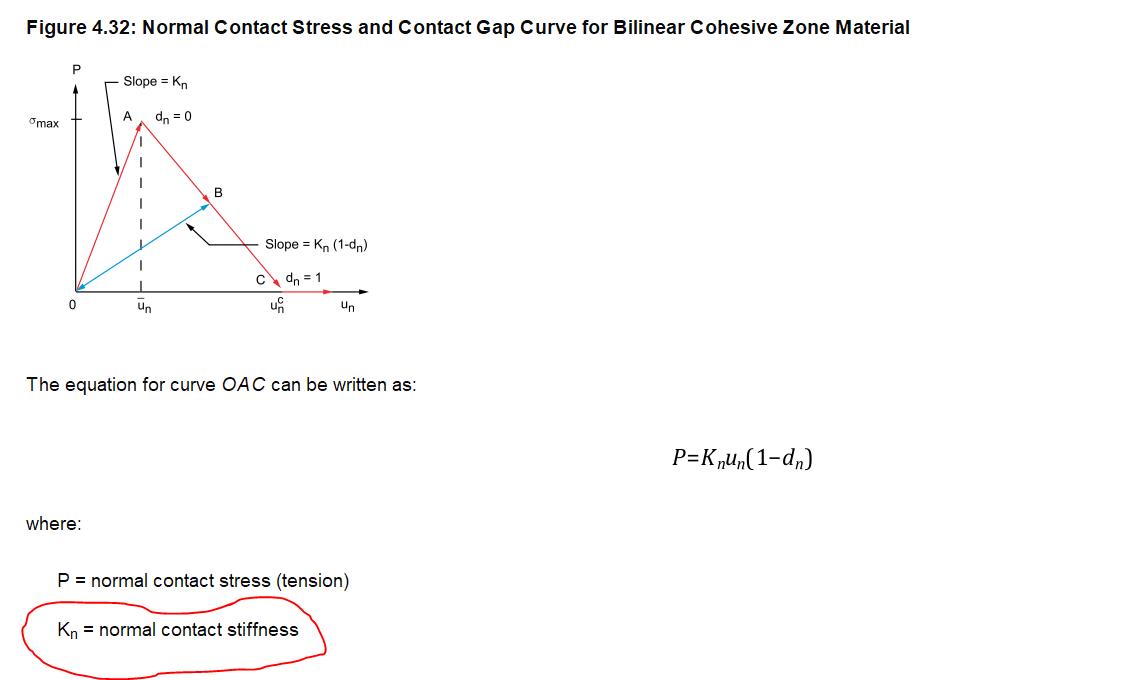
If you are using the Separation Distance-based debonding option of CZM, that Young's modulus you applied in Isotropic elasticity for base material will influence the normal contact stiffness, and in turn affect the initial slope Kn of the CZM.Â
More information can be found here:
1. Cohesive Zone Material (CZM) Model
2. Cohesive Material Law APDL commands
3. Cohesive Zone Materials Used for Debonding
Regards,
Wenlong
================ Note ====================
If you have trouble opening the links I attached, please see the first useful link below
Â
Â
Useful Links
- How to access Ansys Online Help Document
- How to show full resolution image
- How to use Google to search within Ansys Student Community
Â
-
April 29, 2020 at 6:58 pm
konsmi
SubscriberThank you very much for the response.
I want to study the elasticity of the interface in my model.I thought a combination of isotropic elasticity and CZM would be an option to simulate the properties of the interface of my model.Since this is not possible could you suggest me another way ?
In addition what do you mean with the phrase 'for the base materials'?Are the materials where the interface(CZM) is applied on?
Kind regards.
-
April 29, 2020 at 8:38 pm
Wenlong
Ansys EmployeeHi konsmi,
Yes, that's what I meant for base materials.Â
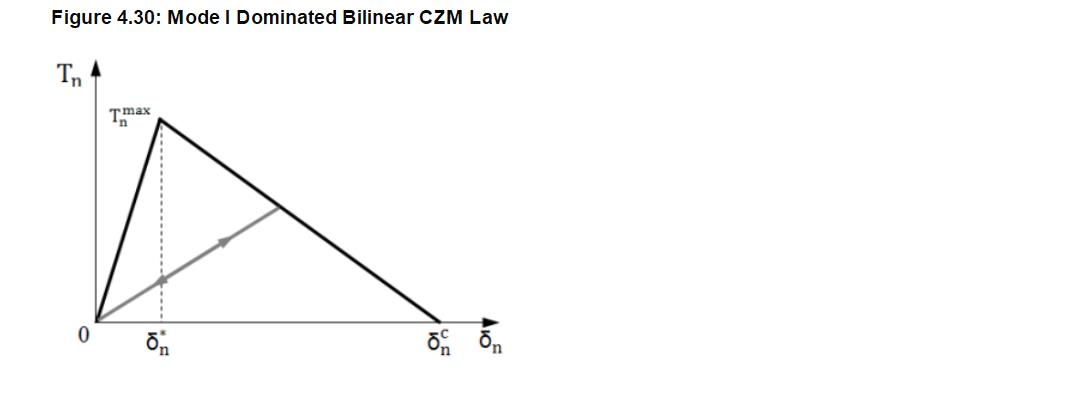
To achieve your purpose, you can try "bilinear for interface delamination" in CZM. Although the initial stiffness is not a direct input, you can control it by defining the "Ratio", which is the ratio of delta_n_c over delta_n_star shown in the figure below. This Ratio is the same for both mode I and mode II. Please let me know if this is clear. Again, you can refer to this page for more information: cohesive zone model
Regards,
Wenlong
Â
-
April 29, 2020 at 10:43 pm
konsmi
SubscriberThank you again very much for the response Mr Wenlong.
I read the information in ANSYS HELP page but I am not sure that I understand completely the function of "bilinear for interface delamination" in CZM. This Ratio has a correlation with the elasticity(young's modulus) of the interface that I want to research? With the term "traction" is meant the maximum contact stress(σmax)?Also,what is the input value of "non dimensional weighting parameter" if I want this parameter not to influence my analysis?What is its definition?
I want to apologize for all these questions but this topic is not very familiar to me.I would be thankful if you could provide me with further information.
Kind regards.
-
April 30, 2020 at 12:24 am
Wenlong
Ansys EmployeeHi konsmi,
Yes, the ratio is correlated to the elasticity of the interface. The initial stiffness (the slope of the ascending part of the line) in bilinear law can be taken as Young's modulus. It equals sig_max/delta_n_star, and delta_n_star = delta_n_c*Ratio. (Sig_max, delta_n_c, and Ratio are inputs)
When there is mixed mode, the mixed-mode separation is calculated using mode I and mode II separation by the following equation, and beta in the equation is the weighting parameter. This can also be found in the link I shared in the previous post.Â
Regards,
Wenlong
Â
-
April 30, 2020 at 12:55 am
konsmi
SubscriberThank you for the quick answer Mr Wenlong.I think it's more clear now after your explanation.
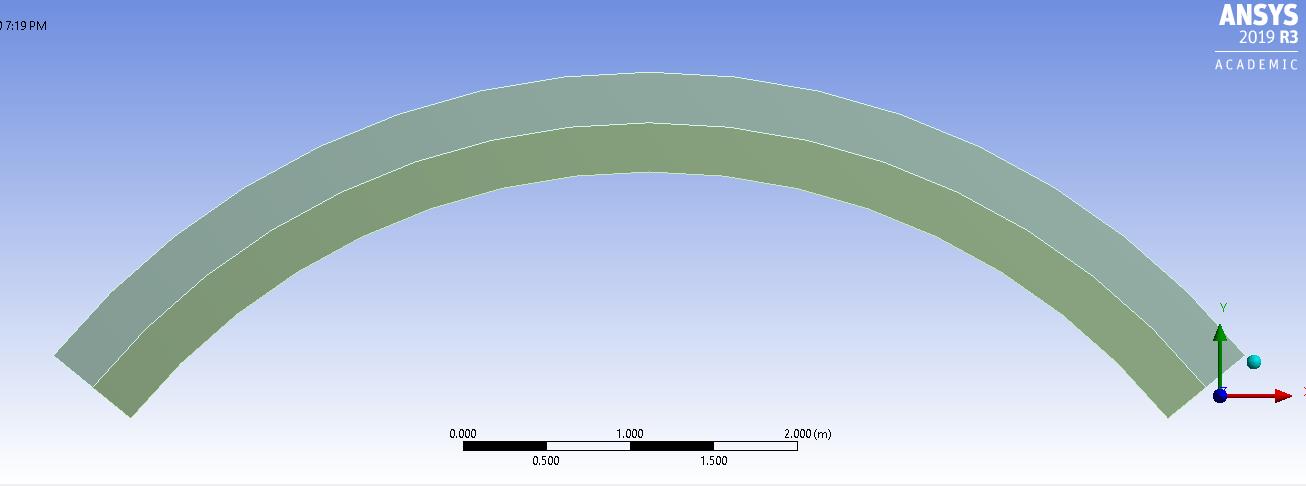
I tried to import the interface delamination in my model but problems occured both for matched meshing and node matching.For instance, in node matching option I got the message "An error occured while trying to find matching element faces for interface elements.Please ensure that a matching element pattern exists on delamination faces." Below a picture of my geometry is attached.Do you know why this happens?(At the side of interface delamination in project settings, I get the sign that it is properly designed.)

Kind regards.
-
April 30, 2020 at 2:22 pm
Wenlong
Ansys EmployeeHi konsmi,
I found this discussion about the same issue. Please let me know if it is helpful.
https://www.researchgate.net/post/Help_with_ANSYS_Interface_Delamination
Regards,
Wenlong
Â
-
April 30, 2020 at 4:15 pm
konsmi
SubscriberGood evening Mr Wenlong.
Yes it is helpful and I think that I am able to run an analysis.Thank you.
I would like to ask you if there is any difference in the results if bonded contact is active or suppressed in the delamination option,because it's not necessary condition in order to be applied like contact debonding.
In addition the ratio which you mentioned in the previous posts is equal to 0.1-0.9(<1)?
Kind regards.
-
April 30, 2020 at 6:29 pm
Wenlong
Ansys EmployeeHi konsmi,
If you are using interface elements, then bonded contact should be suppressed.Â
Right, that "Ratio" should be between (0,1), because if you look at the Bilinear CZM law plot, the delta_n_star (in x-axis) should not exceed delta_n_c (in x-axis). Thus Ratio = delta_n_star/delta_n_c should be smaller than 1.Â
Regards,
Wenlong
Â
-
April 30, 2020 at 9:03 pm
konsmi
SubscriberWith "using interface elements",you mean the interface delamination method?There is a way to know when I use interface elements or it depends on the method?
Also if I'll apply a load(displacement or force) in compression or in tension,then the bonded contact in delamination method should be supressed?
I hope these are my last queries. Thank you again for your time and your quick responses.
Kind regards.
-
May 1, 2020 at 9:49 pm
Wenlong
Ansys EmployeeHi konsmi,
There are two approaches in Ansys Static Structural I know of to simulate delamination using CZM: interface approach and contact debonding approach, and these two are exclusive.Â
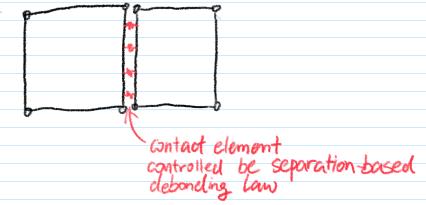
The interface approach uses "zero-thickness cohesive elements (also called interface elements)" to model the interface properties (an illustration is shown below). In this approach, two solid elements are connected by a cohesive element, and that cohesive element has some stiffness (the initial slope we talked about before), thus no contact is needed.
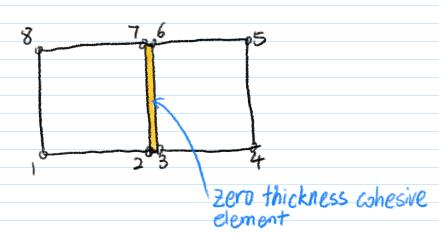
The second approach is using contact debonding. In this one, the CZM is modeled by contact element (you don't need to manually create contact element, the solver handles it in the backstage, all you need is to create penalty-based bonded contact).Â
Feel free to let me know if you have any questions.
Regards,
Wenlong

Â
-
May 4, 2020 at 7:48 am
konsmi
SubscriberHello Mr Wenlong,
Thank you very much for the explanation,as well for your valuable advice which extremely helped me with my project.
Kind regards.
-
May 19, 2020 at 11:23 pm
konsmi
SubscriberHello Mr Wenlong,
I hope you are doing well.
As I read in theory there are three modes for Bilinear for Interface delamination option in CZM(Mode I,Mode II,Mixed).
I would like to ask you how could I know which mode option I use each time in my model?How do I control it? For example, in Separation-Distance based Debonding there is Debonding Interface Mode property allowing to choose your preferable mode.
Kind regards.
-
May 20, 2020 at 1:41 pm
Wenlong
Ansys EmployeeHello Konsmi,
I would use Mixed mode since it is a general case. If in your model there is only normal separation, then it will be equivalent to Mode I. If in your model there is only tangential separation, then it will be equivalent to Mode II.Â
Regards,
Wenlong
Â
-
May 20, 2020 at 1:49 pm
konsmi
SubscriberThank you for your quick response.
Something in addition. The input value of the ratio in properties of  Bilinear for Interface delamination option in CZM is correlated both for normal and tangential separation?
Kind ragards.
-
May 20, 2020 at 2:59 pm
Wenlong
Ansys EmployeeYes, that ratio is used and is the same in both normal and tangential separation. You can verify that by checking the notations in https://ansyshelp.ansys.com/account/secured?returnurl=/Views/Secured/corp/v194/ans_thry/thy_mat11.html
Regards,
Wenlong
Â
-
May 29, 2020 at 1:45 pm
konsmi
SubscriberGood evening Mr Wenlong,
I would like to ask you if it is possible to combine interface delamination option with another standard non linear contact(for instance frictionless) in Ansys Mechanical.
In addition something different from all the aforementioned queries, I am conducting a concrete non linear analysis and I would like to ask you which model of geomechanical(for instance drucker prager model?) is better for a 2d non linear analysis in static structural.
Kind regards.
-
- The topic ‘STRUCTURAL ANALYSIS_COHESIVE ZONE’ is closed to new replies.
-
5869
-
1906
-
1420
-
1306
-
1021
© 2026 Copyright ANSYS, Inc. All rights reserved.