-
-
March 2, 2020 at 5:32 pm
Stefanie97
SubscriberHello everybody,
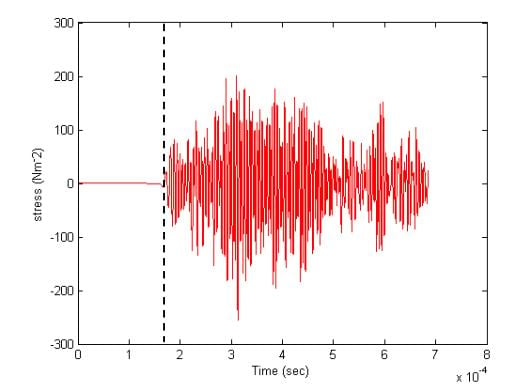
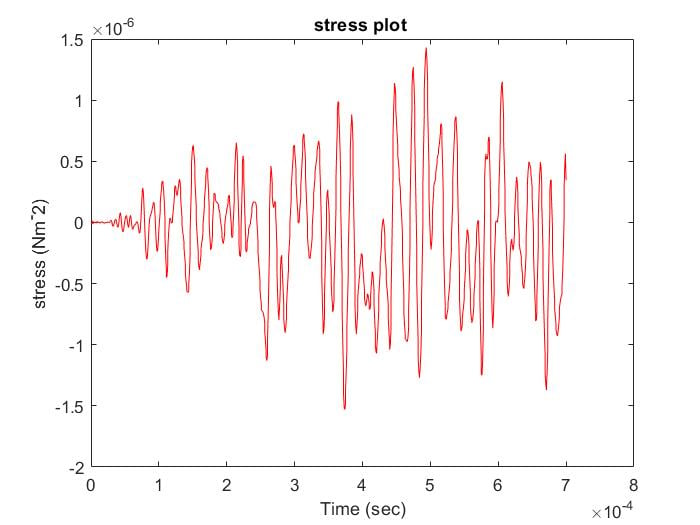
I want to simulate and measure the development of stress waves in a structure at different distances from a loading point. For this purpose, I performed a transient analysis, defined a time-dependent force and generated coordinate systems at different distances. Now I wanted to determine the stress at the respective points with stress probes at the coordinate systems. Unfortunately, the results are not as I expected. Normally you should be able to see the arrival time of the stress wave and this should increase with increasing distance. I have attached pictures of how the results should be and how they actually are. I have the assumption that the analysis at the different points does not start at time 0 but when first reactions in the structure occur. Can someone please help me with this? -
March 2, 2020 at 6:58 pm
peteroznewman
SubscriberPlease insert an image in your reply with the geometry, the face that is being loaded and the face that is the fixed support. What is the length from the load point to the point you are monitoring? What is the wave speed in the material? Are there any other loads at T=0?
ANSYS staff are not permitted to open attachments so I have inserted your attached images below.
Expected...
Simulation result...
-
March 2, 2020 at 7:09 pm
Stefanie97
SubscriberThe geometry is a section of a wind turbine blade and the force is applied to a small circular area (green on the following pictures). I applied a fixed constraint to both ends of the model and I want to measure the reaction in 1 m, 2 m and 3 m from the loading point. I've included a graph of the time-dependent load. With the analysis I wanted to determine the wave speed of the material (I used the Epoxy E-glass material from the Granta Design material database) so I do't have a value for this yet.
-
March 3, 2020 at 12:51 am
peteroznewman
SubscriberThe speed of sound for compressive waves in a solid is simply
v = sqrt(B/rho) where B is the Bulk Modulus and rho is the Density.
Here is the material spec for ABS in Engineering Data.
So the compressive speed of sound in ABS = 1,947 m/s.
There is also a shear wave, which has a velocity = sqrt(G/rho) where G is the Shear Modulus.
The shear wave speed for ABS is less than the compressive speed at 906 m/s.
It seems you will give a transverse excitation to a thin wall part, so the shear wave will probably dominate in this model.
-
March 3, 2020 at 10:52 am
Stefanie97
SubscriberIt makes sense that the shear wave dominates. What I do not understand, however, is that the arrival time for the wave does not increase with increasing distance (I add all three results for 1m, 2m and 3m distance from the force). I don't know if I can change anything in the simulation settings to map the arrival speed.
1 m
" alt="" width="401" height="301">
2 m
-
March 3, 2020 at 12:54 pm
peteroznewman
SubscriberYou may need more elements through the thickness of the wall to properly transmit the pressure wave.
I recommend you make a simple rectangular cross-section beam, and have a 4x4 grid of elements on the cross-section. See if you can get the effect on that simple geometry first. Plot displacement instead of stress. It has less noise in the data.
Then convert that simple rectangular beam to be shell elements and see if the effect remains the same. If it does, then convert your wing to a midsurface mode land mesh with shell elements.
-
- The topic ‘Stress waves simulation with a transient structural analysis’ is closed to new replies.

-
6450
-
1906
-
1457
-
1308
-
1022
© 2026 Copyright ANSYS, Inc. All rights reserved.