TAGGED: ansys-forte, cyclic-symmetry, diesel-engine
-
-
June 26, 2026 at 12:32 pm
elias.amancio
SubscriberHello,
I am setting up a closed-cycle simulation of a diesel engine combustion chamber (from Intake Valve Closing (IVC) to Exhaust Valve Opening (EVO)) and I have a question regarding the use of symmetry in my model.
The cylinder head is flat, and the fuel injector is located exactly at the center of the head, which makes the geometry favorable for the use of symmetry.
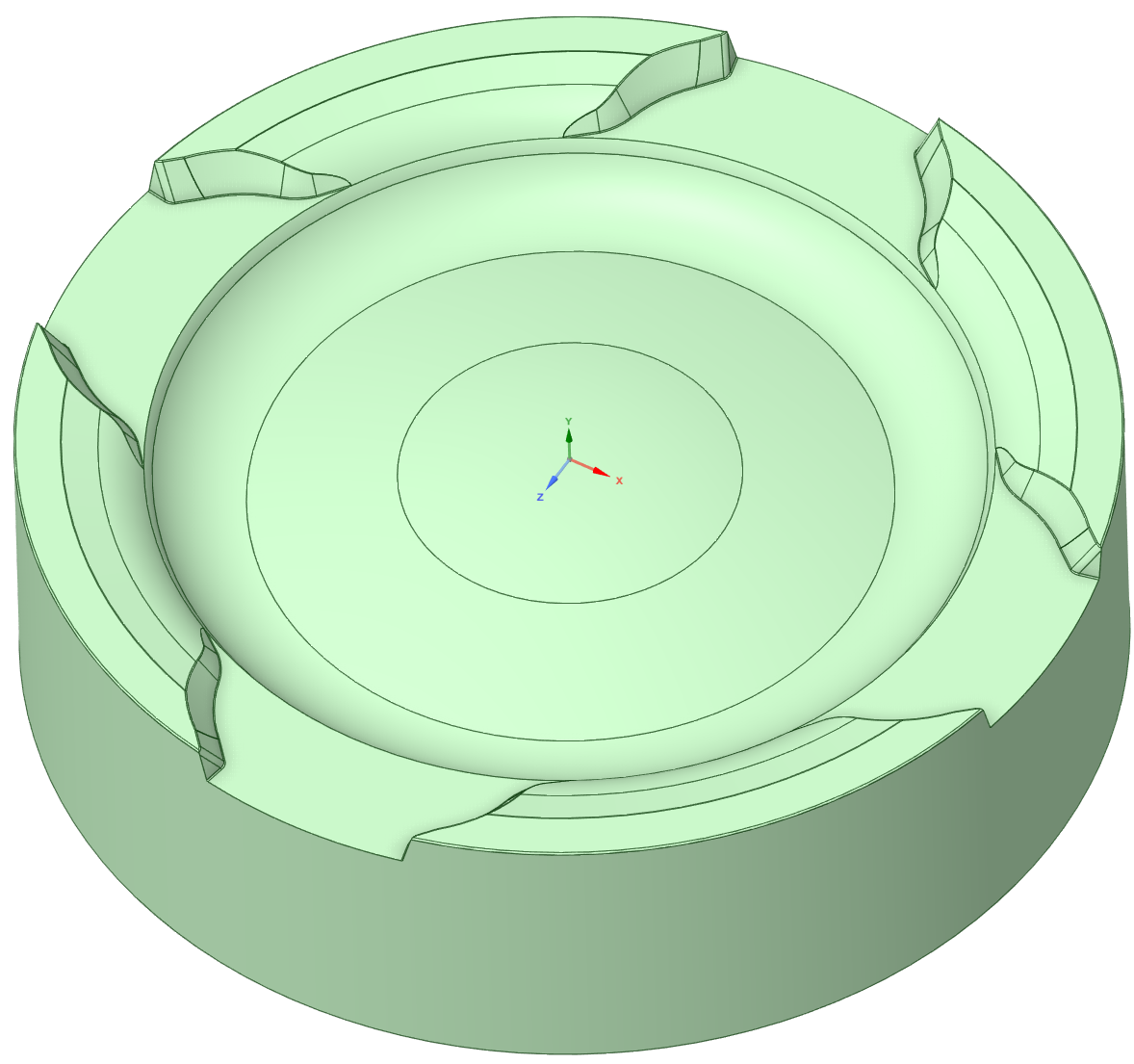
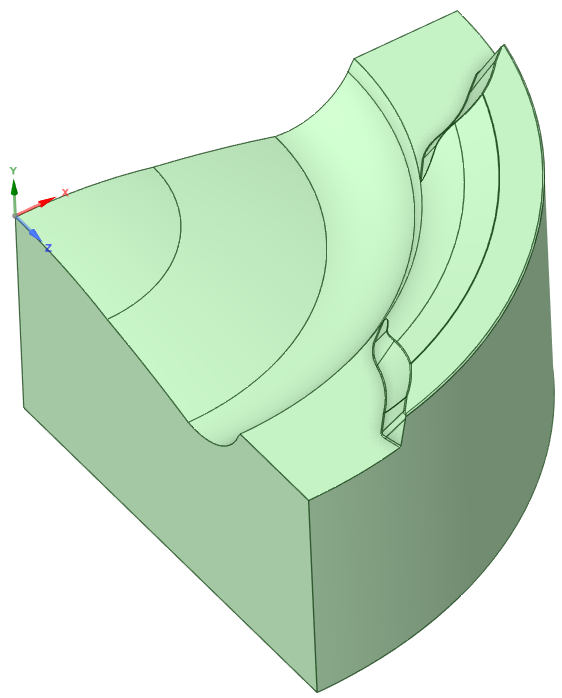
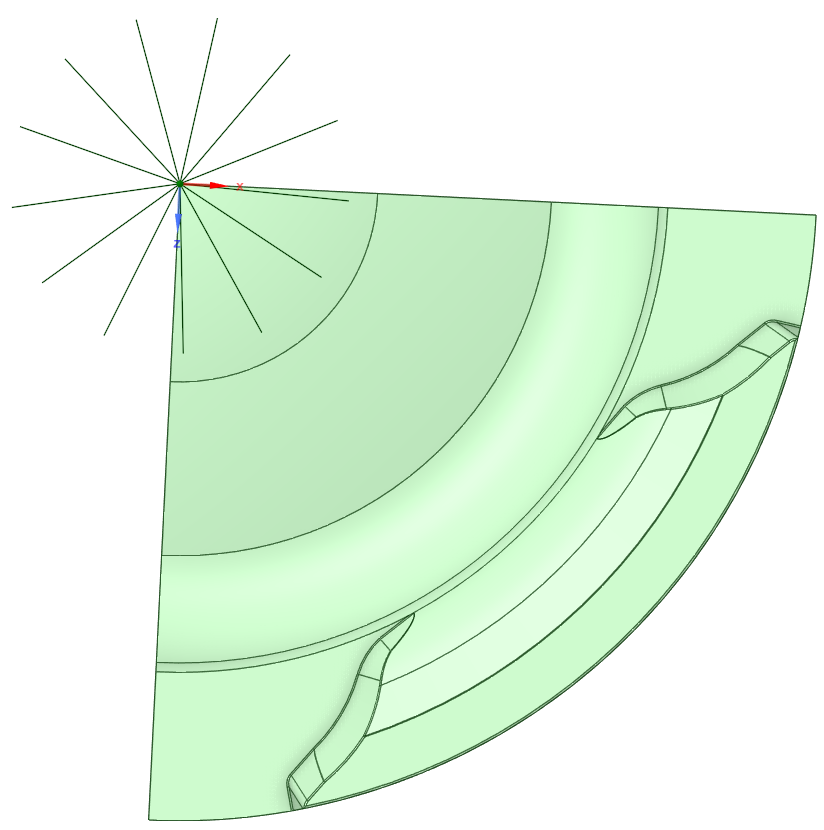
The piston bowl is somewhat complex, but it has a 90° rotational symmetry, as shown in the images below.
Â
The issue is that my injector has 13 nozzle holes. If it had 12 holes, a 90° sector would naturally contain 3 nozzles, making the setup straightforward.
However, with 13 holes, defining the nozzles in the sector becomes somewhat awkward. The nozzle holes near the sector boundaries end up very close to the symmetry planes, so the corresponding spray solid cones appear to be partially inside and partially outside the computational domain, at least visually.
Since this is a relatively large combustion chamber, running a full 360° simulation would be computationally expensive.
Do you have any suggestions on how to handle this situation?
Thank you in advance.
Best regards,
Elias
-
June 26, 2026 at 1:59 pm
Rob
Forum ModeratorIf you use 13 injections onto a 90 sector you also risk adding far too much liquid into the one sector that gets the "spare" diesel spray. So.... You could switch to 12 injections and correct for mass, model 180 degree sector with 6.5 injections or model the full domain. As you're unable to do the latter I'd seriously consider on fewer diesel injections.Â
-
June 26, 2026 at 2:44 pm
elias.amancio
SubscriberFrom what I understand, the two most practical options at this point are either:
simulating the full 360° combustion chamber with all 13 injector holes, or
simplifying the injector to an equivalent 12-hole configuration and simulating a 90° sector with three nozzle holes.
I have already been able to run several cold-flow simulations (without fuel injection) on the full combustion chamber using Adaptive Mesh Refinement (AMR). The approximate initial cell counts were:
10 mm global mesh: ~160,000 cells
7.5 mm global mesh: ~350,000 cells
5 mm global mesh: ~900,000 cells
3 mm global mesh: ~3,000,000 cells
A 2 mm global mesh could not be completed because the simulation ran out of available memory.
My concern is that once fuel injection through all 13 nozzle holes is included, together with the additional AMR required around TDC to accurately resolve the spray, mixing, and combustion processes, some of these mesh configurations may become computationally impractical.
The ANSYS Forte Best Practices Guide recommends a 2 mm global mesh, but for a model of this size that does not appear to be feasible with the computational resources currently available.
I understand that performing a proper mesh independence study and validating the predictions against experimental combustion data are essential steps, and those are planned as the next stage of this work.
From a CFD standpoint, would you consider using a coarser global mesh, such as the ones I am currently testing, to be fundamentally inadequate for capturing the relevant flow structures, turbulence, spray development, air-fuel mixing, and combustion behavior? Or is it reasonable to rely on AMR to recover sufficient local resolution in the critical regions while accepting a coarser background mesh?

-
June 26, 2026 at 3:32 pm
Rob
Forum Moderator I can't comment on Forte as I don't use that solver. I'll flag to the wider team as my Forte expert is on holiday. Apologies, I missed the tags.Â
From a general standpoint, an over reliance on adaption can cause the mesh to steer the solution to some extent - so some caution is needed, especially if the initial mesh is coarse. From a compute resource standpoint, if you can't afford more cells the result is likely the best you will get: you need to then decide if it's good enough for your need, or whether you need to get a bigger computer.Â
Â
-
- You must be logged in to reply to this topic.
-
6765
-
1906
-
1490
-
1330
-
1127
© 2026 Copyright ANSYS, Inc. All rights reserved.