Hello,
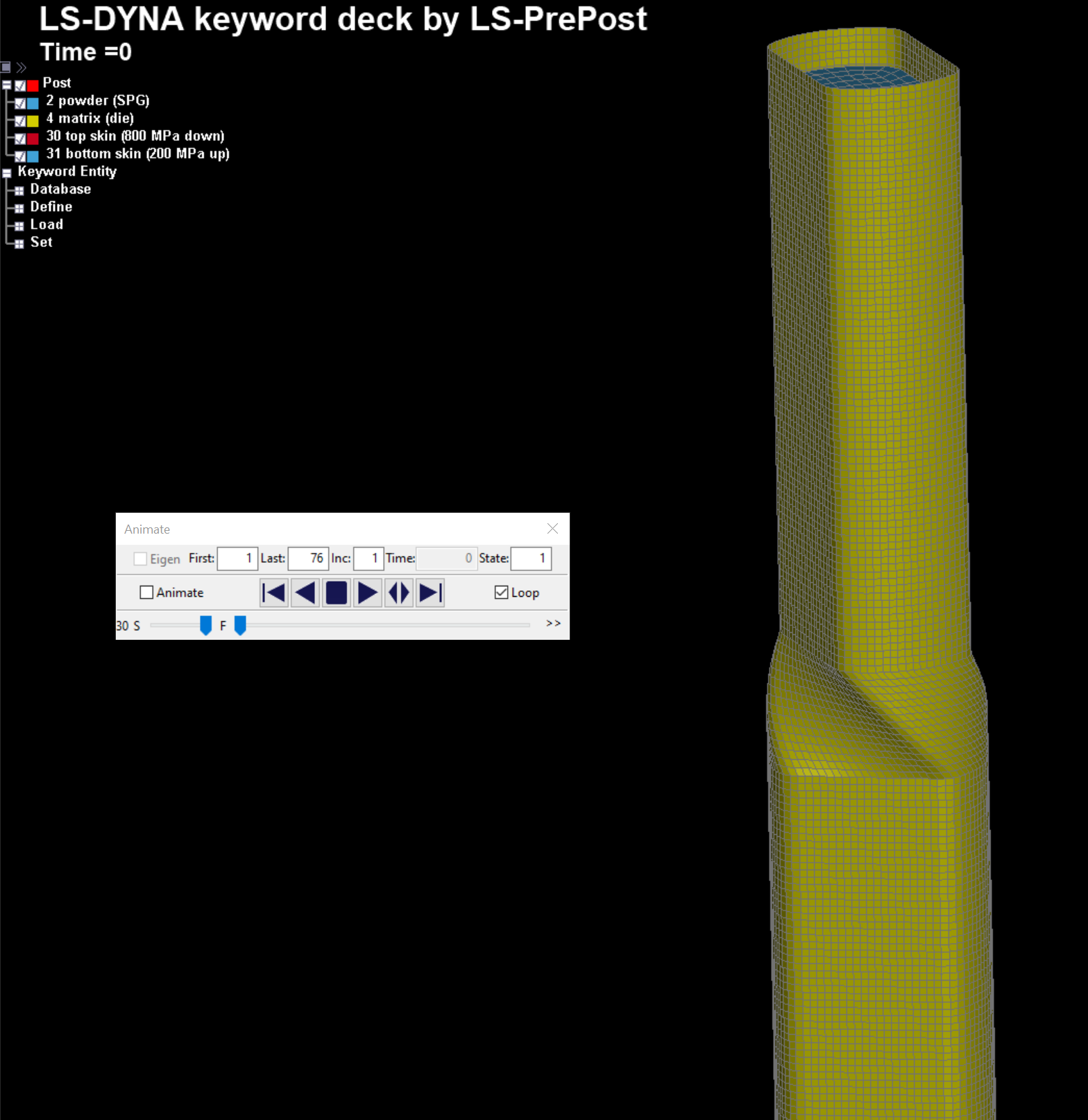
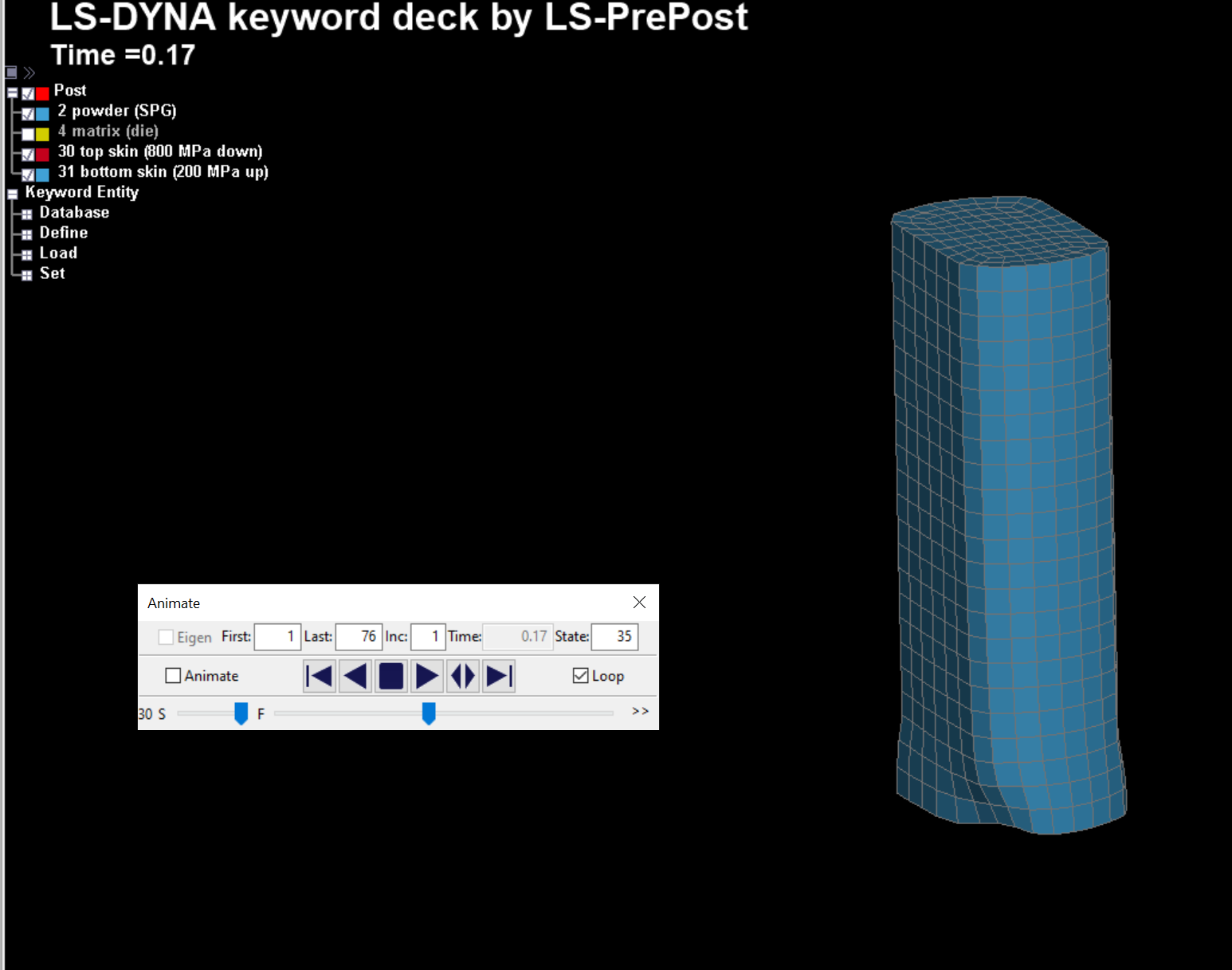
I am simulating twist extrusion (helical/ECAP-type die) of Ti powder using SPG
(ELFORM 47) with LS-DYNA R16.1.1 MPP double precision, 12 cores.
MODEL
- Billet: SPG solid, MAT_CSCM (cap model), relative density 0.70,
rate effects disabled, softening disabled.
- Die: rigid shells; contact via *DEFINE_SPG_TO_SURFACE_COUPLING (SPGP=powder,
SURF=die segment set).
- Helical section: cross-section rotates ~64 deg over 18 mm of channel length.
- Loading (both tried): (a) pressure on null-shell skins on the billet end faces,
(b) prescribed velocity through a soft elastic spacer merged to the SPG nodes.
- Back pressure 200 MPa on the exit face in both cases.
PROBLEM
The run is perfectly healthy for a long time: time step stays constant
(~1.2e-7 s), KE/IE ~ 0, internal energy grows smoothly, no erosion at all.
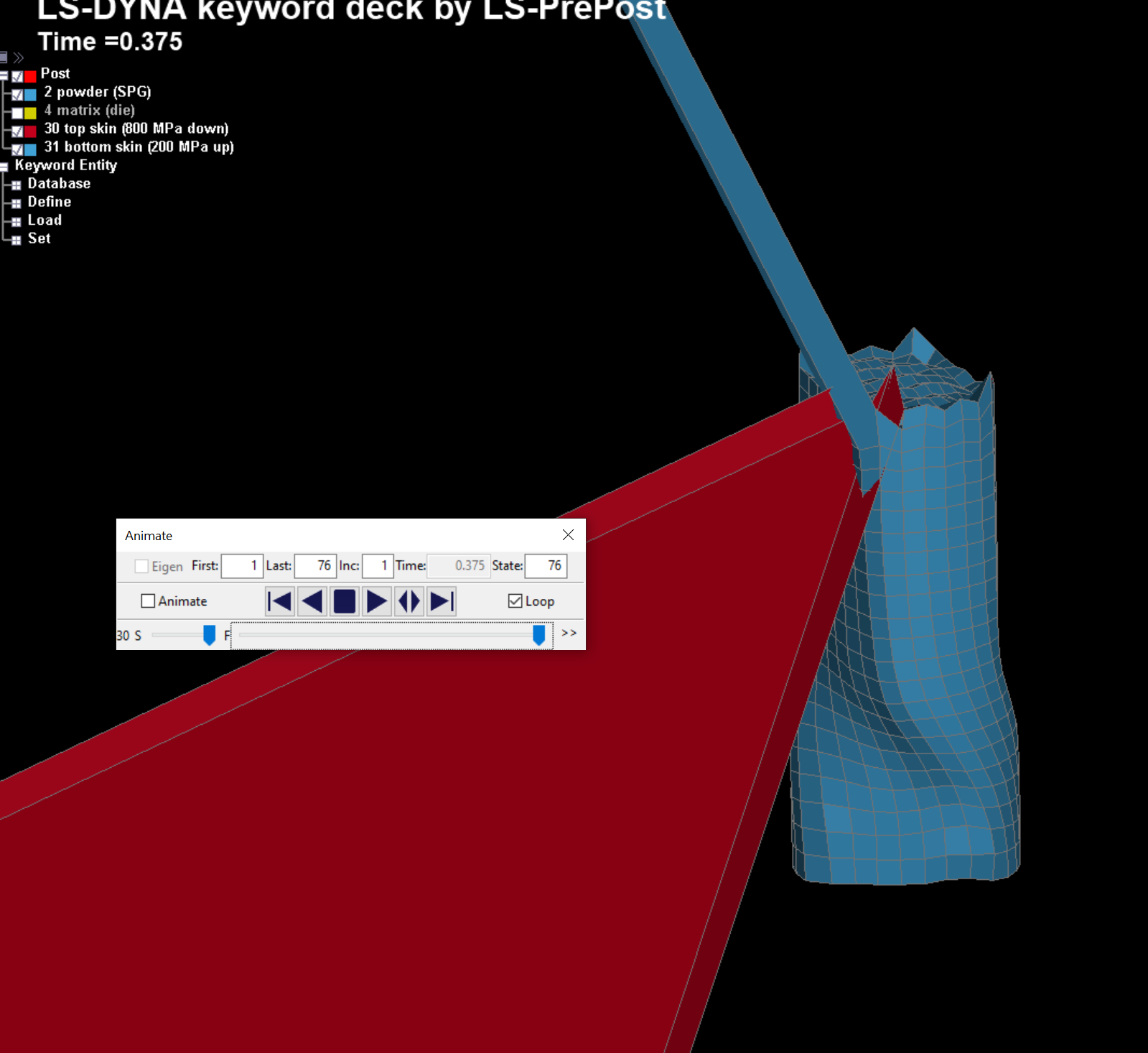
Then, within less than 1 ms, an entire transverse layer of background elements
inverts (negative volume), and the job dies with either
"gt ispgnumextn"
or a hard crash:
forrtl: severe (157): Program Exception - access violation
SPGBSORT (spgbsort.f) / SPGMGBUCKET_SMP / SPGFINOD3 / SPGFINOD / SPGSMOOTH
Checking the deleted nodes, the first failures are all from one original element
row, located at the EXIT of the helical section (where the cross-section stops
rotating and the material "unwinds"), and they are spread across the whole
cross-section (r = 2...11 mm, channel radius 14.7 mm) - i.e. in the core, NOT at
the die wall.
SETTINGS ALREADY TRIED (none of them removes the failure, they only delay it)
- DX = DY = DZ: 1.5 / 1.6 / 1.8 / 2.0
- KERNEL = 1 (Eulerian); ISPLINE = 0
- SMSTEP: 15 / 5 / 3
- MSC = 1 together with ITB = 3
- IDAM = 1, STRETCH = 1e10 and 6
- PDAMP = -0.005 / -0.01, BOXID active
- Coupling SFP = 0.5 / 0.7, THK = 0.25 / 0.5, friction = 0 / 0.05 / 0.1
- CONTROL_TIMESTEP: TSSFAC 0.5, DT2MS = 0, ERODE = 1; DTMIN = 0.1
- Mesh size of the billet: 2.8 mm / 1.24 mm / 1.0 mm
- Drive speed 100 mm/s and 50 mm/s
QUESTIONS
1. Are there recommended SPG settings for large TORSIONAL/shear deformation of
this kind (background mesh must follow a ~64 deg rotation)? Any guidance on
DX and SMSTEP for this class of problem?
2. What controls the internal array dimension behind "gt ispgnumextn", and can
it be increased (keyword/parameter/memory)?
3. For a helical rigid wall, is *DEFINE_SPG_TO_SURFACE_COUPLING the recommended
approach, or is *CONTACT_AUTOMATIC_NODES_TO_SURFACE preferred?
4. Is *CONTROL_SPG required or recommended here? I have not used it so far.
5. For powder consolidation I do NOT want material separation. What are the
recommended IDAM / STRETCH / FS settings for a "no bond failure" setup?
Any advice would be greatly appreciated.



















 You are navigating away from the AIS Discovery experience