-
-
December 11, 2023 at 10:20 am
Sharan Brar
SubscriberHello,Â
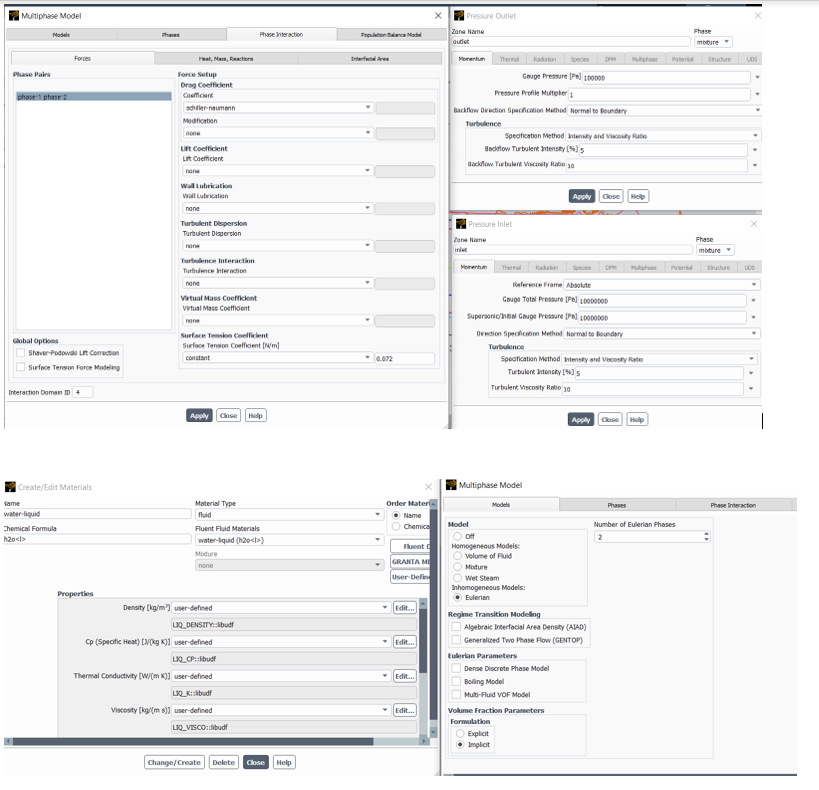
I am trying to simulate flashing flow conditions in a pipe. It is a 2-D simulation. Till now, I have used Mixture Model>Evaporation-condensation Model>Lee Model (with UDF for Saturation Temeprature and Eulerian Model>Evaporation-Condensation Model>Lee Model (along with UDF for saturation Temperature). The convergence for both of these cases are good with quite low residuals but, I am not getting chocked flow/flashing conditions i.e. the velocity of the vapour phase is not reaching mach conditions as we expect them to. I am using pressure inlet with 100 bars inlets pressure and 583.15 K Temperature and 1 bar at the outlet with backflow temperature set at 500 K. Moreover, I am using UDFs for both water and vapour materials property ranging from 275 K till 635 K saturation conditions.
What can I do so that I can have choked/flashing in the pipe and the velocities reach higher values. I am using SST k-omega model right now. Can someone give me some advice. I can post the images of the simulation set-up if required.Â
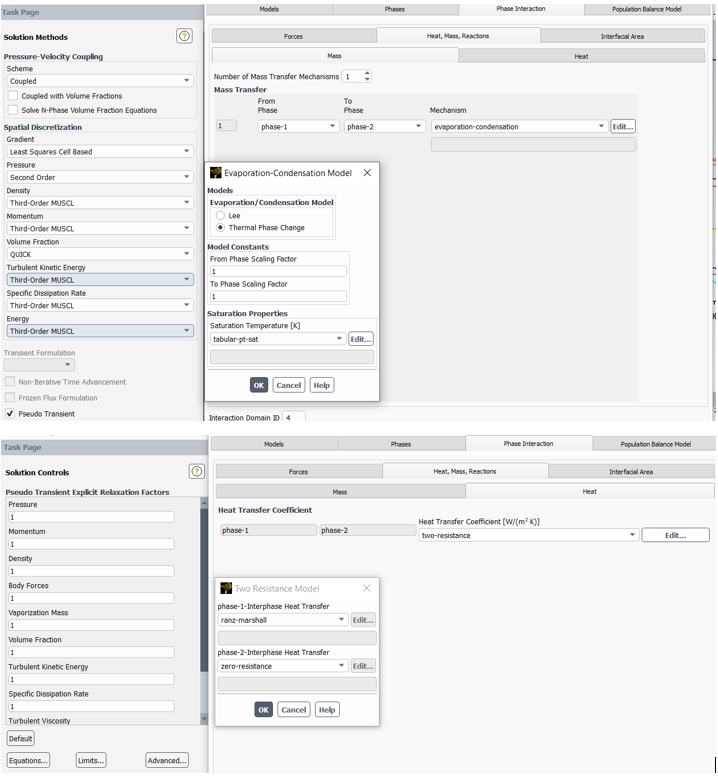
Currently, I am trying with Eulerian>Evaporation-Condensation>Thermal Phase change (didnot change the tuning factor) along with two-resistance model. The velocities are now reaching almost 290m/s as compared to 180-200 m/s of the previous models but still not as we expect. But, the residulas are quite high in this case.
Can someone please provide some suggestions and help me out.
 Thanks in advance.
-
December 12, 2023 at 11:53 am
Rob
Forum ModeratorImages will help.Â
Choked flow means you're getting shocks, which will need to be well resolved (fine mesh) to model well. With multiphase that may get interesting as the liquid phase interacts with the shock region. Pressure in & pressure out solutions can be sensitive to the initial conditions so mass in and pressure out may be a better combination. In your case, if you're also modelling phase change you need to check the rate of phase change and initial amount of phases doesn't mean the solution can be numerically OK with the wrong phase fraction.Â
-
December 12, 2023 at 1:41 pm
-
December 12, 2023 at 1:44 pm
-
December 12, 2023 at 1:47 pm
-
-
December 12, 2023 at 1:52 pm
Sharan Brar
SubscriberThanks for the infromation Rob. I will try it with Mass Inlet instead of Pressure inlet. As far as the Mesh is concerned, I have tried to make it refined keeping in ind the boundary layer effects and more no.of cells towards the outlet of the pipe.
Rob if you can explain this statement of yours - ´´if you're also modelling phase change you need to check the rate of phase change and initial amount of phases doesn't mean the solution can be numerically OK with the wrong phase fraction´´.Â
Rest, please let me know if you have some other advice or suggestions that you can make. I would be very grateful to you. Thanks in advance.
-
December 12, 2023 at 3:11 pm
Rob
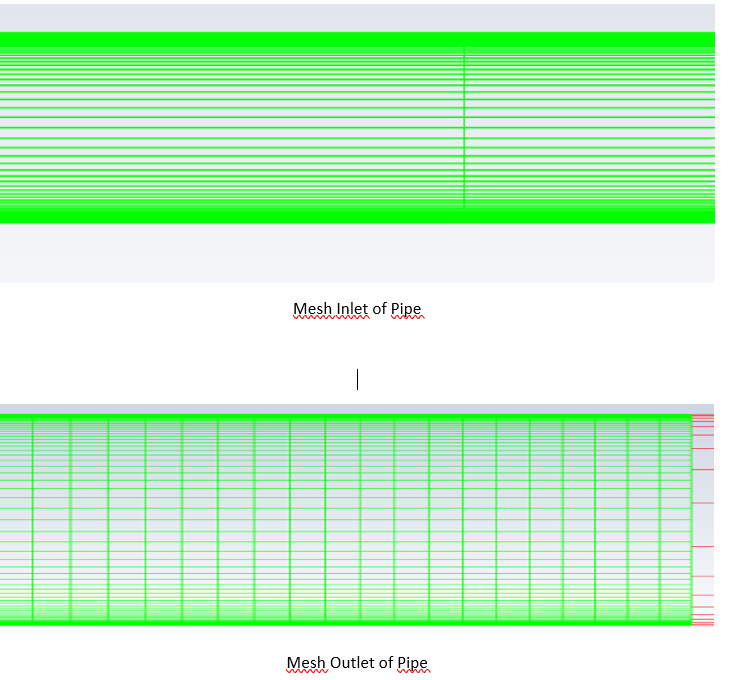
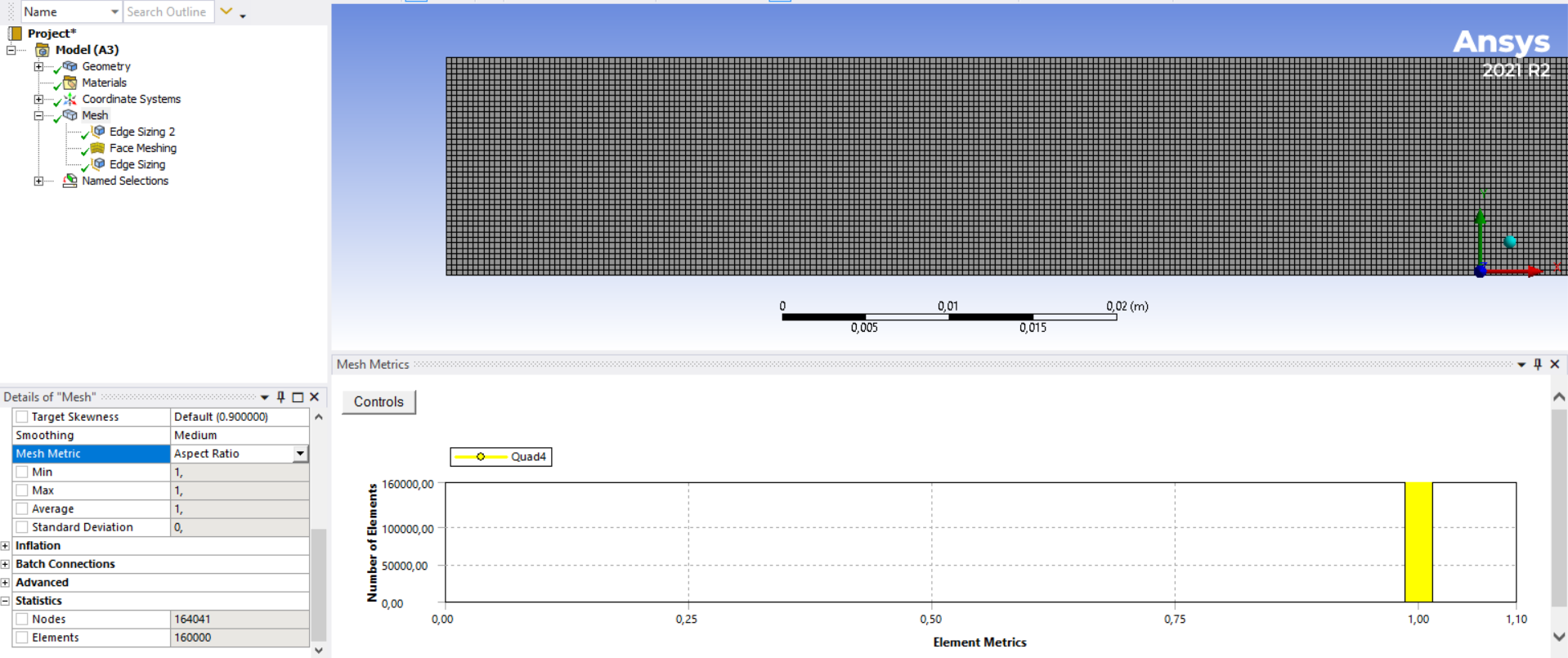
Forum ModeratorOK, first problem is the mesh. Given the flow may well change in the "along" direction you need to have an aspect ratio near one. Inflation is good for when the flow gradient wall>core flow changes but "along" doesn't: that's not the case here.Â
Liquid density can't be a function of pressure unless you're using the compressible liquid option: there's a note in the UDF manual somewhere. It's linked to the way Fluent calculates the cell mass balance.Â
For phase change. If you have a dP over the domain you could have low density material going VERY quickly or high density going much slower. That satisfies the pressure condition. That then alters the phase composition, which may or may not be sensible re the flow. Very simply, the solver maths becomes unstable and convergence isn't good: the results then may be misleading or nonsense.Â
-
December 13, 2023 at 1:11 pm
Sharan Brar
SubscriberHello Rob,
Thanks for the reply and the infromation.Â
Firstly, I will update the mesh and try to bring the aspect ratio of the cells near to 1 along the length of the pipe.
Secondly, according to what I understood from your 2nd paragraph about the Liquid density, shall I then keep it as constant without any UDF library? But, my UDF for liquid density varies with tempearture amd not pressure for both the liquid and the vapour phase.
Now according tot he 3rd paragraph of the Phase change, what can I do solve this problem?
Â
Thanks in advance
-
December 13, 2023 at 1:31 pm
Rob
Forum ModeratorOK, density with temperature is fine, but check there aren't any odd regions in curves if using a polynomial. I see far too many with far too many significant figures and T^12 terms......Â
For the phase change, a small amount of liquid becomes a very large amount of gas, which then has to go somewhere. Velocity then spikes, so the solver may do something interesting. Because mass flow is part of the solution, for a fixed dP it gets numerically stiff.Â
-
December 13, 2023 at 2:08 pm
Sharan Brar
SubscriberOkay Rob, I will try to make the changes and simulate the case and get back to you.Â
But, if you have any other suggestions, please recommend them.
Thanks
-
December 18, 2023 at 9:02 am
Sharan Brar
Subscriber -
December 19, 2023 at 10:07 am
Rob
Forum ModeratorMesh looks OK. You really want to be using 23R2 or (very soon) 24R1 though. The phase change models have been seeing a lot of development attention.Â
-
December 19, 2023 at 1:20 pm
Sharan Brar
SubscriberRob, I have another question. Do I need to make a tank like geomerty for the hydraulic effects or simulation to begin or it can work in a simple pipe like structure too?
-
-
December 19, 2023 at 1:10 pm
Sharan Brar
SubscriberHello Rob,
Thanks for the information but I am using my university licence for the 2022 and 2021 (currently using 2021 as university do not have th licence for the 2022 post processing).Â
Rob, I was searching quite a lot and found a conversation thread on another ANSY Forum for flashing flow where they used cavitation model along with the Zwart-Gerber-Belamri model for flashing.
Here´s the link of the conversation - /forum/forums/topic/cfd-modelling-of-flashing-flow-in-cd-nozzle/
Do you have any other advice as with this mesh, still I am not getting the required results.
Â
Â
-
December 19, 2023 at 3:50 pm
Rob
Forum ModeratorI'm always wary of the cavitation models. The mesh looks OK, so it's now a case of understanding how the model(s) work, and also any settings that are present. When you say you're not getting what you want, what are you seeing?
-
December 19, 2023 at 4:51 pm
Sharan Brar
SubscriberAccording to my understanding, due tot this huge pressure difference, the water flashes and turns into vapour and there will be a point of this flashing/chocking where it happens and this huge difference between the upstream and the downstream pressure, as the flow is chocked, i must see the velocity of the phase 2 or velocity in general reaching sound speed (mach) as it would give an idea of the choking onset. Along with this, the pressure should decraese from the inlet towards the outlet, the temperature change should also be seen as the void fraction increases.
In the previous mesh that I was using, with boundary layer meshing; I was using Eulerian>Lee>Saturation Temperature Table> K-omega SST model and mostly I was getting everything but the velocity was not reaching what I am expecting it to. So, if its not reaching Mach values, how can I make sense of the results of where and how the chocking is happening.Â
I am trying now with the current updated mesh with Eulerian>SST K-omega>ThermalPhaseChangeModel(along with saturation temeperature table) but, firstly the residuals are too high, though, i have not ran the simulations with this set-up for too long but the initial results, I am not able to make sense of it.

-
-
December 19, 2023 at 5:28 pm
Rob
Forum ModeratorYes, and you also need to consider the speed of the phase change, and the initial condition. If we add liquid at the base of a flashing jet, why wouldn't Fluent do the phase change instantly? If we model the hole/orifice the liquid inlet is probably going to stay as liquid, but we need to consider how/where/what the liquid jet looks like.Â
Boiling level models are generally difficult to converge, where the phase change is potentially instant you may find the time step makes the solution very time consuming.Â
-
December 20, 2023 at 10:35 am
Sharan Brar
SubscriberHello Rob,
In the UDF of my materials, for both the vapour and the liquid phases, I have provided temperature dependent sound speed also.
I am just stuck and can´t figure out what next steps I can take.
-
December 21, 2023 at 12:08 pm
Rob
Forum ModeratorTake a step back, and review how the real world flow would behave. If I add a liquid at above it's boiling point to a pipe what happens? How would I add it to the pipe to prevent flashing in the delivery system? From what I can see the solver is OK, it's more a problem with the problem definition: ie what would happen in reality.Â
-
- The topic ‘Simulation of Flashing Flow using FLUENT’ is closed to new replies.
-
6710
-
1906
-
1469
-
1313
-
1022
© 2026 Copyright ANSYS, Inc. All rights reserved.