-
-
February 11, 2025 at 5:02 pm
arjun.janardhanan
SubscriberHello everyone,
I am working on a floating structure analysis and need to simulate mooring effects in ANSYS Static Structural. I have the hydrodynamic stiffness matrix from AQWA output files and would like to understand the best approach to implement it in a static structural analysis. Or just the pressure mapping is enough to simulate tthe structure with the moorings already defined in diffraction model?                                                                                     Â
I would appreciate any insights, best practices, or example workflows from anyone who has tackled similar simulations.
Thanks in advance!
Best regards
-
February 13, 2025 at 1:15 pm
Mike Pettit
Ansys EmployeeHello,
If you want to include mooring loads in the structural calculation, the best approach may be to map from a time domain Hydrodynamic Response analysis to a Static Structural analysis. In the Analysis Settings of the time response analysis the Analysis Type should be set as 'Irregular Wave Response' or 'Regular Wave Response', and the structure(s) should be selected in the Time Domain Pressure Output settings. Then the time domain cable forces can be directly applied to selected locations on the structural model. Please see this section of the Aqwa User Manual for more information.
Mike
-
February 21, 2025 at 5:08 am
arjun.janardhanan
SubscriberThank you very much for your response!
I was wondering if it is possible to map directly from the hydrodynamic diffraction analysis. Would a frequency domain structural analysis be feasible in this case?
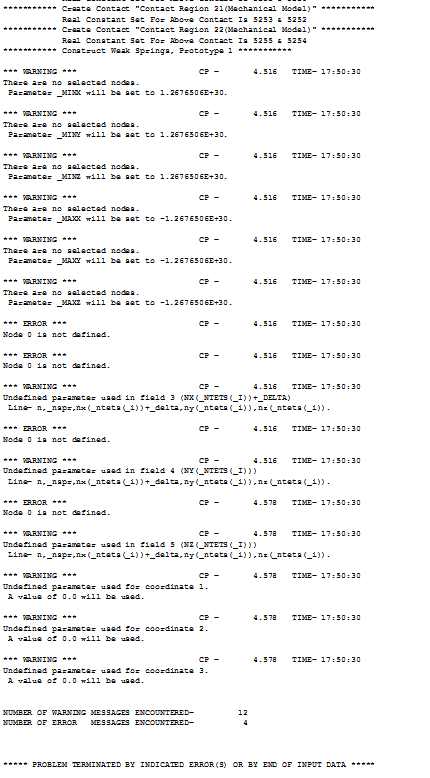
Additionally, I encountered issues when trying to simulate the platform as freely floating in the static structural analysis. With Weak Springs enabled, I receive node errors, and when using Inertia Relief, I get the error: "Inertia relief is not valid in a nonlinear analysis." I am using nonlinear concrete as the material.
I also understand that accelerations are mapped along with pressure mapping. My main issue is with the boundary conditions, whether the platform be moored or freely floating.                                                                                                                                                  Kind regards
                                                                    Â
-
-
February 21, 2025 at 3:25 pm
Mike Pettit
Ansys EmployeeHello,
In the Hydrodynamic Diffraction analysis we do not account for any cables (or other connections) you have defined in the model; these are only effective in Hydrodynamic Response systems. The exception to this is the Connection Stiffness matrix, which is used in the Hydrodynamic Diffraction RAO calculations. However, this matrix represents the overall linearized mooring effect at the structure's analysis position, rather than the cable tensions at specific locations on a moving structure. In other words, the effect of the cables in the structural analysis would be spread across the entire structure, rather than acting on specific points, so you would not capture the additional stresses induced at the cable connections.
Which version of the Ansys software are you using? We made some significant changes and corrections to the hydrodynamic load mapping on to solid structures in Release 2024 R2, so I would strongly recommend updating to this version if you are using an older release.
In terms of Inertia Relief: it is not essential to use this, and as you have found it is not permitted for nonlinear cases. The main issue may be the deformation results in the structural analysis, which will be dominated by global motions so that local deformations are obscured. Stresses and strains will still be meaningful, though.
The (RAO-based or instantaneous) accelerations from the hydrodynamic calculations are applied to the inertial reference frame in the structural analysis, so that the overall acceleration of the structure should be close to zero. This will only work if the mass properties (total mass, inertia matrix, COG position) are consistent between the hydrodynamic and structural models.
I hope this helps!
Mike

-
March 5, 2025 at 2:47 pm
arjun.janardhanan
SubscriberHello Mike,Â
Thank you for the insights!
I am using 2023 R1. Could you also explain why turning on weak springs is giving me the Node 0 not defined error in the solution? Is it due to the nonlinear material? I have also matched the mass properties in aqwa and mechanical. How do you suggest I simulate a freely floating body in Static Structural?
Kind regards
-
-
March 1, 2025 at 12:16 am
arjun.janardhanan
SubscriberHello Mike,Â
Thank you for the insights!
I am using 2023 R1. Could you also explain why turning on weak springs is giving me the Node 0 not defined error in the solution? Is it due to the nonlinear material? I have also matched the mass properties in aqwa and mechanical. How do you suggest I simulate a freely floating body in Static Structural?
Kind regards
-
March 6, 2025 at 4:34 pm
Mike Pettit
Ansys EmployeeHello,
Sorry for the delayed reply. Please could you check whether the error still exists if you suppress the Hydrodynamic Pressure object? This will tell us whether it is related to the hydrodynamic pressure mapping, or to the structural geometry/model itself.
Mike
-
March 11, 2025 at 4:54 pm
arjun.janardhanan
SubscriberHello Mike,
Thank you for your response.
I tried it without the pressure. Turns out the problem is with steel rebars for the concrete, which are line bodies modelled as reinforcements, with circular cross sections. I also tried adding manual bonded contacts between reinforcements and concrete but still the same error persists. Or is there any better method to model it, so that weak springs does not give error of missing nodes.
Kind regards
Â
-
March 11, 2025 at 4:58 pm
Mike Pettit
Ansys EmployeeHello,
I'm afraid this is outside of my expertise - I would recommend creating a new thread for this. I'm happy to leave this thread open in case you have any further questions on the hydrodynamic load mapping.
Mike
-
March 18, 2025 at 3:20 pm
arjun.janardhanan
SubscriberHello Mike,
I couldnt get any solution from the other thread but i think, the error is about selecting the nodes for attaching weak springs, as the reinforcement elements does not allow access to its nodes.
Is there any other possible method to simulate a freely floating body?
Kind regards,
Arjun
-
March 18, 2025 at 3:32 pm
Mike Pettit
Ansys EmployeeHi Arjun,
I've only ever used weak springs for this. You could probably try creating some spring elements yourself, maybe one in each corner of the structure - if the hydrodynamic and inertial loads are well-balanced then the force reactions on the springs should be small, so they shouldn't affect the overall stress distribution much.
Mike
-
March 26, 2025 at 4:31 pm
arjun.janardhanan
SubscriberHello Mike,
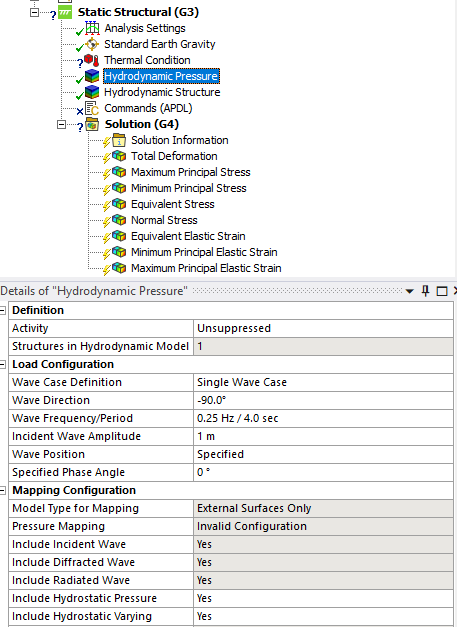
We have updated Ansys to 2025 R1, and now we cannot manually select "Model Type for Mapping" to "External Surface only" as the structure has reinforcement line bodies. It is automatically set to "External Surface and line bodies", which now gives an error that "It is not possible to map loads on to Solid Bodies and Line Bodies". In 2023 R1 we were able to manually set this, even if line bodies were present. How to solve this or is it better to use 2024 R2? (In the image I have supressed line bodies and now it automatically sets to "External Surface only")
Kind regards,
Arjun
-
April 9, 2025 at 2:30 pm
Mike Pettit
Ansys EmployeeHello,
Sorry it has taken a little while to get back to you on this one. There is a way to work around this in Release 2025 R1: You can add a Mesh > Pull > Surface Coating in Mechanical, then scope the Hydrodynamic Structure surface selection to the surface body created by the Surface Coating operation. Or, you can use Release 2024 R2 if that is more convenient.
It seems like you are now forced to map to Line Bodies if they exist in the Mechanical model, so I'll try to get this fixed for the next release. You can always scope the Hydrodynamic Structure line body selection to any line body that is not in the water, if needed.
Mike
-
May 6, 2025 at 2:31 pm
arjun.janardhanan
SubscriberHello Mike,
I noticed the warning about Additional Damping from the upstream Hydrodynamic Diffraction analysis. It mentions that structure accelerations will be incorrect in the Static Structural system. Since I’d like to include viscous damping, what’s the best way to simulate realistic accelerations in Static structural? Would introducing damping springs be the correct approach?
Kind regards
-
May 16, 2025 at 9:20 am
Mike Pettit
Ansys EmployeeHello,
It is not necessarily a problem that the structure accelerations are not correct in the Static Structural analysis. All this means is that there will be some load acting on the weak springs; as long as this load is relatively small compared to the total hydrodynamic forces, then the structural analysis should still be valid.
If you want to capture a distributed viscous load in the structural analysis, you could add Line Bodies to the edges of the solid parts of the structure, then select those Line Bodies in the Hydrodynamic Structure selection. If you are mapping from a Hydrodynamic Diffraction system, you do not need to include the Line Bodies in the hydrodynamic analysis as well; they are handled separately by the load mapping program (which also recalculates the RAOs to account for the drag effects).
Mike
-
-
-
April 15, 2025 at 2:36 pm
arjun.janardhanan
SubscriberHi Mike,
I tried using Mesh > Pull > Surface Coating, but the issue still persists. Mechanical continues to auto-scope to both surface and line bodies, even after creating the surface body. The error remains the same about mapping loads to both solid and line bodies. I also tried scoping the line bodies to only those above the waterline, but since these are reinforcement bodies (not beams or pipes), they can’t be used for Morison load mapping anyway.
Additionally, I noticed the warning about Additional Damping from the upstream Hydrodynamic Diffraction analysis. It mentions that structure accelerations will be incorrect in the Static Structural system. Since I’d like to include viscous damping, what’s the best way to simulate realistic accelerations in Static structural? Would introducing damping springs be the correct approach?
Kind regards
-
- You must be logged in to reply to this topic.
-
6269
-
1906
-
1457
-
1308
-
1022
© 2026 Copyright ANSYS, Inc. All rights reserved.