

TAGGED: ansys, spring, transient-structural
-
-
February 17, 2021 at 4:40 am
alvincsl97
SubscriberDear All,
I am trying to simulate the motion of a wilberforce pendulum on ANSYS. (https://youtu.be/M0Zjl_tMOZg)
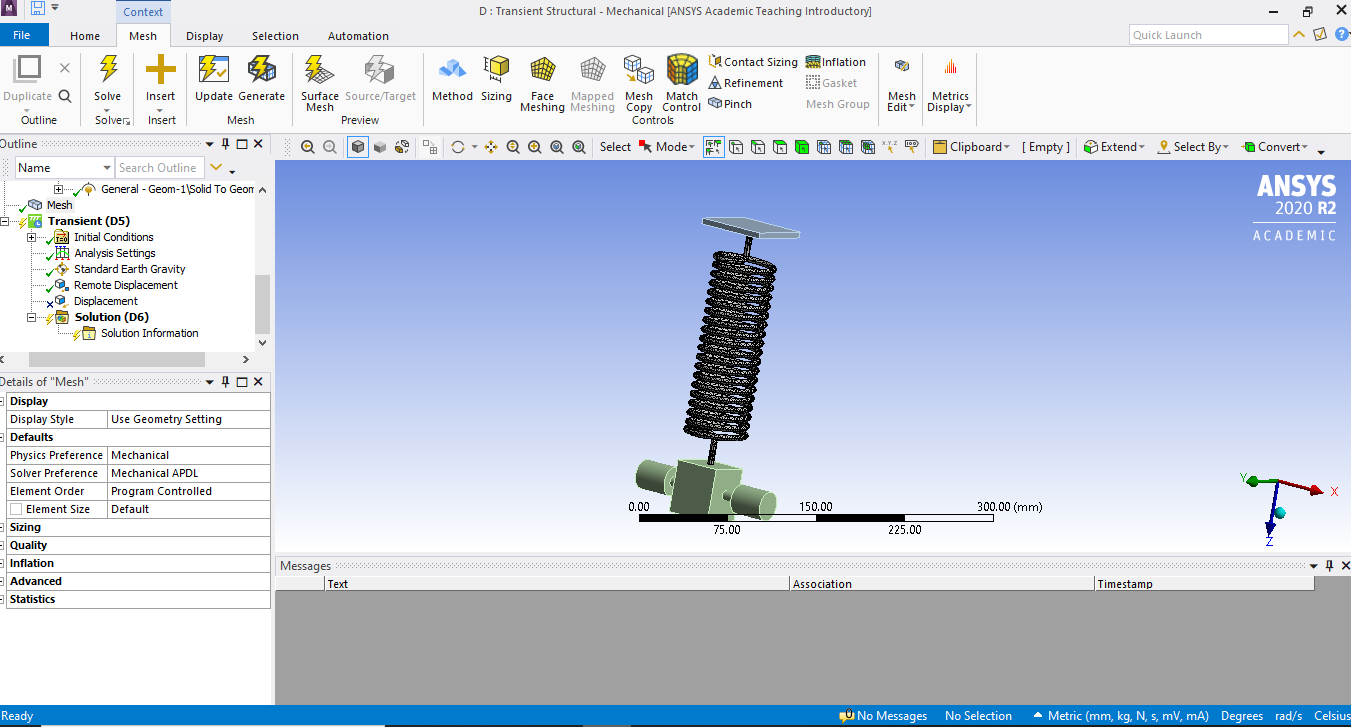
These is the model I created. There are 3 parts joint together, the top plate and the load are set as rigid bodies as I am not interested in the deformations. The spring I set it to flexible as I want it to extend and oscillates, and coupled with the rotational movement.
February 18, 2021 at 4:40 am1shan
Ansys EmployeeHelloArray,nThe bottom load should also be constrained to move and rotate along its axis only. I suggest you try defining a cylindrical joint body ground about the z axis and see if the issue persists. Also not 100% sure but instead of a revolute joint between the spring and top plate, also try with a fixed joint. The pendulum rotates because of torsion generated by the spring. If you define a revolute joint the torsion effect may not be significant since its free to rotate along its axis. Also, play animation till the last converged step, this might give you an hint about any undesired motion. nRegards,Ishan. nFebruary 23, 2021 at 5:00 amSubscriberHi, thanks for your reply and I managed to get it work. I changed the joint setup between spring and load as fixed joint as I was trying to simulate coupled system. Now it provides animation results and I can work from there. THanks again. nViewing 2 reply threads- The topic ‘Simulating coupled motion of Wilberforce Pendulum’ is closed to new replies.
Innovation Space Trending discussions
 Top Contributors
-
peteroznewman
 6450
6450 -
scabo
 1906
1906 -
Dennis Chen
 1457
1457 -
javat33489
 1308
1308 -
Shyam Prasad V Atri
1022
Top Rated Tags
© 2026 Copyright ANSYS, Inc. All rights reserved.
Ansys does not support the usage of unauthorized Ansys software. Please visit www.ansys.com to obtain an official distribution.
-


The Ansys Learning Forum is a public forum. You are prohibited from providing (i) information that is confidential to You, your employer, or any third party, (ii) Personal Data or individually identifiable health information, (iii) any information that is U.S. Government Classified, Controlled Unclassified Information, International Traffic in Arms Regulators (ITAR) or Export Administration Regulators (EAR) controlled or otherwise have been determined by the United States Government or by a foreign government to require protection against unauthorized disclosure for reasons of national security, or (iv) topics or information restricted by the People's Republic of China data protection and privacy laws.

 You are navigating away from the AIS Discovery experience