-
-
May 9, 2023 at 12:30 pm
KK
Subscriberi would like to use the results of the sensitivity coefficients in opislang to weight the objective function for the optimisation. is this possible?
-
May 10, 2023 at 12:57 pm
Ashish Khemka
Forum ModeratorHi,
Please see if the following links help:
An Ansys optiSLang Overview and Optimization Example with Ansys Icepak - PADT (padtinc.com)
sensetivity analyse with Optislang (ansys.com)
Regards,
Ashish Khemka
-
May 11, 2023 at 6:22 am
KK
SubscriberI cannot export the coefficients to a .txt file, for example, can I? Which parameter influences my structure the most?
E.g. E-modulus 64 %, poisson number 20%, density 16 % and then take these directly into an objective function as weighting (with signal processing). -
May 11, 2023 at 7:39 am
Markus
Ansys EmployeeHi,
The sensitivity coefficients are the importance of the individual parameters contributing to the variation of the response. I do not see a reason why using them in the objective function. The optimizer will adjust all given input parameters.
Instead, I would recommend scaling the components of the objective function to the same order of magnitude. Here you see an example:
If you do not scale it, the optimizer will tend to improve the component of objective with the larger numerical value. After scaling, the objectives have a rather equal importance.
If you have multiple objectives you may also start with a Multi-Objective Optimization (more information here: 3.2. Multi-Objective Optimization (ansys.com)) and conduct the Single-Objective Optimization afterwards.
Best regards,
Markus
-
May 11, 2023 at 7:51 am
KK
SubscriberIs it not possible to implement a simple least squares objective function in Optislang?J(p) = zWz or after linearisation (GWG)p = GWzz = resiude vectorW = weighting matrixG = weighting matrix (partial derivative of the residuals after the paramers)p = parameter changeI would like to know if it is possible to implement a least squares objective function using Optislang, or if there are simpler approaches that can take my weighting matrices directly from Optislang. Furthermore, I would be interested to know which approach is considered the best or simplest to realise the alignment between test and simulation. Are there any proven methods that are particularly recommended and what factors should be taken into account when choosing? -
May 11, 2023 at 4:09 pm
Markus
Ansys EmployeeHi,
yes, you can implement a least square objective function. There are different ways of doing that.
1 You can calculate the least squares of vectors/signals in the “Variables” tab of the ETK node or the Signal Processing e.g. using Sum of squared error (SSE), or the Root squared error (RSE).
For the objective formulation you are using then a scalar value e.g. RSE. You find examples in the help on how to do this in the software:
In Ansys Workbench: Calibration of a Damped Oscillator in Ansys Workbench
In optiSLang: Calibration of a Damped Oscillator (ansys.com)2 You can also use vectors or signals in the objective formulation. It’s also possible to include a weighting vector.
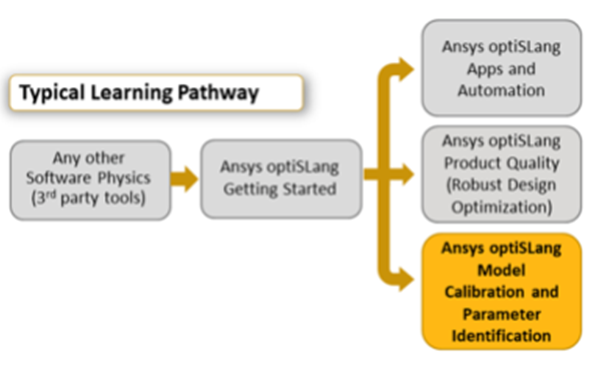
To realize alignment between test and simulation is in general a Model Calibration/ Parameter Identification question. There is in Ansys Learning Hub (Connect | Ansys optiSLang - Ansys optiSLang Model Calibration and Parameter Identification (sapjam.com)) an advanced optiSLang course on that topic:
This talks a lot about signal/vector usage, the workflows, best practices etc.
I hope this helps.
Markus -
May 12, 2023 at 7:10 am
KK
SubscriberThank you markus.
I assume you are referring to the "How to define objective with scattering reference". My objective function would be:
objective = euclid[(y* - y) * w]
But where do I get the vector weights w?
Can I export them in the sensitivity analysis or read them directly into ansys signal processing somewhere?
Don't I already have to define the same objective function for the sensitivity analysis? -
May 12, 2023 at 9:47 am
Markus
Ansys EmployeeHi,
Yes, I refer to that. The context of this is how to deal with a scattering in the reference curve. If you repeat the measurement, it sometimes shows some not constant scatter or noise along a signal.
Consequently, in regions of low scatter, the fit (to the simulation) may should be accurate. In regions of high scatter, the fit may can be less accurate.
So, the weighting vector can come from the evaluation of different reference curves. This is not a result of the sensitivity analyses but an Information that needs to be provided by the user.
If you have this vector, you can either type the vector in or read it automatically with ETK from a text file.
Best regards,
Markus

-
- The topic ‘sensitivity coefficients’ is closed to new replies.
-
5884
-
1906
-
1420
-
1306
-
1021
© 2026 Copyright ANSYS, Inc. All rights reserved.