Ansys Assistant will be unavailable on the Learning Forum starting January 30. An upgraded version is coming soon. We apologize for any inconvenience and appreciate your patience. Stay tuned for updates.
Fluids

Fluids

Topics related to Fluent, CFX, Turbogrid and more.

RPM as output in CFX?

TAGGED: 

    • vinnakbm
      Subscriber

      Hi

      I'm trying to perform a fluid flow simulation to estimate the RPM (unknown) and torque of a rotating element when the inlet mass flow rate is known. Unfortunately, in CFX I had to define the RPM (estimated value was used) of the immersed solid as input during set up. This seems to be a roundabout way to determine the speed of rotary element due to known mass flow rate. Is there a way to set it up in CFX for RPM to be an output?

      Thank you!

    • Rob
      Forum Moderator
      The RPM will be a function of the force, so you could use an expression to translate the blade force into rotational speed.
    • vinnakbm
      Subscriber
      Right, but I cannot go to the solver stage without defining an RPM to the immersed solid (rotating element) in the set up. Once, the RPM is defined it is no longer an output of the simulation. I found that in fluent as well, if I use a rotating mesh, I have to define the RPM for the rotating mesh in the set up itself. I'm still confused how to address this problem. Thank you for your response
    • Rob
      Forum Moderator
      Yes, the RPM is the output of the expression that's put into the rotational speed. The reason it's set as it is with a RPM as a boundary is the solver can't account for blade efficiencies, gearbox drag etc.
    • vinnakbm
      Subscriber
      So, for example, if I define 1000 RPM as input to the rotary element, inlet boundary as mass flow inlet (Kgs-1) and run the solver, from CFX post I should be able to extract a different RPM because of the losses/inefficiencies? Since the RPM was unknown and was guessed to start the simulation, how can verify that the guess RPM was correct to start with?
    • Rob
      Forum Moderator
      I think it'll show up on the blade pressure. may know more, as may the courses at the top of the page. I don't have much experience with spinning things.
    • vinnakbm
      Subscriber
      Thank you. Do you know if I can contact Kremella directly through this forum?
    • Rob
      Forum Moderator
      He'll see the notification, but as I don't know if he's in it may be a few days: we're in different time zones as well as offices.
    • vinnakbm
      Subscriber
      Thank you Rob!
    • Karthik Remella
      Administrator

      If I understand your problem, you wish to estimate the RPM of a rotary system based on incoming fluid velocity. You may want to use the 6DoF in Fluent for this. For this, Fluent should be set up to calculate the forces on the blades. This will estimate the blade RPM. I would suggest that you look at some tutorials on 6DoF in Fluent. You should find several videos on YouTube. This, in CFX, is a bit tricky.
      Karthik

    • vinnakbm
      Subscriber
      Thank you very much! I'll go through the tutorials for 6DoF. Since I already have it set up in CFX, can you point me to some resources on how to do it in CFX? I'd like to compare both the results. Also, my fluid domain has 50-micron clearances between the rotating part and the casing in which it rotates. So, in fluent when I subtract the solid to get the fluid domain, it leaves these thin 50-micron regions around the periphery. Will fluent be able to handle that?

    • Surya Deb
      Ansys Employee
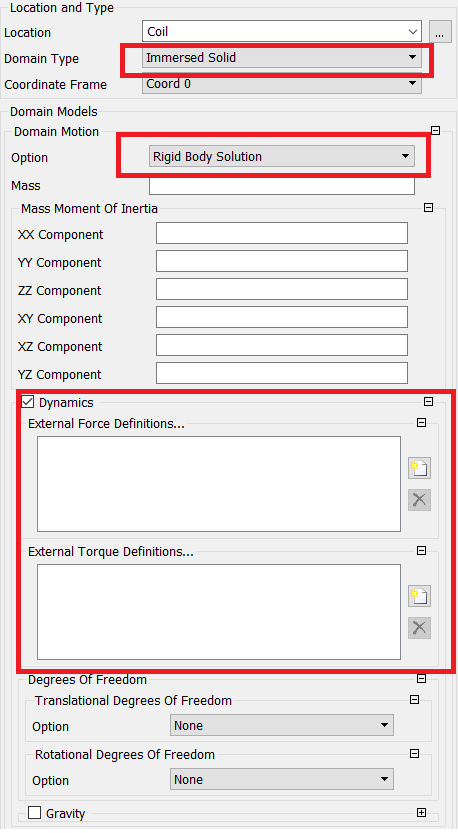
      In CFX, you can use Immersed Solid as Domain Type and Rigid Body Solution as Domain Motion. You will then need to provide the mass and moment of inertia details and specify the rotational/translational constraints.
      For the external force and torque, you need to use expressions on the specific blade walls. This is already done automatically in Fluent but in CFX, you will need to provide the expressions like force() etc.. You can check this link [https://ansyshelp.ansys.com/account/secured?returnurl=/Views/Secured/corp/v221/en/cfx_ref/quant_func_list.html]

    • vinnakbm
      Subscriber
      Thank you very much!
    • vinnakbm
      Subscriber
      Good morning! I have a follow up question. In CFX, I defined the mass and inertia details. However, there are no external forces acting on the rotor other than those resulting from fluid movement around it. Do I still need to use quantitative functions for external force/torque? Thanks in advance.
    • vinnakbm
      Subscriber
      Hello, In CFX rigid body solution, is it possible to couple motion of 2 rigid bodies so that they don't intersect (unrealistic as one body cannot penetrate the other during the motion)? Thank you!
Viewing 14 reply threads
  • The topic ‘RPM as output in CFX?’ is closed to new replies.
[bingo_chatbox]