-
-
May 15, 2019 at 8:25 pm
yanivVK
SubscriberHello,
I am trying to do a Rigid Body Dynamic analysis of a manipulator arm with multiple modules of two triangular shaped plates, a spherical joint connector and springs in place. I want to find the forces experienced by the spherical joint, springs as well as the rotation of the spherical joint wrt the x and z axis.
I am applying a force of 30lbf on the top plate. There is a gravity effect and the lower cylindrical segment of the base plate is fixed. The materials used are ABS+PC plastic. I have not used any contacts. Just the universal joint, and two other fixed joints(Body-Body which connects the spherical joint connectors' cylindrical part to the top plate) plus the fixed joint (Body to ground) for the lowest module. Â
After running the simulation, the spherical ends of the connector move out of position almost as if they are sliding in the direction of applied force. They penetrate through the spherical socket/base/holder.Â
My question is:
1) Why are they not behaving like a universal joint. They should not have any translation. I have only used a universal joint and no contacts. I had used a 'forced frictional contact in my previous attempt with 1 module (or 2 triangular plates) and I encountered warnings like this in the solution information-
  None of the LCP solvers succeeded, Abort computation.
  No set of active contact stops can satisfy all the constraint equations. Solve cannot proceed
 Solve failedÂ
  Error found at time 1.377963e-04
Â
  Solution terminated before normal completion
I don't get this warning when I don't use any contacts. I am able to solve it just by using joints but the penetration problem exists.
Can someone please tell me what I should do to make the spherical end (modeled as universal joint) realize that it has to stay in its holder position and just rotate instead of sliding and penetrating into other bodies?Â
Any tips related to modeling such systems in RBD of ANSYS would be highly appreciated.
Thanks in advance. -

May 15, 2019 at 9:22 pm
peteroznewman
Subscriber Please attach a Workbench Project Archive .wbpz file after you post a reply that says what version of ANSYS you are using.
-
May 15, 2019 at 9:26 pm
yanivVK
SubscriberHello Mr. Newman,
I am using ANSYS 2019 R1 version.
Regards, -
May 15, 2019 at 10:26 pm
yanivVK
SubscriberI have attached the Workbench Project Archive file. Hope you were able to download it.
-
May 16, 2019 at 12:59 am
peteroznewman
SubscriberYou are looking for a mechanism that respects the limits on the angles that the shaft can come out of the spherical cup. You tried to achieve this with contact that replaced a spherical joint, but it is not working.Â
Return to using a Spherical Joint. Make a donut shaped solid (toroid) to replace the cap on the ball and socket joint. Delete the spherical body at the end of the shaft and extend the shaft to be tangent with where the ball ended. Now you will have a donut and a long shaft that passes through the donut on both sides. This will give the contact algorithm the best possible chance to detect the contact at the appropriate time.
While you are in CAD making those changes, unite the shaft to the plate so that you can eliminate the fixed joints that connect them.
The above are my suggestions for what might help. I don't know that it will help, but it is worth trying.
-
May 16, 2019 at 6:11 pm
yanivVK
SubscriberHello Mr. Newman,
Thank you for your reply.Â
 - I am using a Universal joint (like you had suggested me last time). With the spherical joint I was getting a Y-rotation which was undesirable. I did not use contacts to replace the spherical joints. Using contacts always results in ANSYS throwing an error that it couldn't solve the problem completely. I have a feeling that returning back to a spherical joint behavior, the Y-rotation will return. Then, I would have to use some torsional springs to prevent it.
- I understood the toroidal cap part. But, I am having difficulty visualizing the other suggestions about deleting the spherical body. If the ball part is deleted, then it would just be a long shaft. Then, the toroid won't be able to hold it in place, I think. Can you please share a rough hand sketch regarding this modification?
Thanks and Regards. -
May 16, 2019 at 9:10 pm
peteroznewman
SubscriberContinue using Universal joints.
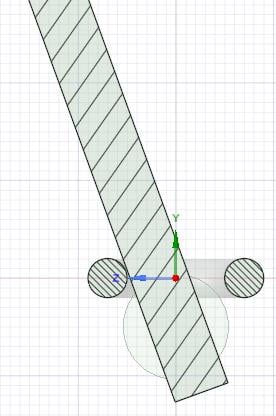
In the image below, I have removed the ball on the end of the shaft. It serves no purpose. Instead I have lengthened the shaft so that there is a large overlap of the shaft and the toroid. I show where the ball used to be. You can see there is a much longer shaft surface to make contact with the toroid. The U-joint has its origin on the shaft, at the center of where the ball used to be.
There is a Fixed Joint between the toroid and the triangular base (not shown).
-
May 23, 2019 at 10:23 pm
yanivVK
SubscriberHello Mr. Newman,
Thank you for your reply and the drawing. I apologize for the late reply. I was trying out a few things and ANSYS was taking up almost all the CPU power. Hence, each simulation took sometimes about an hour or two.Â
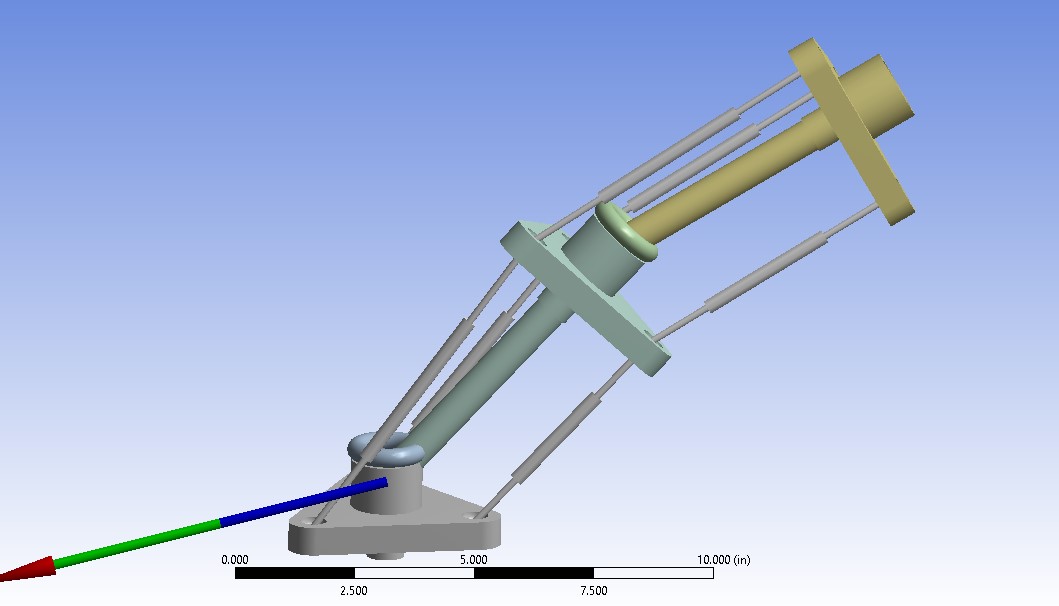
I tried it with the modification that you suggested. I did the RBD analysis for two modules and it still shows interference. Please find the attached image.Â
I thought maybe increasing the stiffness of the springs would solve it. It does so some extent. In the above case, it was 80lbf/in for the lower springs and 60 for the upper ones. I changed it to 160 and 100 and the solver didn't complete the analysis. It stopped after step 11 of 25. I am out of ideas and can't pin point what/where the actual issue lies.
-
- The topic ‘Rigid Body Motion – body moves out of position and penetrates’ is closed to new replies.
-
4763
-
1565
-
1386
-
1242
-
1021
© 2026 Copyright ANSYS, Inc. All rights reserved.