Ansys Assistant will be unavailable on the Learning Forum starting January 30. An upgraded version is coming soon. We apologize for any inconvenience and appreciate your patience. Stay tuned for updates.
Fluids

Fluids

Topics related to Fluent, CFX, Turbogrid and more.

Reverse flow at inlet

    • TingWangUNO
      Subscriber

      Hi,


      I have a flow reversal in whole domain. In fact, I have put velocity inlet and if I monitor my vector plot at the inlet itself, they are reversed. It is a transient simulation that is initialized with a steady state case. The original steady state case has the correct direction of velocity vectors at inlet.


      Question: Why does Fluent overwrite my velocity inlet boundary condition and creates reverse flow!

    • DrAmine
      Ansys Employee
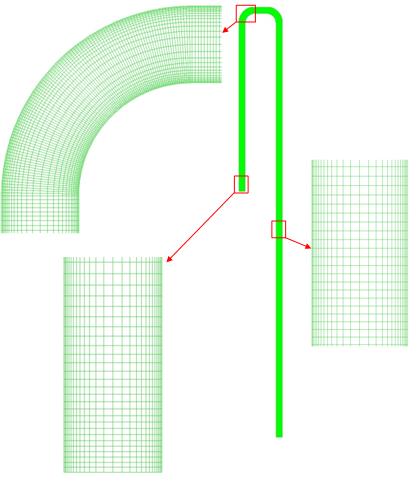
      Screenshot of Mesh and Geo as well as boundary condition definition for inlet.
    • Raef.Kobeissi
      Subscriber

      Hello,


      It must be something to do with your boundary conditions or your mesh. Can you please provide what Amine has requested.


      Thanks

    • TingWangUNO
      Subscriber


      The geometry is a siphon as shown in the figure above. It has velocity inlet boundary condition on the left horizontal face...and a pressure outlet boundary condition on the right horizontal face. Gravity is turned on.


      For a steady-state case the results are perfect. However, I used the steady case results to initialize an unsteady case...this involves thermal phase change model as liquid water enters the siphon it flashes to produce vapor. 

    • DrAmine
      Ansys Employee

      Mesh is okay and at velocity boundary condition I won't expect reversal flow (not possible from the implementation side). Please provide a zero operating density under Operating conditions and provide the right gauge pressure at your outlet (as it opens to atmosphere I  guess ambient). Please add the plot of the velocity contours as well as the inlet boundary condition. Do not use the results of single phase flow as initialization for two-phase flow runs. I would rather start with two-phase flows, switch off VOF equation from the equations which will be solved and then switch back. 

    • TingWangUNO
      Subscriber

      Dear Amine,


      1. I'm using the Eulerian model.


      2. Yes, I have provided zero operating density.


      3. When you say correct outlet pressure, I used Bernoulli's equation to calculate it for the single phase steady-state simulation. However, for the two-phase (the one with flow reversal) I don't know what value it will have!


      Question: Shouldn't Fluent increase the inlet pressure (velocity inlet BC) and adjust according to the outlet pressure boundary.


       4. If I don't initialize with the steady-state case...what should be the appropriate initial condition! Initialize from the inlet BC then?


      5. I will attach the velocity vector plots and pressure contours soon!


      Thank you.



    • DrAmine
      Ansys Employee

      Yes Fluent would provide correct total pressure at inlet. The correct outlet pressure is the pressure outside: Example your pipe is opening into the ambient room then the pressure will be 1 atm. Or your pipe is opening into an ocean under 1000 meters then the pressure outside will be 1000*g*water density.


      Unsteady problems are Initial and boundary value problems so provide the most realistic appropriate initial field for the iterative process. 

    • TingWangUNO
      Subscriber

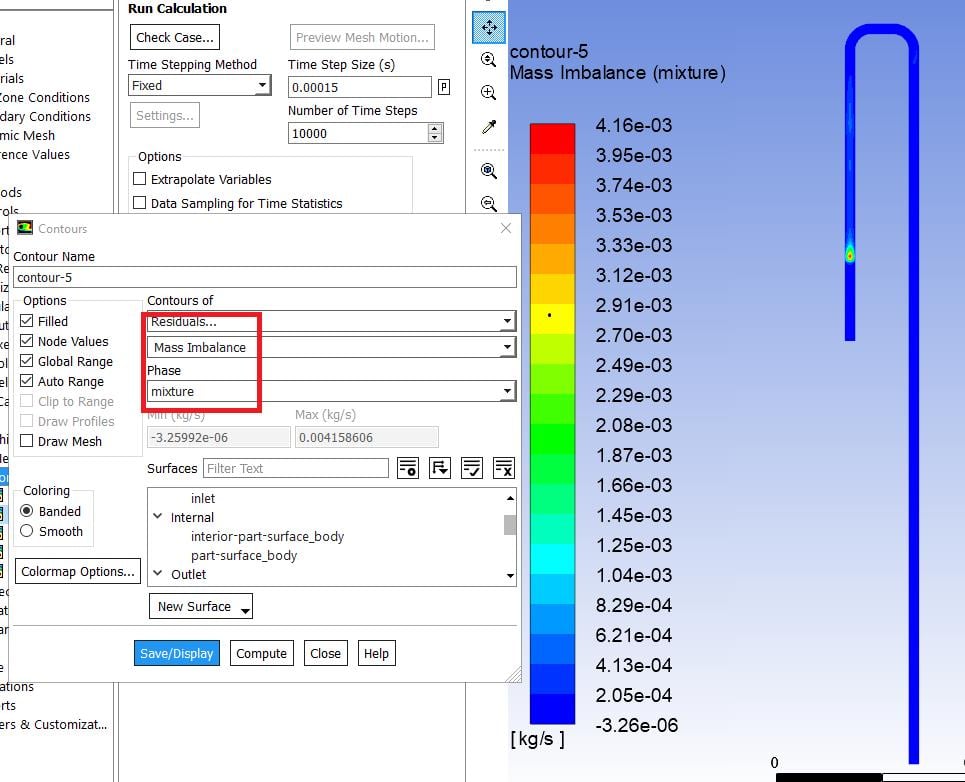
      I see that my simulation has a lot of mass imbalance...like if I plot mass flow rate difference between inlet and outlet...its huge.


      Question: In transient simulation should the mass flow difference between inlets and outlets be equal to zero? This is a phase change problem so it involves condensation and evaporation!! Would this be considered diverged solution then!!

    • DrAmine
      Ansys Employee

      No as In transient you will have transient mass accumulation. But the mass out of one phase has to be the one into the other phase for phase change.

    • TingWangUNO
      Subscriber

      So this is the Mass imbalance I plotted! It seems fine, right?

    • TingWangUNO
      Subscriber

      I have adiabatic walls in this case, is there a way I could plot thermal energy imbalance as well?? Thank you.

    • DrAmine
      Ansys Employee

      I don't know as it is just non scaled residual. Judge quality of results by monitoring temperature void and mass transfer rates so that the behavior remains  constant towards the end of the time step.

    • TingWangUNO
      Subscriber

      Hi,


      I realize there is a huge mass imbalance. The mass flow rate of mixture at inlet and outlet have a difference as high as  -19.986084 kg/s. The mass flow rate at the inlet is around 6.2980032 kg/s. This is a huge mass flow rate difference!!


      In transient simulations the mass flow rate difference between inlet and outlet should be low at each time-step? Thank you.


      Best regards


      This is for time-step t = 0.3s


                               mixture


      Mass Flow Rate (kg/s)


      report-def-0 -19.986084


      mixture


      Mass Flow Rate (kg/s)


      inlet 6.2983917


      mixture


      Mass Flow Rate (kg/s)


      outlet -26.284476


      water-liquid


      Mass Flow Rate (kg/s)


      inlet 6.2980032


      water-liquid


      Mass Flow Rate (kg/s)


      outlet -26.284476


      water-vapor


      Mass Flow Rate (kg/s)


      inlet 0.00038851637


      water-vapor


      Mass Flow Rate (kg/s)


      outlet 0


Viewing 12 reply threads
  • The topic ‘Reverse flow at inlet’ is closed to new replies.
[bingo_chatbox]