

-
-
May 24, 2021 at 4:14 pm
rkoomul
SubscriberI am new to modeling radiative heat transfer using Ansys/Fluent. Any pointers to model the following problem will be greatly appreciated.
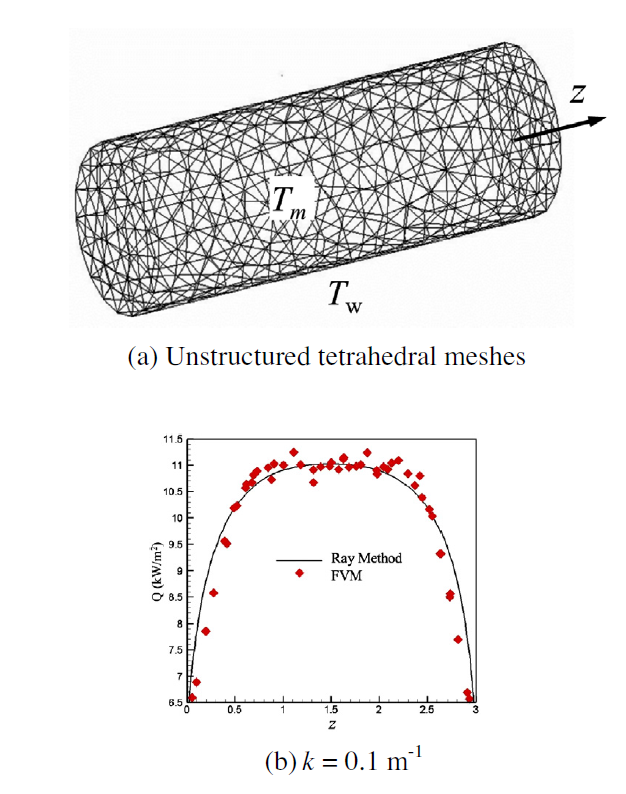
The computational domain is cylindrical cavity with 0.5 m radius and 3 m long, and the boundary surfaces are black surfaces at 300K. The medium is a participating medium with an absorption coefficient of 0.1 m^-1 (gray gas) and temperature 1200K. In this problem, I would like to calculate the radiative heat flux to the cylindrical surface.
Here is the setup that I used.
Radiation Model: Discrete Ordinate (DO) method with 4 divisions along theta and phi directions and number of bands as zero (gray gas).
Material models: Absorption coefficient as 0.1 m^-1 and scattering coefficient as 0.0 m^-1.
Cell Zone Conditions: Set as Participates in Radiation
Boundary Condition: For “Thermal” condition, selected “Radiation” and set “External Emissivity” as 1.0, and “External Radiation Temperature” as 300K. For “Radiation”, set the BC Type as opaque, and “Internal Emissivity” as 1.0 and “Diffusion Fraction” as 0.0
I tried two different options.
· In the first case, flow, energy, and DO equations are solved. In this case, as expected, the temperature became uniform at the end of the iterations and radiative heat flux became a very small value.
· In the second case, I solved only DO equation (turned off the flow and energy equations under Solution -> Control -> Equations), since I wanted to calculate the radiative heat flux when the temperature inside the cavity is 1200K and wall temperature is 300K. DO method converged in a few iterations. However, the radiative heat flux at the wall is showing as zero. I guess, this is because the energy equation is not solved. Is there any way I can calculate the radiative heat flux, after DO method converges?
Attached is an image of the heat flux distribution for this case from a published paper.
May 26, 2021 at 12:12 pmKarthik Remella
AdministratorHello You will need to solve the energy equation model to obtain the radiative heat flux value. DO is only solving the radiative transfer equation for the intensity. It should be solved with the energy equation in a coupled manner. If you are solving for a steady state solution, you might perhaps want to freeze the flow solution and solve the energy and DO equations in a coupled manner? Does that help?
Karthik
May 27, 2021 at 1:25 pmSubscriberThank you Karthik for your comments.
Air inside the cavity is stationary. So, I turned off the flow equations, and solved only energy and DO equations. Once the steady state conditions are reached, the temperature inside the cavity became 300K, because of the heat transfer from the hot air to the wall. As a result of the heat transfer, the air inside the cavity cools down, and reaches the wall temperature when steady state conditions are reached.
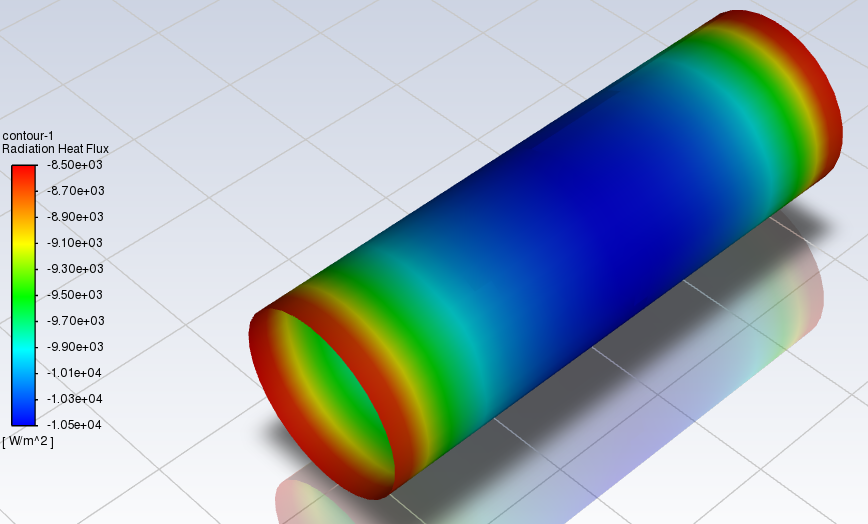
I tried another approach. I solved the DO equation first (without flow and energy equations). Then turned on the energy equation, and solved both the equations in transient mode with a very small time step (1.0E-07 seconds) for one time step. The goal is to estimate the heat transfer rate at the first time step, before a lot of energy being transferred to the wall. Attached is an image of the predicted heat transfer rate to the wall. This results matches well with the published data.
Thanks.
May 28, 2021 at 11:34 amAdministratorHello Good to know that this worked and you are able to match your simulation results with the paper.
Karthik
April 21, 2022 at 2:15 pmlei2019
Subscriber@koomullil Thank you for sharing your case setting. could you provide the source of the journal paper you mentioned? Thank you.
Viewing 4 reply threads- The topic ‘Radiative Heat Flux’ is closed to new replies.
Innovation Space Trending discussions
 Top Contributors
-
peteroznewman
 6450
6450 -
scabo
 1906
1906 -
Dennis Chen
 1457
1457 -
javat33489
 1308
1308 -
Shyam Prasad V Atri
1022
Top Rated Tags
© 2026 Copyright ANSYS, Inc. All rights reserved.
Ansys does not support the usage of unauthorized Ansys software. Please visit www.ansys.com to obtain an official distribution.
-
Ansys Assistant will be unavailable on the Learning Forum starting January 30. An upgraded version is coming soon. We apologize for any inconvenience and appreciate your patience. Stay tuned for updates.


 You are navigating away from the AIS Discovery experience