Ansys Assistant will be unavailable on the Learning Forum starting January 30. An upgraded version is coming soon. We apologize for any inconvenience and appreciate your patience. Stay tuned for updates.
LS Dyna

LS Dyna

Topics related to LS-DYNA, Autodyn, Explicit STR and more.

Question Regarding Applicability of YLD2004-18p for Shell Elements

    • pneufeld
      Subscriber

       Dear LS-DYNA Support Team, I hope you are doing well.

      I would like to ask whether the yield locus model **YLD2004-18p** can be applied to **shell elements** in LS-DYNA.

      Could you please let me know if this material model is supported for shell formulations, and if there are any specific limitations or requirements that need to be considered?

      Thank you very much for your support.

       Best regards,

       Philipp

    • Ram Gopisetti
      Subscriber


      Hi, 

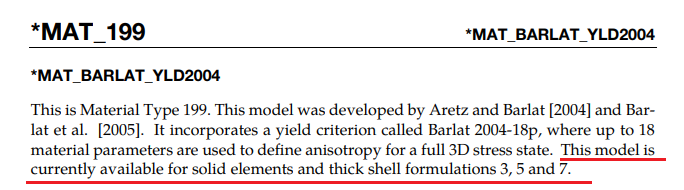
      MAT_199_YLD2004 captures the yield criterion  where up to 18 material parameters define anisotropy for a 3D stress state.

      This model is currently available for solid elements and thick shell formulations 3, 5, and 7. 

      Cheers, Ram


    • Armin
      Ansys Employee

      Hello Philipp,
      Please see the screenshot below from the LS-DYNA keyword manual R16. For shell elements, consider MAT_BARLAT_YLD2000 model (*MAT_133).

      • pneufeld
        Subscriber

        Hello Armin,
        thank you for your clarification.
        In that case, I would like to ask which material model in LS-DYNA would be suitable for shell elements if the material exhibits six-lobed anisotropy (for example, a pronounced six-ear earing profile in sheet metal forming).
        Could you recommend a yield criterion or material card that is capable of capturing this behavior for shell formulations?
        Best regards,
        Philipp
    • Armin
      Ansys Employee

      No problem Philipp.

      You can try using the Yld2000 model to see if it captures all ears, but in most cases, capturing more than four ears requires the Yld2004 model, which uses solid elements. Remember that to accurately capture this behavior, the r-values (Lankford coefficients) must be fully represented by the calibrated model in various orientations relative to the reference direction, such as 0°, 15°, 30°, 45°, 60°, 75°, and 90°.


Viewing 3 reply threads
  • You must be logged in to reply to this topic.
[bingo_chatbox]