-
-
June 2, 2020 at 3:11 pm
ASDzxc
SubscriberHi there,
can DEFINE_HEAT_FLUX be used for CHT problems? is there any test cases for this UDF (not radiations cases)
for example, in fluid-wall coupling convective heat transfer problem, can it be used to modify the fluid-wall heat transfer coefficient?
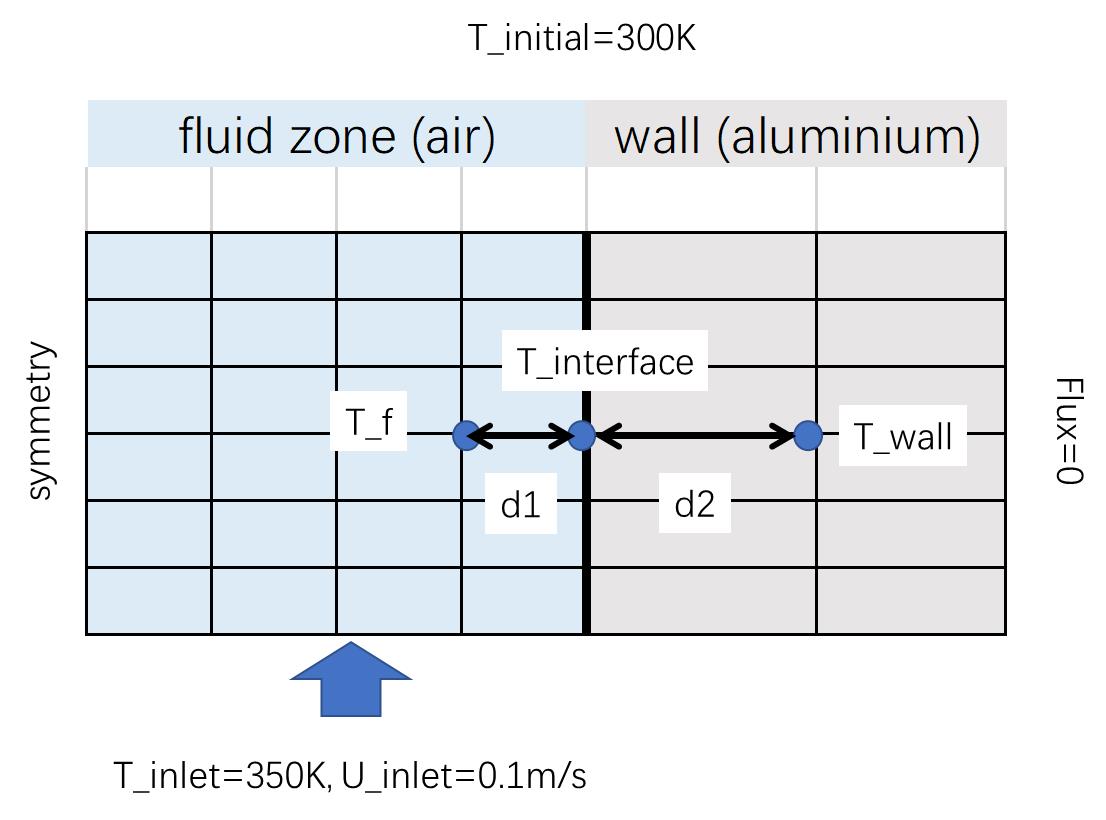
      In the figure that I uploaded, is h(T_f-T_interface)=-k_wall*(T_interface-T_wall)/d2 correct?, where h is the coefficient assigned using udf, k_wall is the wall conductivity.
DEFINE_HEAT_FLUX(heat_flux, f, t, c0, t0, cid, cir)
{
      real h=2000.;
      cid[1] = h;
      cid[2] = h;
      cid[0] = 0.;
      cid[3] = 0.;
Â
}
thanks,
-
June 3, 2020 at 12:57 pm
Rob
Forum ModeratorNo, it's for external walls. You want to read the  7.4.15.3.6. Augmented Heat Transfer section of the Fluent User's Guide.Â
Â
Â
-
June 3, 2020 at 1:29 pm
ASDzxc
SubscriberThanks for your reply, sir.
I've checked the section that you mentioned. It seems that I may adjust the convective heat transfer (at fluid-solid interface) by modifing the "Convective Augmentation Factor" (or "caf_fac" in udf), if I have "perturbed flow and/or disturbed boundary layers". Am I correct?
P.S. I checked the section "Augmented Heat Transfer", but I didn't find any sentence that restrict the use of "Convective Augmentation Factor" to external walls.
-
June 3, 2020 at 3:43 pm
Rob
Forum ModeratorThe augmentation is fine for all "wet" walls and I've used it to help account for small pins on a nominally flat surface before.Â
The Define Heat Flux macro is used for external walls as it forces a set heat load onto that surface: on internal walls Fluent works that out based on local flow & temperature.Â
-
June 5, 2020 at 3:19 am
ASDzxc
SubscriberThanks, sir.Â
-
- The topic ‘Question of udf DEFINE_HEAT_FLUX’ is closed to new replies.
-
4838
-
1587
-
1386
-
1242
-
1021
© 2026 Copyright ANSYS, Inc. All rights reserved.