Hello everyone,
I am currently performing a CFD simulation using ANSYS Fluent to study CO₂ distribution in a classroom with multiple occupants. The model includes supply air (SA), return air (RA), and CO₂ sources from human breathing.
I initially attempted to simulate HVAC recirculation by defining the CO₂ concentration at the supply inlet using an expression:
C_SA = 0.3 × C_OA + 0.7 × Average(CO₂ at RA)
where:
- C_OA is the outdoor air CO₂ concentration (500 ppm),
- C_RA is the area-weighted average CO₂ at the return outlet.
However, I encountered several issues:
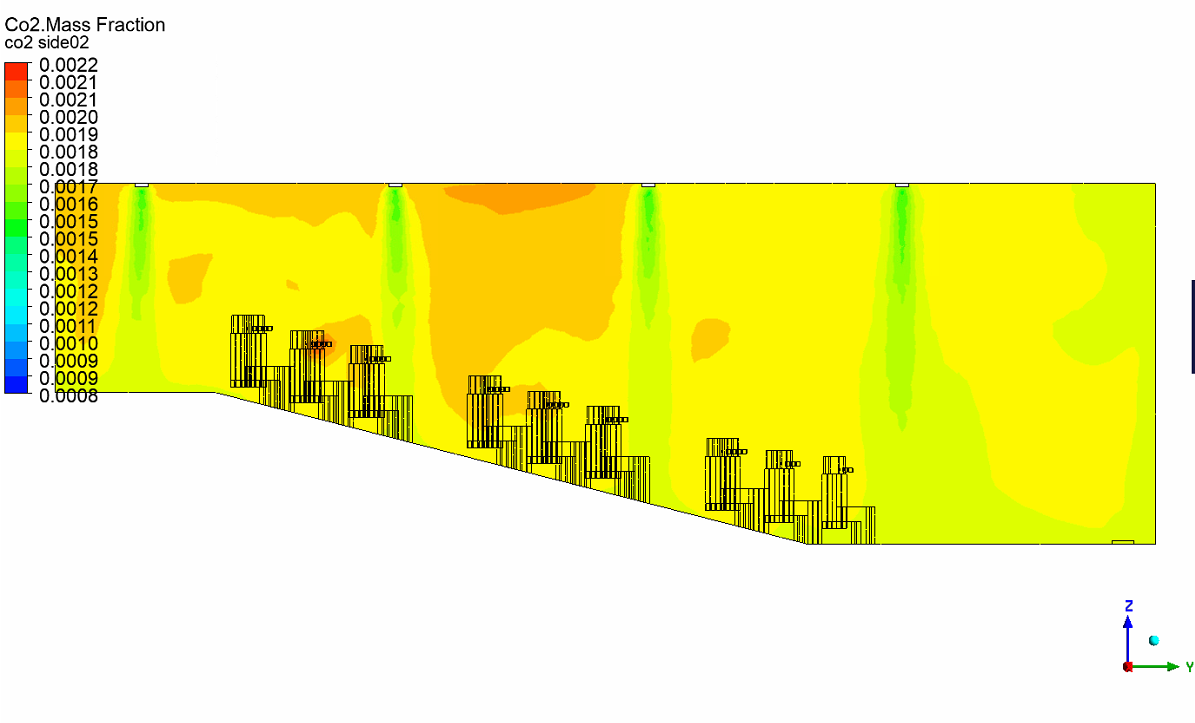
- The indoor CO₂ concentration becomes unrealistically high (around 1800–2000 ppm).
- The spatial distribution becomes overly uniform, losing expected airflow-driven gradients.
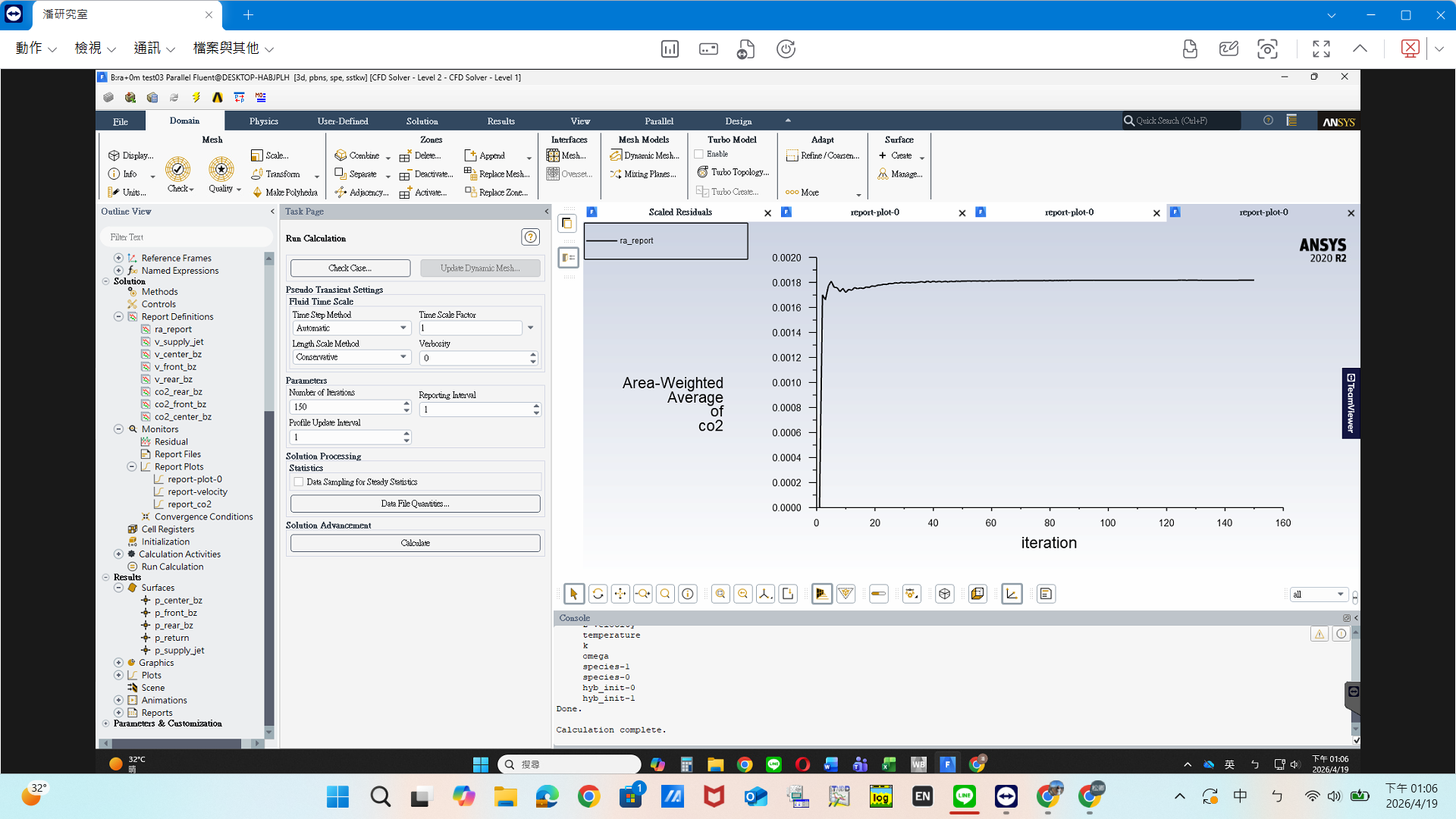
- I am not sure whether Fluent updates the "Average()" expression at every iteration, or if it remains fixed during the solution process.
- I suspect this setup creates a feedback loop where the boundary condition depends on the solution itself.
My questions are:
- Is it appropriate to directly use expressions referencing surface averages (e.g., Average(CO₂ at RA)) as boundary conditions in Fluent?
- Does Fluent update such expressions every iteration, or only at initialization?
- Would it be more correct to implement this type of recirculation using an iterative (manual) coupling approach instead?
- Are there recommended practices for modeling HVAC recirculation (mixing of return and outdoor air) in Fluent without using UDF?
Any insights or references would be greatly appreciated.
Thank you!
 `
`


















 You are navigating away from the AIS Discovery experience