

-
-
June 26, 2021 at 4:43 pm
Tiago98
SubscriberHi, I'm an engineering student and I want to do an applied static analysis on a bicycle frame. The bicycle frame is defined as a wood composite (Medium density fiberboard E= 3.59 GPa v=0.25 and tensile stress= 16 MPa),
Some aluminium components are also included in the simulation to reinforce the areas of greater efforts.
All contacts between the different components were established as bounded.
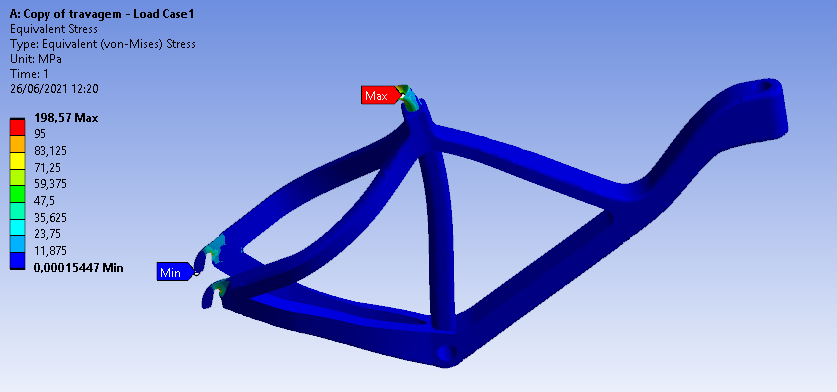
My question is related to the viability of the results, is it normal to get a reduced stress distribution across the frame?
Are the results justified due to the use of a material with a reduced modulus of elasticity?
If anyone can help me, I would appreciate it?
June 28, 2021 at 1:30 pm1shan
Ansys EmployeeIts hard to say whether the results are viable or not without any other data to compare with. But what you can do is try minimizing the errors and create a model which is as close as possible to reality. From the above picture it looks like only certain areas close to supports are experiencing very high stresses, while the mainframe is almost stress free which doesn't look very realistic. In your last post I recommended you to modify your support conditions according to https://www.youtube.com/watch?v=lWcAHI37hb8. Did you try that?
Regards Ishan.
June 29, 2021 at 9:51 amSubscriber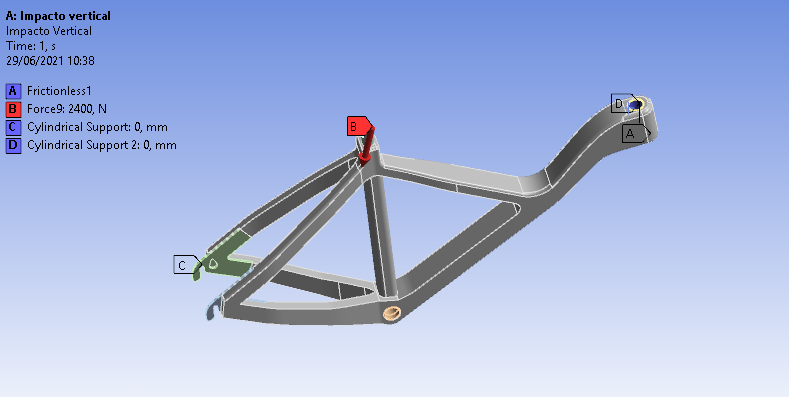 Hello, firstly thank you for your answer .
Yes, I changed the supports for this type as shown in the figure, looks the same that the youtube video that you recommended to me. The results are the same and I think is because the material I choose for the structure is the Medium density fiberboard.
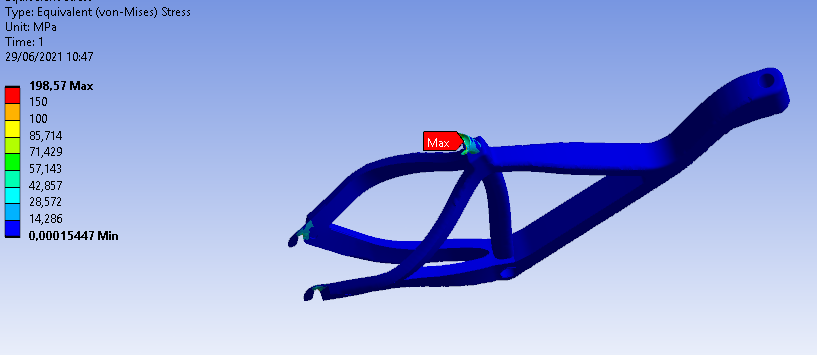
Viewing 2 reply threads- The topic ‘problem with structural analysis bicycle frame?’ is closed to new replies.
Innovation Space Trending discussions
 Top Contributors
-
peteroznewman
 6485
6485 -
scabo
 1906
1906 -
Dennis Chen
 1458
1458 -
javat33489
 1308
1308 -
Shyam Prasad V Atri
1022
Top Rated Tags
© 2026 Copyright ANSYS, Inc. All rights reserved.
Ansys does not support the usage of unauthorized Ansys software. Please visit www.ansys.com to obtain an official distribution.
-


The Ansys Learning Forum is a public forum. You are prohibited from providing (i) information that is confidential to You, your employer, or any third party, (ii) Personal Data or individually identifiable health information, (iii) any information that is U.S. Government Classified, Controlled Unclassified Information, International Traffic in Arms Regulators (ITAR) or Export Administration Regulators (EAR) controlled or otherwise have been determined by the United States Government or by a foreign government to require protection against unauthorized disclosure for reasons of national security, or (iv) topics or information restricted by the People's Republic of China data protection and privacy laws.

 You are navigating away from the AIS Discovery experience