Ansys Assistant will be unavailable on the Learning Forum starting January 30. An upgraded version is coming soon. We apologize for any inconvenience and appreciate your patience. Stay tuned for updates.
General Mechanical

General Mechanical

Topics related to Mechanical Enterprise, Motion, Additive Print and more.

Problem with a transient analysis of a telescopic boom.

    • Rok Kuhar
      Subscriber

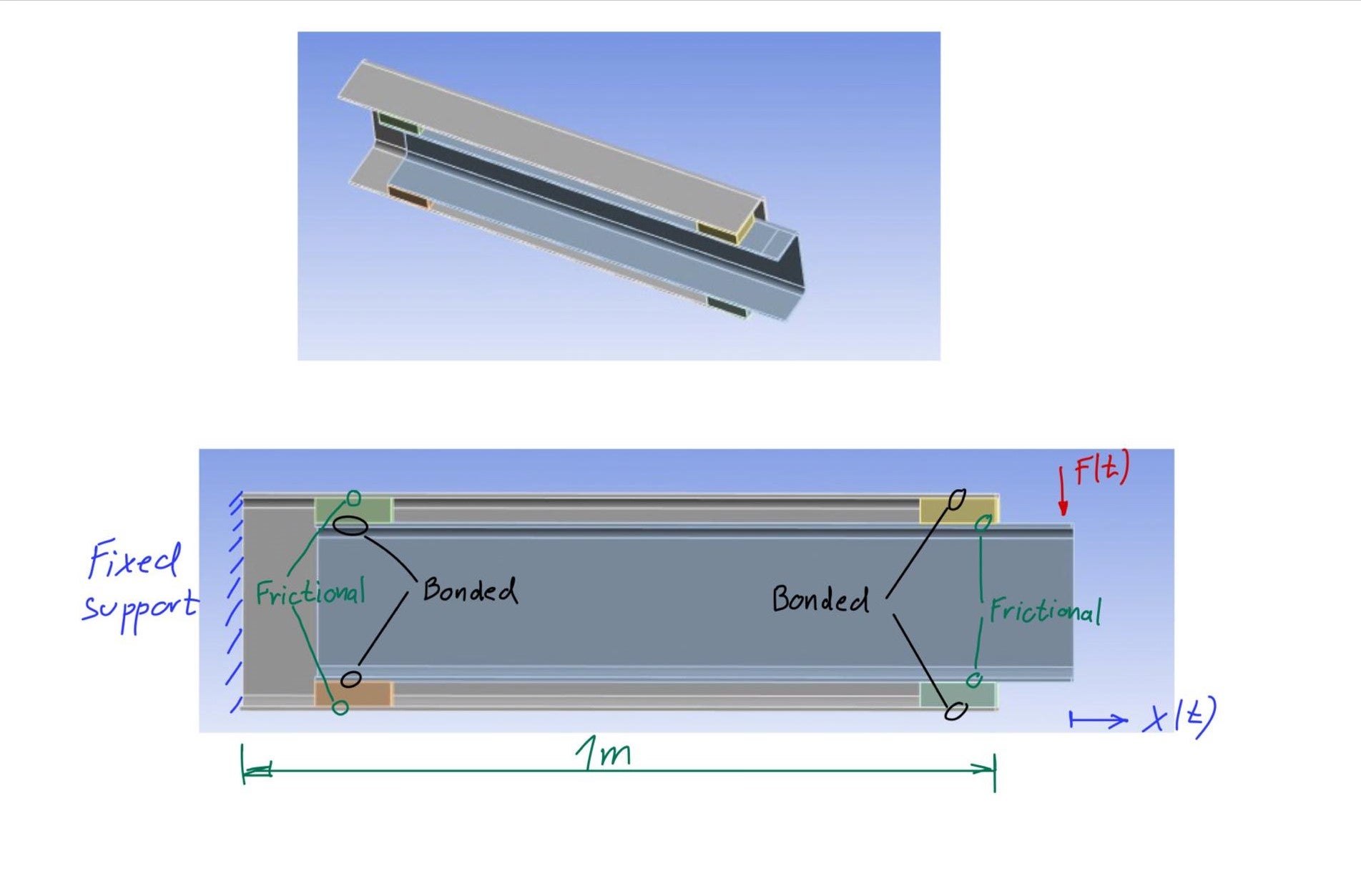
      Hello. I conducted an analysis of a telescopic boom because I wanted to analyze the local contact stresses resulting from contact loads transferred from the guides to the external boom. The system operates in such a way that the internal boom moves outward to the final position, during which the external load changes over time from maximum (max F) to minimum (min F). I tried to perform the simulation using transient analysis. I defined all the contacts shown in the image and the translational movement of the internal boom using a joint. The analysis executes the movement of the internal boom to the final position, but it does not calculate the normal stresses on the external boom, which should change over time. I would ask for help. Where could the problem be?

    • peteroznewman
      Subscriber

      Hello Rok,

      I expect the Translational Joint is causing the problem.  Delete that. Select the flat vertical end face of the inner boom and insert a Remote Displacement. In the Details panel, set the Behavior to Flexible. Enter Tabular Data for the X component to extend the inner tube over time, leaving the other five DOF set to Free.

      I recommend you change the analysis to Static Structural because the inertia forces are going to be insignificant. However, under Analysis Settings, turn on Large Deflection because that is automatically turned on in Transient Structural but is off by default in Static Structural.

      After you get this model working, you may benefit from converting the tubes to midsurface models and mesh the surfaces with shell elements.

    • Rok Kuhar
      Subscriber

      Hello Peter,

      Thank you for your response. I followed your suggestions and conducted a static analysis with 10 steps. Now, the program reports the following error: "The solver engine was unable to converge on a solution for the nonlinear problem as constrained. Please see the Troubleshooting section of the Help System for more information." Do you know where the mistake might be? I have read on other forums that the error could be in the mesh preparation or in defining the time steps?Also as you mentioned that I could convert tubes to midsurface (2D elements). Is this possible since I have a contact problem?

    • peteroznewman
      Subscriber

      Hello Rok,

      You will benefit from converting the tubes to midsurfaces, the solution will solve much faster. On the Frictional Contact definitions, turn on Shell Thickness effect, which will automatically put the contact surface at the same location is was on the solid.

      Does the solver get a few substeps converged before it fails to converge or does it fail to converge on the very first substep? This is important to know how to proceed. Please show the Newton-Raphson Convergence Plot.

    • Rok Kuhar
      Subscriber


      Hello Peter

      Yes, the program calculates a few substeps, but then fails to converge. I am attaching the model and asking if you could please take a look. 


    • ErKo
      Ansys Employee

      Hi

      Search online for convergence and help:

      Google convergence ansys

      many good videos and posts

      All the best

      Erik


    • peteroznewman
      Subscriber

      Hello Rok,

      Your solid model has only 1 element through the thickness, which is inadequate.  A minimum of 2 quadratic elements is needed. To avoid the work to get 2 elements through the thickness of the solid, please make the midsurface model and let us know if the convergence is still an issue.

    • Rok Kuhar
      Subscriber

      Hello Erik and Peter

      Thank you both very much for your help. Now, I have created a shell model of the outer and inner tubes, and the result converges (the settings I used were: displacement of 300 mm and a constant force of 5000 N). Then, I set the displacement to 700 mm and the force which varies from the initial 5000 N to 3000 N, and in this case, I encountered convergence issues. I set it up with 2 steps; initial 5 substeps, and a minimum of 5 substeps and a maximum of 10 substeps. Is it possible that because of these settings, the result does not converge? Would it be better to define the displacement of the inner tube in several steps, or can I define a displacement, for example, of 500 mm in one step? And is there any rule regarding the number of substeps needed (initial substeps, minimum and maximum substeps)?


    • peteroznewman
      Subscriber

      Increase the Initial and Minimum Substeps to 20 and make the Maximum Substeps 200.  You can do the displacement all in one step, but since your model converges with 300 mm, make that Step 1 so Step 2 can be to 500 mm.  Make sure you make these substep settings for Step 2.

    • Rok Kuhar
      Subscriber

      Hi Peter

      Now that I have increased the substeps, it works. Thank you for the help.

    • ErKo
      Ansys Employee

      Make sure the inner part that is pulled out does not slide outside the outer because then it can not converge

Viewing 10 reply threads
  • The topic ‘Problem with a transient analysis of a telescopic boom.’ is closed to new replies.

[bingo_chatbox]