-
-
May 29, 2020 at 8:36 am
agaddam
SubscriberI am simulating a pipe flow with periodic boundary conditions by giving a fixed mass flow rate in Fluent 18.2. At the end of the calculation, I don't see a value of pressure gradient (Pa/m) in the 'periodic conditions' dialogue box. I never had this issue with the previous versions. How can I see/obtain the value of the pressure gradient?
-
June 1, 2020 at 2:35 pm
Rob
Forum ModeratorWeird. Can you post a screen shot? If you plot pressure on the two periodic surfaces what do you see?
-
June 2, 2020 at 5:00 pm
agaddam
SubscriberHi,
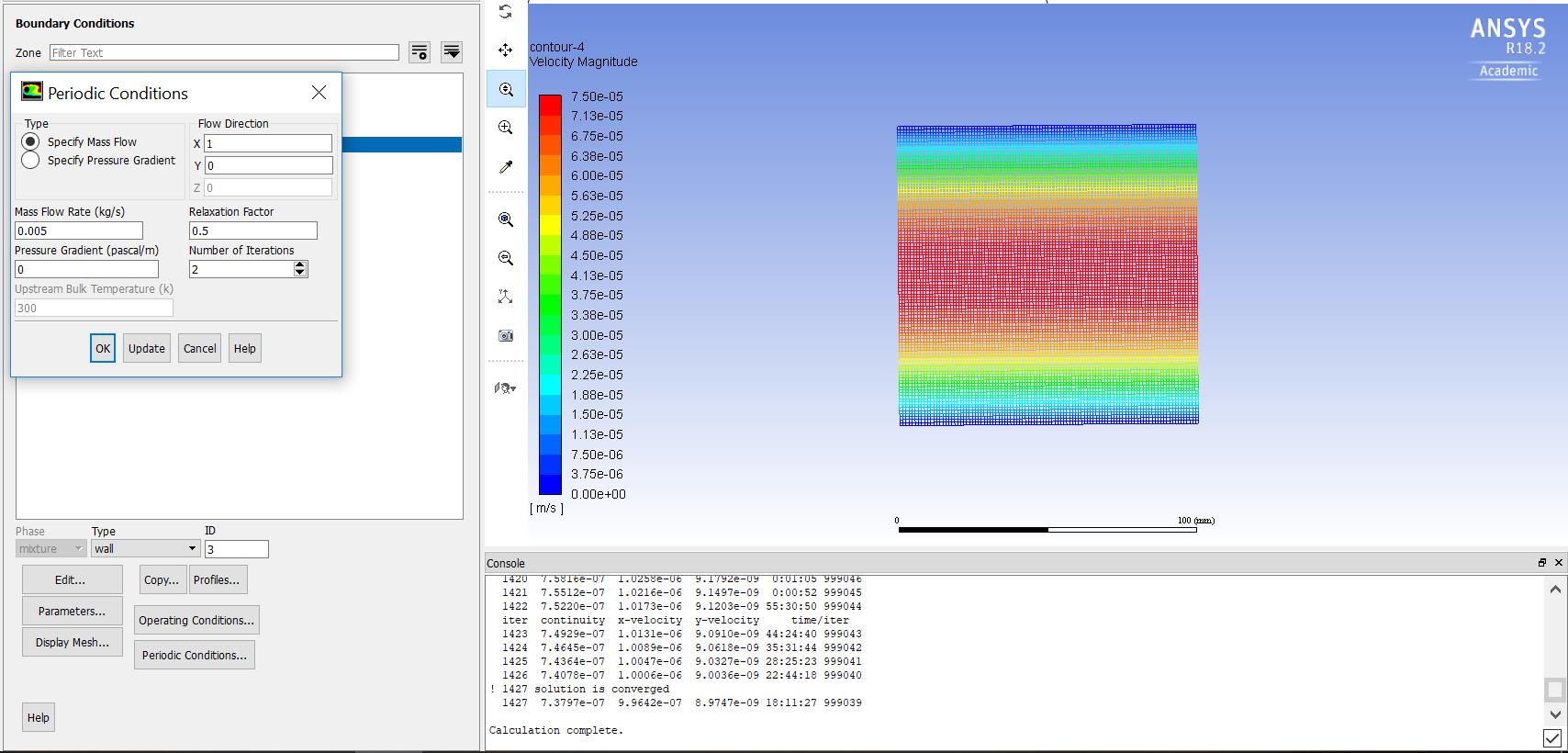
Thanks for your reply. Please see the attached screenshot. The domain is 2D with periodic inlet and outlet, while wall boundaries are defined with some shear. I generally never found a problem (the pressure gradient value) in previous versions. Apparently, after solution converged in 18.2, it shows always zero!
-
June 2, 2020 at 11:51 pm
Karthik Remella
AdministratorCould you please check if you are able to reproduce this in the latest version of the tool - 2020R1?
Thank you.
Karthik
-
June 3, 2020 at 7:40 am
agaddam
SubscriberHi Karthik,
Thanks for your reply. My university currently doesn't have a license for the new version it seems. They provided 18.2. Is there any way we can obtain a pressure gradient other than from the dialogue box in the case of periodic boundary conditions?
-
June 3, 2020 at 10:57 am
Rob
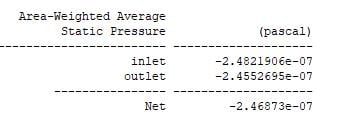
Forum ModeratorYour pressure difference is about 1e-8 Pa according to the graph so I suspect it's not so much the panel isn't working as it's not showing that many significant figures. Can you calculate the area average pressure on each periodic surface?
-
June 3, 2020 at 1:53 pm
agaddam
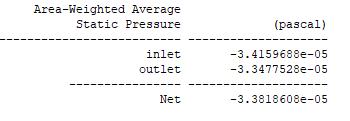
SubscriberI tried that way. And the result is below between 2 planes at the inlet and outlet (periodic boundaries).
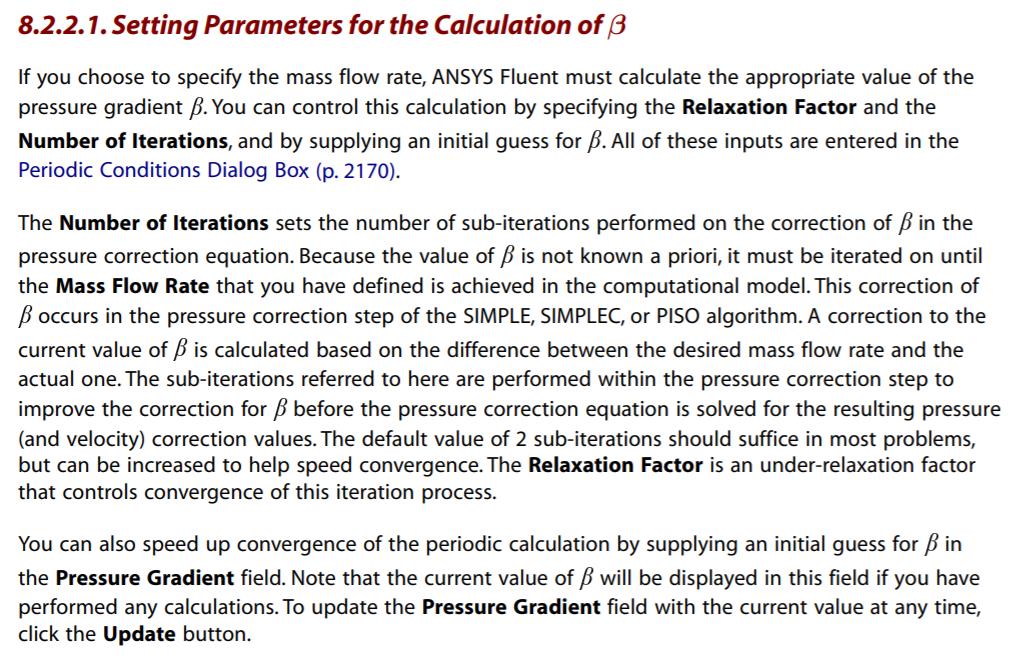
The thing is according to the theory below, the linearly varying component of pressure drop should be being updated in the dialogue box in fluent. I although provided initial guess, there is no use.
-
June 3, 2020 at 2:28 pm
Rob
Forum ModeratorIncrease the mass flow by about a factor of 10 and see if that helps. If it doesn't try another factor of 10. I want to see if the problem is the model or the fact the pressure drop is near enough zero.
-
June 3, 2020 at 3:57 pm
-
June 4, 2020 at 10:42 am
Rob
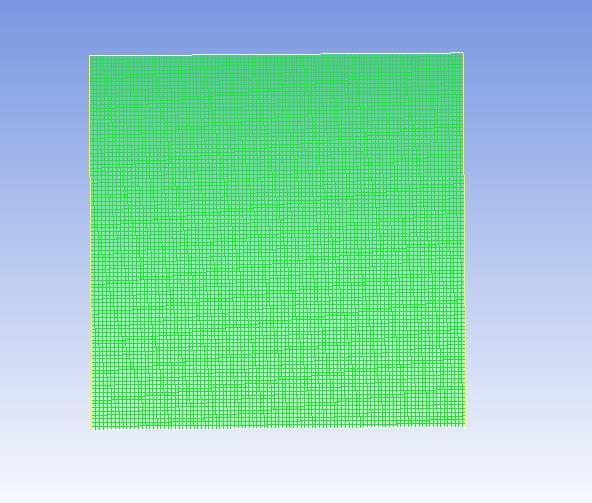
Forum ModeratorPlease can you post some images of the geometry and highlight the periodic surfaces?
-
June 5, 2020 at 9:41 am
-
June 5, 2020 at 3:53 pm
Rob
Forum ModeratorHow do the flow results look? Without knowing the scale it's hard to judge but flow through a duct at very low velocity will have a very low dP.
-
June 5, 2020 at 4:26 pm
agaddam
SubscriberIt's a simple 2D model (50 mm x 100 mm) with right and left boundaries as periodic. The top and bottom are the no-slip walls. The mass flow rate of water is 0.005 kg/s, which corresponds to a Re of about 10. I attached the screenshot of the velocity contour with the periodic boundary panel below. It shows the pressure gradient zero.
As I mentioned earlier, I never saw the value of pressure gradient zero for this simulation in previous versions of Fluent. I am not sure what is with this 18.2. If there is any way around to get the linearly varying component of the pressure gradient in periodic flows other than from this panel, it would have been helpful.
-
June 8, 2020 at 1:26 pm
Rob
Forum ModeratorIf you plug the 1e-8 Pa in what mass flow do you get?
-
June 18, 2020 at 2:34 am
newbie123
Subscriber
Not OP but I am using 2020 R1 academic version. Likewise I am using similar periodic condition for pressure between inlet and outlet and my static pressure shows e-7 almost similar to OP's case.
-
- The topic ‘Pressure gradient in Fluent 18.2’ is closed to new replies.
-
4783
-
1566
-
1386
-
1242
-
1021
© 2026 Copyright ANSYS, Inc. All rights reserved.