-
-
August 17, 2018 at 7:48 pm
krany3
SubscriberHow does a C-equation model in premixed combustion work in Fluent? How does it know when to start the reaction i.e., the generation of product species? How does it define the progress variable excluding the inlet and outlet?
-
August 20, 2018 at 5:12 am
DrAmine
Ansys EmployeeIt does need to know the region of burnt and unburnt mixture. So the progress variable is then usually either 0 (unburnt) or 1 (burnt).
-
August 20, 2018 at 8:27 am
DrAmine
Ansys EmployeeMoving to the related Fluid Dynamics thread for followup questions.
-
August 20, 2018 at 1:45 pm
krany3
SubscriberI just defined the progress variable at the inlet and the outlet. At the inlet, c=0 and at the outlet c=1. In between there is a sudden expansion, that's where the combustion takes place. It predicted the flame at the expansion. How did it solve with just the boundary conditions, especially 'c'?
-
August 20, 2018 at 7:42 pm
DrAmine
Ansys EmployeePerhaps you have had reversal flow at your outlet. Please a value of 1 at inlet as anything else does not have any sense.
-
September 3, 2018 at 4:00 pm
-
September 4, 2018 at 9:24 am
Rob
Forum ModeratorHow much swirl have you got in your system?Â
I would suggest keeping this thread for the flow field, and keep the combustion questions here  /forum/forums/topic/pre-mixed-combustion-using-finite-rate-eddy-dissipation-model/   otherwise you (or we) may miss something.Â
Â
-
September 4, 2018 at 2:14 pm
krany3
SubscriberThe swirl number was 0.4.Â
-
September 4, 2018 at 3:42 pm
Rob
Forum ModeratorAnd what happens to the flame if you increase the swirl?
-
September 4, 2018 at 3:57 pm
krany3
SubscriberI didn't try that. May be I can do that. But, this one I'm trying to match with the experimental results.
-
September 6, 2018 at 8:40 pm
Gilles Eggenspieler
Ansys Employee Quick suggestions:
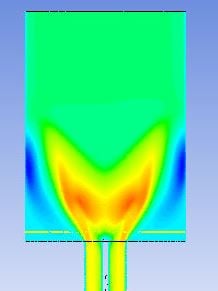
   1) On your velocity profile I see 2 lines perfectly aligned with the dump plane. What are those? some types of plates or numerical issues?
   2) Did you correctly resolve the wall area? A good wall resolution in the inlet is key to accurately predicts swirling flows
   3) Did you try different mesh resolution in general? This is key to predict circulation zones
   4) There is always some wiggle room on the swirl BC in numerical setup because translating experimental data from a swirl inlet to a simulation can be tricky. As Rob mentioned you should increase the swirl (change only the tangential velocity inlet component to nu modify the mass flow rate if you use a velocity BC). Remember that recirculation zones occur rapidly: a 5% change (+/-) in tangential BC can lead to large velocity pattern changes (full recirculation/no recirculation)
Good luck!
-
September 6, 2018 at 8:57 pm
krany3
SubscriberThe black line is the wire-frame of the model and the yellow line is the region where I'm trying to read the results.
I did tried with different resolutions. But, the results are same. I think it's with the model, C-equation. When I tried with ECFM, I could see the proper velocity profiles. The only issue with ECFM was, it predicted the flame front far downstream.Â
Rob mentioned earlier to check by increasing the swirl. This will obviously make the jet wide open with wider recirculation zone.Â
-
February 3, 2020 at 3:03 pm
mjkh
SubscriberHi
In the theory guide of ANSYS Fluent is told that: ANSYS Fluent has several models to simulate premixed turbulent combustion.
I need to know these approaches for simulating premixed combustion.
If anyone helps me, to introduce these approaches, I would be very grateful
best regards
Â
-
February 3, 2020 at 4:03 pm
DrAmine
Ansys EmployeePremixed, partially premiexed, finite rate models (LFR, EBU, EDC,..) and PDF based approaches.
-
- The topic ‘Premixed Combustion in Fluent’ is closed to new replies.
-
6379
-
1906
-
1457
-
1308
-
1022
© 2026 Copyright ANSYS, Inc. All rights reserved.