-
-
May 15, 2020 at 7:11 pm
SyedZiaUddin
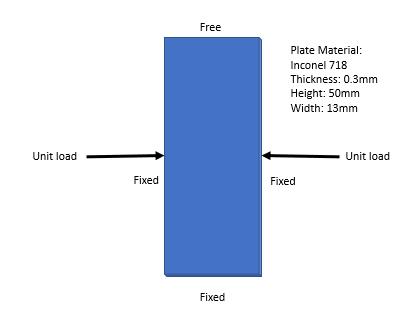
SubscriberHello everyone! I am new to Ansys and I am trying to simulate buckling of a thin plate using Static Structural module. I want to use the Eigenvalue Buckling option to find out the critical load for buckling due to transverse compression of the plate. What I have come to learn so far is that in Eigenvalue simulation I can input unit load and the critical buckling load will be given in terms of a load multiplier. However, I am having issue trying to set up the boundary conditions for this problem (indicated in the attached picture). I am attaching a schematic diagram of the load and boundary conditions. It would be great if someone could guide me about the what boundary conditions to select in the actual Ansys set up. TIA!
Â
-
May 16, 2020 at 12:21 am
peteroznewman
SubscriberYou can't have both a Fixed boundary and a Unit Load on the same edge. The Fixed support nullifies the Unit load.
-
May 16, 2020 at 6:12 am
SyedZiaUddin
SubscriberThanks very much for your reply peteroznewman! My next struggle is with setting up the boundary conditions. For example, in the attached figure, if I want to assign a load on the adef face, should I pick the adef face or apply the load to an edge such as af or de?  Also, if I wanted to restrict the translation and rotation of the  adef face, what would be options other than the fixed support.  I am thinking about using some combination of displacement criteria. I have seen some tutorials where people assigned zero displacements to some of the edges and vertices components keeping others free.  Please suggest any resources where different boundary conditions for plate buckling analysis is reviewed.Â
Your help is very much appreciated! Thanks!Â
-
May 16, 2020 at 10:06 am
peteroznewman
SubscriberJust apply the force to the face if you are using solid elements.
Since the plate thickness is thin compared with the width, replace the solid geometry with a surface body, and assign the thickness as a property in the analysis. The benefit of a a shell model over a solid element model is that it is easy to apply the load to the side, because it is now an edge, and it is also easy to set Z=0 on that edge to prevent buckling sideways while leaving rotations free to allow buckling in the center of the plate.
Â
-
May 17, 2020 at 9:40 pm
SyedZiaUddin
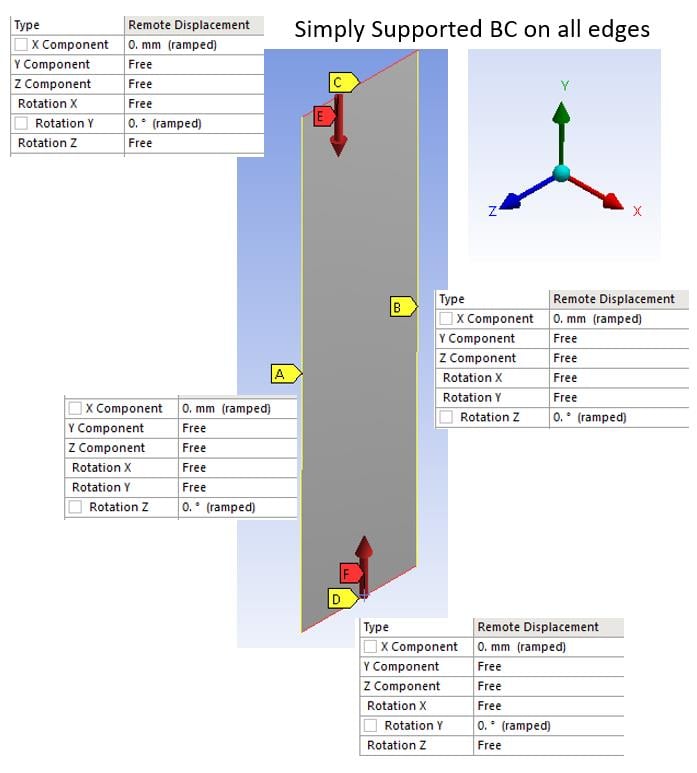
SubscriberHi peteroznewman! Now I am using a surface geometry and trying to set Simply Supported conditions on all the edges as shown in the attached figure:
Still the model doesn't solve due to lack of constraints. I am trying to figure out what I am missing here. Thanks very much for guiding me with this!
-
- The topic ‘Plate buckling simulation using workbench GUI’ is closed to new replies.

-
6465
-
1906
-
1458
-
1308
-
1022
© 2026 Copyright ANSYS, Inc. All rights reserved.