

TAGGED: 1-way-fsi, fluent, transient-structural
-
-
September 27, 2021 at 7:53 pm
tjupt8166
SubscriberHello,
I am currently using Ansys Transient and Fluent to try to simulate the fluid flow when there is structural deformation, which I think should be one-way FSI. However, I could not find the correct settings or layout to do this but only found some materials showing transfer data from Fluid to Mechanical. Could anyone help or give a hint?
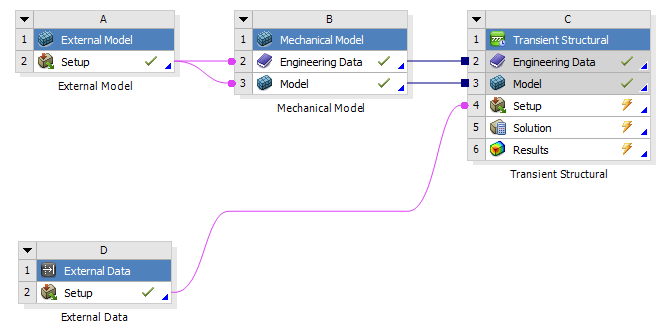
Below is the transient structural calculation I have, I need External Data as the transient load, and then calculate the transient deformation.
September 28, 2021 at 1:43 pmKarthik Remella
AdministratorHello You can use the System Coupling for this. There are several videos on YouTube that explain the model setup (hint - search "1 way FSi ansys"). Please have a look at these and you should be able to move forward with your analysis.
Karthik
September 28, 2021 at 1:54 pmSubscriberThanks, Kremella.
I did watched some videos on Youtube, and I found most are Fluid to Mechanical. What I am trying to do is transferring data from Transient Sturctural to Fluid calculation, 1-way. Could you recommend anything about this application? By using System coupling (I thought it is only for 2-way), could we just transfer data from Mechanical to Fluid?
Many thanks Yuesen
September 28, 2021 at 2:55 pmRob
Forum ModeratorIf you're wanting to transfer the deformed shape I think you can write out the mesh at the end of the Mechanical solution. You then need to remesh this for use in Fluent.
September 28, 2021 at 7:44 pmSubscriberHi Rob, exactly. I want to introduce the deformed surface (transient) onto a counterpart surface the fluid calculation. May I ask how to write the mesh out for all the timesteps?
Very much appreciated Yuesen
September 29, 2021 at 12:21 pmForum ModeratorThat'll need someone with Mechanical knowledge: ie or You then need to decide how to use that deformation in Fluent: read the moving deforming mesh sections of the manual.
September 29, 2021 at 3:12 pmSubscriberThanks, Rob. I will read the section, and probably UDF is needed?
and could you please let me know how to write the transient results out and then feed them into the Fluent part? Many thanks.
September 30, 2021 at 3:41 pmStephen Orlando
Ansys Employee
There are two options.
Using a UDF to define the deformation of the mesh in Fluent.
Run a 1-way coupled simulation using System Coupling. Displacements are sent from Transient Structural to Fluent at every timestep and there is no data transfer of surface pressure from Fluent to Transient Structural. The displacement is defined in Mechanical either with a Remote Displacement, Force, Pressure etc.. You can use the following tutorial as a reference. This is a 2-way simulation but you can remove the Fluent to Transient Structural data transfer in the System Coupling setup. In this example, a Force is applied to the plate to deform it initially. https://ansyshelp.ansys.com/account/secured?returnurl=/Views/Secured/corp/v202/en/sysc_tut/sysc_tut_oscplate_wb_fluent.html
Steve
September 30, 2021 at 3:43 pmSubscriberThank you, Steve. I am actually trying the second option now.
Many thanks to everyone, you are awesome!
Viewing 8 reply threads- The topic ‘One-way FSI: from Transient Sturcture to Fluent’ is closed to new replies.
Innovation Space Trending discussions
 Top Contributors
-
peteroznewman
 4838
4838 -
scabo
 1587
1587 -
Dennis Chen
 1386
1386 -
javat33489
 1242
1242 -
Shyam Prasad V Atri
1021
Top Rated Tags
© 2026 Copyright ANSYS, Inc. All rights reserved.
Ansys does not support the usage of unauthorized Ansys software. Please visit www.ansys.com to obtain an official distribution.
-


The Ansys Learning Forum is a public forum. You are prohibited from providing (i) information that is confidential to You, your employer, or any third party, (ii) Personal Data or individually identifiable health information, (iii) any information that is U.S. Government Classified, Controlled Unclassified Information, International Traffic in Arms Regulators (ITAR) or Export Administration Regulators (EAR) controlled or otherwise have been determined by the United States Government or by a foreign government to require protection against unauthorized disclosure for reasons of national security, or (iv) topics or information restricted by the People's Republic of China data protection and privacy laws.

 You are navigating away from the AIS Discovery experience