Fluids

Fluids

Topics related to Fluent, CFX, Turbogrid and more.

Number of Particles

    • satyam01
      Subscriber

      How to control the number of particles in the flow domain when using DPM?


    • Rob
      Forum Moderator

      In the domain or entering the domain? Please elaborate on your question. 

    • satyam01
      Subscriber

      I am talking about the particles entering.


      I have noticed that the particles enter the domain as parcels and I went to the theory guide to see that there is a formula for calculating the number of particles based on mass flow rate. But I could not calculate the same from my model.

    • Rob
      Forum Moderator

      What are you trying to model/find out? 

    • satyam01
      Subscriber

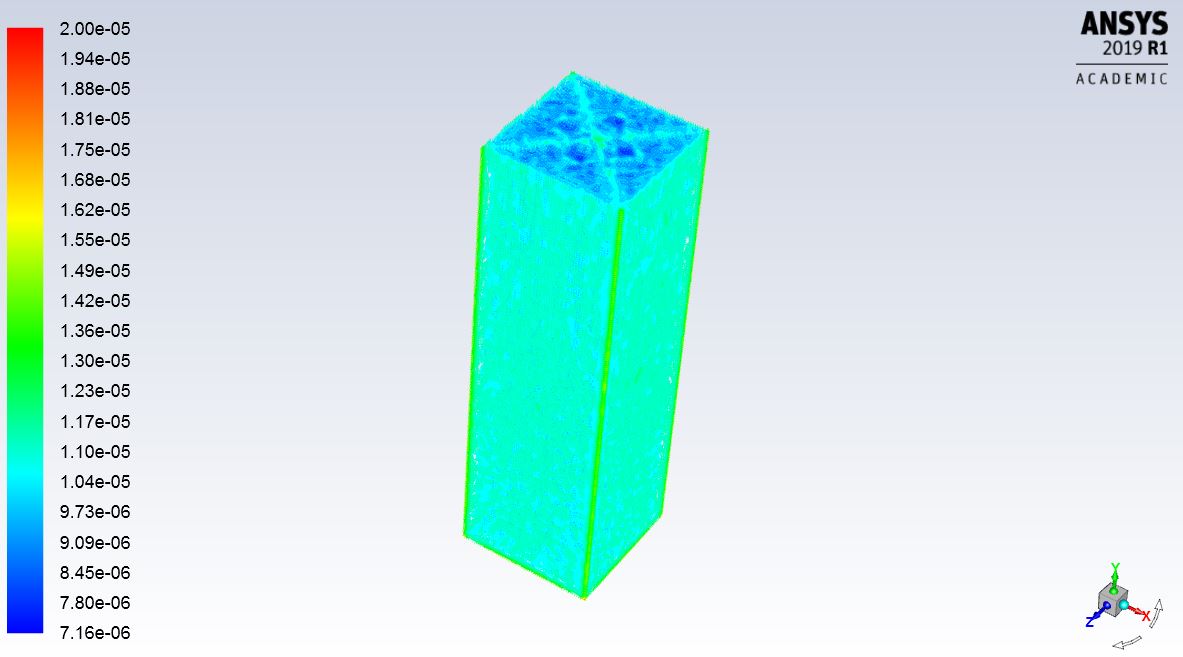
      My work deals with modeling particle flow in a clean room like a data center. I have created a simplified model of particle-laden flow through a floor tile and it looks like the attached image. One of the sides has a low-pressure boundary condition to represent intake fans of the servers and the other three have symmetry boundary conditions. My objective is to steadily create detailed models of such flow to find localized regions of particle concentration in the flow domain.


    • Rob
      Forum Moderator

      OK. If you use several injections each of a different uniform size or density you can track what enters & what leaves the domain very easily.  Don't try and fix the number of particles, work with percentages.  You may want to read up on stochastic tracking too. 

    • satyam01
      Subscriber

      I tried using line and rake to randomize the injection zones and also I could not figure out using multiple injection zones. Initially, I tried using 3-D cone by varying the angle and stagger radius but I want to achieve random injections on my inlet which I haven't been able to do so far. Thank you for your responses!

Viewing 6 reply threads
  • The topic ‘Number of Particles’ is closed to new replies.