

-
-
February 24, 2021 at 12:39 pm
Rameez_ul_Haq
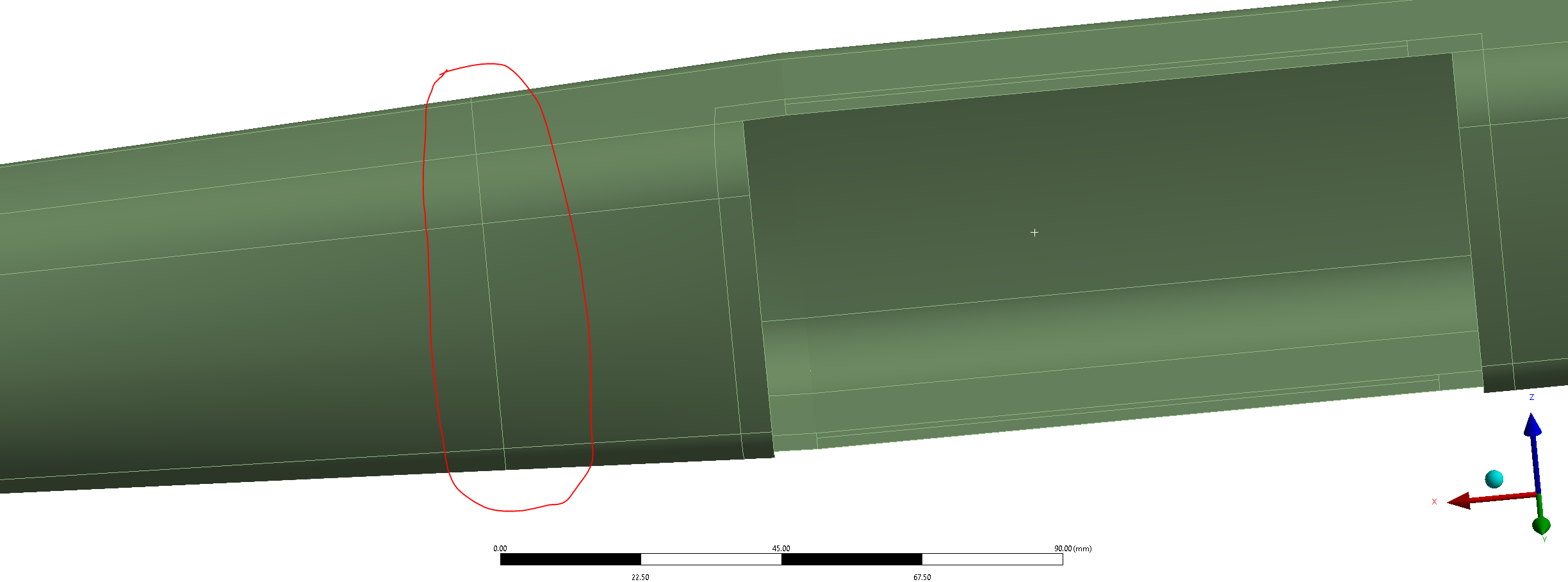
SubscriberObserve the geometry below.
February 26, 2021 at 6:24 am1shan
Ansys Employee,nChange in thickness should be the primary reason for the difference. Near the step, area suddenly reduces whereas the force remains same resulting in an abrupt stress change. Also, there might be a stress singularity at the corners, which causes this difference. Since for small deflections material properties don't affect internal forces and moments, the composition shouldn't affect stress results.nRegards,nIshan.nFebruary 26, 2021 at 12:17 pmSubscriberArray, but the corners are quite far away from the region which, as I have marked, shows a high nodal difference. Ofcourse near the corners, there might be a singularity and locally I am also seeing a region of high nodal difference there. nNear the step, area suddenly reduces whereas the force remains same resulting in an abrupt stress change., so I am guessing that this abrupt stress change will be affecting both the sides, I mean the one which has less thickness and the one which has relatively more, right? Or only one of them? Does this sudden change in the thickness correspond to a singularity? After how many elements can I then depend on these results and expect them to occur in the reality as well? nAt the region of sudden change in the material properties, I heard it results in a singularity. What would you say if I have the same thickness, but set of plies on each side is different from each other? Would you expect same high nodal difference in that region? (Assume large deflection is ON).nnFebruary 28, 2021 at 1:33 pmSubscriber,a reply from you would be appreciated so much.nMarch 1, 2021 at 3:33 amAnsys Employee,nVery sorry for the delay. Both regions should be affected in the sense that the stress should be higher in the proximity of the step where area is lower and vice versa. Also, rather than the change in thickness it is the corner that results in singularity. If you add a small fillet and mesh it with a few elements the singularity will be taken care of. Also, as I said the change in material should not cause much difference in the stress values (unless you are applying displacements as loads/or deflection is large). The reason behind this is simple. Leys say you have 2 rods of different materials but same cross section, and you apply a axial force on both rods. What would be the stress? Force/Area, which is the same for both even though the materials are different. Now, you have a soft material/geometry that results in large deflections, lets say a fishing rod. When you load a fishing rod at the tip the rod bends and there is a considerable reduction in the moment arm and therefore the bending stress, so here the change in material does cause a change in the stress but that is because the force(direction and location) itself is changing.nRegards,nIshan.nMarch 1, 2021 at 6:28 amSubscriberArray, so what you are saying is that the sudden change in the thickness of the composite plies on the two sides, that won't result in a singularity? This means I can safely depend on the results in its vicinity, since the high nodal difference is not the result of a singularity there, isn't it? What I mean to imply is that I am actually seeing an inverse reserve factor greater than my cut off value at that region where there is high nodal difference, and I want to be sure if that would be occurring in the reality or not, or that is just because of the mathematics behind the ANSYS software.nAlso, can the mathematics behind the ANSYS cause a singularity to be seen at the transition from one composite layer to another (having different plies but same thickness)? nbecause the force(direction and location) itself is changing., but as far as I know, ANSYS keeps the force direction and location constant throughout the analysis unless you apply a pressure to the surface or a follower force, isn't it?nMarch 2, 2021 at 4:50 amAnsys EmployeeHello Array,n1) the sudden change in the thickness of the composite plies on the two sides, that won't result in a singularity? - If you could avoid a corner, then the thickness change wont result in singularity. n2) This means I can safely depend on the results in its vicinity, since the high nodal difference is not the result of a singularity there, isn't it? - The best way to find a singularity is to refine the mesh and check if its converging. I may be wrong but in your case I see a corner which might result in a singularity. If your area of interest is away from the corner than you need not worry much.n3)Also, can the mathematics behind the ANSYS cause a singularity to be seen at the transition from one composite layer to another - No, I don't see any reason for this to happen. n4) but as far as I know, ANSYS keeps the force direction and location constant throughout the analysis unless you apply a pressure to the surface or a follower force, isn't it?, yes the direction of force remains the same but the point of application changes and this is significant for large deflections(again a fish rod gets bent and the moment arm decreases).nRegards,nIshan.nMarch 2, 2021 at 9:39 amSubscriber,so if I decide to use solid model in ACP Pre instead of going with shell elements, so at the transition between two different thicknesses, I can expect a singularity, right? (Because of sharp interior corner).nMarch 8, 2021 at 4:31 pmSubscriberArray, still waiting for your views on this one?nPlus, you mentioned this, 3) Also, can the mathematics behind the ANSYS cause a singularity to be seen at the transition from one composite layer to another - No, I don't see any reason for this to happen. I mean the reason can be that the single set of nodes only a line where the transitioning is happening between two layers of composite having a different ply layup, so it means that single set of nodes are a part of two different stiffnesses, one belonging to the composite layer on its left and other belonging to composite layer on its right. Now, isn't this considered as an abrupt change in the stiffness matrix at those nodes? I was thinking this will cause the singularity to be seen at the transition location because of the mathematics behind the ANSYS FEA, but you said it shouldn't. nFor the solids, the situation is going to be different unless I use shared topology between two solids of different Elastic Moduli, or a node merge between them. Isn't it?nArray, if you would like to add something here, I would be glad. Thank you.nMarch 9, 2021 at 5:10 amAnsys EmployeeHey Array,n Now, isn't this considered as an abrupt change in the stiffness matrix at those nodes? - Lets consider a single composite bar of uniform cross section with 2 different materials. So left half is lets say steel and right half is brass. You apply a uniform tensile force at the ends. What is the stress at the interface? What is the stress at the brass part and steel part? All of them are same right even though the interface is shared between 2 materials. Check out https://www.ccg.msm.cam.ac.uk/images/FEMOR_Lecture_1.pdf might give you some basic idea about how the forces and displacements are calculated in FEA nRegards,nIshan.nMarch 9, 2021 at 8:28 pmSubscriber,I mean I would expect a difference in the stresses at the interface of the two materials since the Elastic Modulii (E's) are different, meaning that the strains should be different for both of them under the same force, but since they both are bonded together therefore they must have equal deformations. Since we are going against the natural behavior of the materials coming from the Poisson's ratio, therefore additional forces will be generated at the interface which might make the overall stresses unequal (for each material at the interface). This will die out after a certain distance from the interface and the stresses within each material after that distance will then again become equal to the nominal stresses within each. Isn't it?nThank you for the lecture, let me have a look at that too.nViewing 10 reply threads- The topic ‘NODAL DIFFERENCE in the Static Structural Analysis of a Composite beam.’ is closed to new replies.
Innovation Space Trending discussions
 Top Contributors
-
peteroznewman
 6570
6570 -
scabo
 1906
1906 -
Dennis Chen
 1463
1463 -
javat33489
 1311
1311 -
Shyam Prasad V Atri
1022
Top Rated Tags
© 2026 Copyright ANSYS, Inc. All rights reserved.
Ansys does not support the usage of unauthorized Ansys software. Please visit www.ansys.com to obtain an official distribution.
-


The Ansys Learning Forum is a public forum. You are prohibited from providing (i) information that is confidential to You, your employer, or any third party, (ii) Personal Data or individually identifiable health information, (iii) any information that is U.S. Government Classified, Controlled Unclassified Information, International Traffic in Arms Regulators (ITAR) or Export Administration Regulators (EAR) controlled or otherwise have been determined by the United States Government or by a foreign government to require protection against unauthorized disclosure for reasons of national security, or (iv) topics or information restricted by the People's Republic of China data protection and privacy laws.

 You are navigating away from the AIS Discovery experience