Ansys Assistant will be unavailable on the Learning Forum starting January 30. An upgraded version is coming soon. We apologize for any inconvenience and appreciate your patience. Stay tuned for updates.
Fluids

Fluids

Topics related to Fluent, CFX, Turbogrid and more.

Need help with simulating particle deposition in porous zone

    • peter_beshay
      Subscriber

      Hi,

      I am trying to simulate the flow of air through hedges.

      Using Dense Discrete Phase Model (DDPM), injecting black carbon particles 2.5e-5 meter diameter.

      My questions is:

      1- any recommended values for viscous and inertial coefficients for hedges? I appreciate if anyone can provide a reference.

      2- i tried simulating deposition by adding a mass sink in the porous zone (-ve value for air, as i cannot add source for black carbon), however, before and after the zone, the BC concentration didnt differ, almost the same.

      Thank you

    • Rob
      Forum Moderator
      Maybe start at the beginning and explain why you're trying to fill a hedge up with carbon black and what you want to see in the results?
    • peter_beshay
      Subscriber
      Hi Mr Rob Thank you so much for your reply.
      I am simulating the pollutant-air flow through hedges as a particle-laden flow, using DDPM model. So some of the pollutants would deposit on the hedges and part will be diffused with the flow of air
      So i think i need a UDF for simulating a sink for pollutants in the dispersed flow model. Could you help me in that? i do not have any experience in UDFs.
      Thank you
    • Rob
      Forum Moderator
      OK, I'd not use DDPM for this as the particle loading isn't high enough. Use DPM. You'll need to work out the probability of a particle being caught by the hedge, and then terminate it based on said criterion. I'd also tag the cell it "died" in using UDM for post processing.
      As you may have noticed, we don't support UDFs in any depth, we're limited to pointing you at the documentation. Other contributors to the community are able to offer more advice as they're not bound by the same restrictions.
      Re the resistance coefficients, short of dragging a hedge into a wind tunnel (if you do we want pictures!) you're going to have to either estimate from the various options in the User's Guide or look in the literature. Ben Gurion University have done some work in the field so they may be a good starting point.
    • peter_beshay
      Subscriber
      Thank you Mr Rob Could you direct me on who can i contact regarding a UDF ?
    • Rob
      Forum Moderator
      Not really, the wider community participation is entirely voluntary.
    • peter_beshay
      Subscriber
      Dear Mr Rob I tried running dpm not ddpm, but i cannot monitor the concentration of the particles, also i find that some particle status is "incomplete", but if i use DDPM under Eulerian, i can monitor concentration and all particles are complete.
      How can i find the concentration if i am using only DPM?
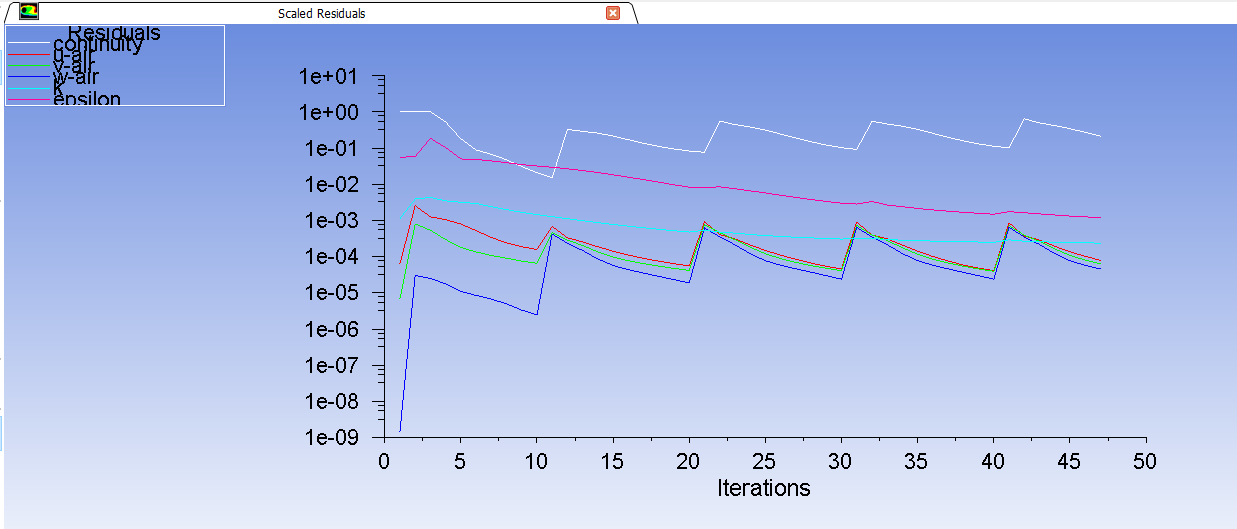
      And also, when i update the DPM sources every say 40 or 50 iterations, the solution never converges, as can seen in the screenshot below. how can i overcome this? how can i solve the flow without particles until convergence then inject particles?
      i tried turning on the DPM after convergence of the flow field, but calculation stops it says "converged solution"


    • peter_beshay
      Subscriber
      Hi Just an update for the above post, i could get concentration with only DPM, but i wonder how to run the flow field until convergence then start injecting particles and how to solve the issue of "incomplete particles"
    • Rob
      Forum Moderator
      Concentration requires a coupled (interaction with continuous phase) to be available. You can run the flow to completion and then track particles: that's done fairly often when the particle loading is low. As you want to look at deposition blocking the filter that may not be appropriate.
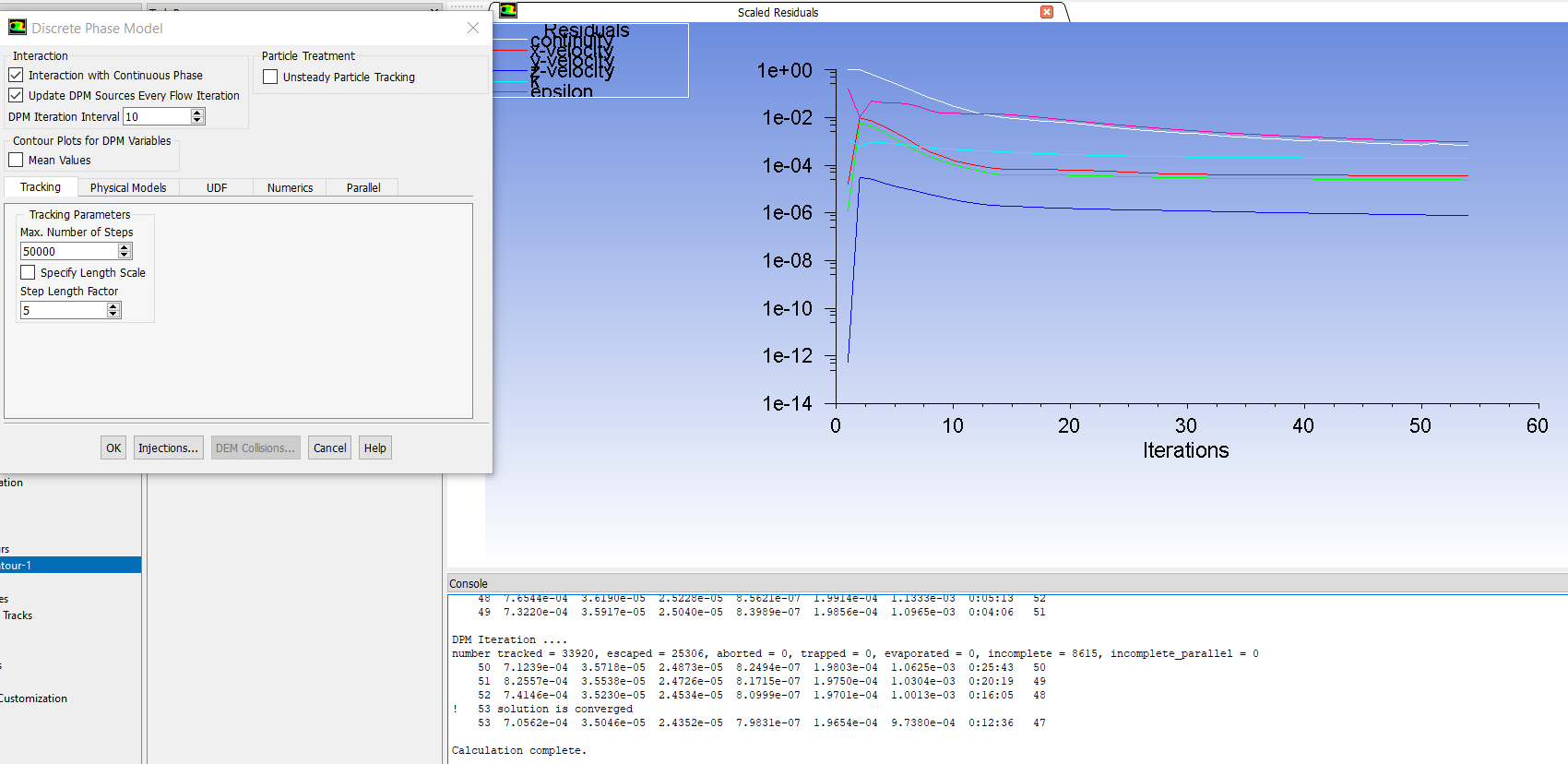
      Incomplete means the particle ran out of integration steps before leaving the domain. This can mean they're stuck in a recirculation zone and will never leave or that you've not set enough steps. Default is about 5,000 (from memory), try 10,000 and see if that helps. Don't blindly increase that value too far as the solver must do those integration steps if they're needed so you could be waiting a long time for a result.
    • peter_beshay
      Subscriber
      Thank you so much Mr Rob
      Could you just please clarify how to run the flow to completion then start tracking particles? i cannot turn off dpm model unless i delete the created injections
    • Rob
      Forum Moderator
      Just turn off DPM interacting and you're fine. Or are you using transient injections?
    • peter_beshay
      Subscriber
      it is a steady case and steady particle tracking too.
      Thank you so much Mr Rob, i will try that
    • peter_beshay
      Subscriber
      Mr Rob, the solution converged, but still incomplete particles, although i increased the max number of steps to 50,000.
      Any suggestions how can i solve this issue?
    • Rob
      Forum Moderator
      Have a look in post processing to see where they've gone.
    • peter_beshay
      Subscriber
      Ok, thank you so much
Viewing 14 reply threads
  • The topic ‘Need help with simulating particle deposition in porous zone’ is closed to new replies.
[bingo_chatbox]