Fluids

Fluids

Topics related to Fluent, CFX, Turbogrid and more.

Natural circulation loop

    • Tejosatya
      Subscriber

      Hi,


      I'm completely new to ansys. Could someone help with the simulation of natural circulation loop

    • peteroznewman
      Subscriber

      Please provide a sketch of the space the fluid is contained within, what the fluid is, what you want to get out of the simulation.

    • Tejosatya
      Subscriber

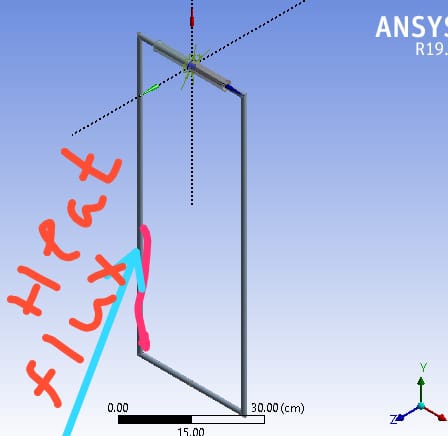
      the fluid is initially at rest and as the heat flux is given it rises up. Then there is a heat exchanger in which fluid at atmospheric temperature and flow rate of 0.3lps flows. The fluid contained is water in both the loop and the heat exchanger. The main aim is to find the flow rate of fluid in the loop.

    • Tejosatya
      Subscriber

      The fluid is water. As the heat flux is given to the fluid in the rest, it starts rising up. Heat flux of 50W at a temperature maintained at 90 degree centigrade is given. A heat exchanger is provided at the top where the water at a temperature of 25 degree centigrade flows. The main aim is to find the flow rate of fluid in the loop.


      The rectangular loop dimensions are 30*80 cm and the dia is 1.2cm.


      Could you help me with the simulation?


    • peteroznewman
      Subscriber

      Why did you check the Is Solution link to your last post?  Do you no longer need help with this?  That is what the check mark indicates.  If you still need help, delete your last post.

    • peteroznewman
      Subscriber

      I recommend you start with a 2D model of the loop because that will solve much faster than a 3D model, and everything you learn for the 2D model will apply to a 3D model.


      Watch this video to learn about how to model Natural Convection.


      https://www.youtube.com/watch?v=UlDUDspxn6g

    • Tejosatya
      Subscriber

      Thank you.

    • peteroznewman
      Subscriber

      That video is for air.  I couldn't find one for water.  Natural convection requires temperature dependent density for the fluid to create buoyancy for the lighter water after its temperature increases, and a gravity field to pull down the colder, denser fluid that pushes up the warmer less dense fluid.

    • Rob
      Forum Moderator

      For water you may need to use the Bousinesq approach for density as the density needs to change but there's nowhere for the volume to go. You will also need to be careful how you initialise the model to make sure the warm water doesn't just try and recirculate in one side of the loop. 

Viewing 8 reply threads
  • The topic ‘Natural circulation loop’ is closed to new replies.